
Your needs, this model
Does it fit your priorities?
Does your AC plan stay at or below 500 W on 110 V, with at least 508 Wh nameplate capacity?
The A1756 manual lists 110 V AC, 500 W maximum and 508 Wh. Four sockets share the 500 W ceiling; a 501 W continuous load is outside the stated limit. A hard 120 V or 240 V need is not satisfied by this reviewed plan.
Explore this need in the finder →Would 120 W solar input or the included 120 W vehicle-charge path suit your recharge plan?
The station supports a compatible 11–28 V, 10 A, 120 W DC7909 solar source and a separate vehicle-charge route using the included cable. The standalone package list does not include a panel or solar lead; the two input routes are not assumed simultaneous.
Explore this need in the finder →Is 60 W USB-C, a 120 W 12 V socket and a 17 lb station-body limit enough?
The A1756 has one USB-C port rated up to 60 W and a 12 V/10 A car-style output rated 120 W. Its station-body weight is 16.75 lb, so it fits a 17 lb maximum but not a 16 lb maximum. No 100 W USB-C output is documented.
Explore this need in the finder →The Anker 536 PowerHouse (product number A1756, U.S. SKU A1756111) is a 508 Wh portable station with four AC receptacles sharing a 500 W limit, one 60 W USB-C port, three USB-A ports and a 12 V car socket. Its exact manual specifies 110 V AC, so it should not be treated as a confirmed 120 V or 240 V source. Check the voltage range on the device you intend to power before making it an essential part of a plan.
Four outlets still share one modest AC ceiling
The four receptacles are convenient for small loads, but they do not provide four independent 500 W outputs. The station has 500 W total rated AC output; the manual says a device drawing more than 500 W will make it turn off. A pair of 300 W loads already exceeds the shared limit. No dependable surge allowance is established, so check startup demand separately.
The voltage detail matters. The A1756 manual lists 110 V AC at 4.54 A and 60 Hz. The current U.S. product page identifies the model as 500 W but does not document a separate 120 V or 240 V output plan. If a device label requires a particular voltage, compare the two directly; the matching profile only treats 110 V as confirmed. The 500 W rating is the limiting figure for an otherwise suitable load.
508 Wh for a short list of essentials, not a runtime promise
The advertised 508 Wh is nameplate capacity, not a promise that an AC appliance receives all 508 Wh. Conversion losses, reserve settings, temperature and load affect delivered energy; no load-specific AC-energy figure is published. It is better suited to modest, intermittent loads—phones, lights or a compatible laptop—than to long heating or cooking sessions.
At 16.75 lb and 11.48 × 9.88 × 7.4 inches, it is a handle-carry station for a car, campsite or room-to-room kit, not a pocket battery or a comfortable long-distance hiking load. The listed 508 Wh is slightly less than the 512 Wh Anker assigns to the 535 PowerHouse; both are listed at 500 W AC and similar weight. The larger model number does not mean more capacity.
The U.S. page identifies LiFePO4 cells and advertises a five-year full-device warranty. It also makes a long-life claim, but no independent cycle or aging test was performed here. The manual's temperature and storage guidance still matters more to day-to-day ownership than the headline lifespan: keep the station dry, avoid direct sun and hot vehicle storage, and follow the manual's maintenance schedule.
USB-C and car power are useful, but not high-power substitutes
Alongside AC, the 536 has one bidirectional USB-C port rated up to 60 W, three USB-A ports rated up to 12 W each and a 12 V/10 A car-style output rated at 120 W. That mix can cover phones, cameras, compatible laptops and 12 V accessories without using the inverter. A laptop that needs 100 W USB-C will not get its full input rating from this port. The manual gives a per-port USB-A maximum; it does not establish that every output can deliver its individual maximum at the same time.
The front light offers ordinary illumination and an SOS mode, while the display shows remaining charge and input/output information. AC and car outputs must be switched on, and the manual warns that leaving those outputs enabled consumes power even with nothing plugged in. Power Saving Mode can stop low-draw devices when their charging ends; disable it for the steady low draw of a camera or CPAP, as the manual instructs. That does not make this a safe sole source for life-critical medical equipment: Anker's manual warns against relying on it where a failure could endanger life or property.
Two recharge paths; no solar kit in the standalone box
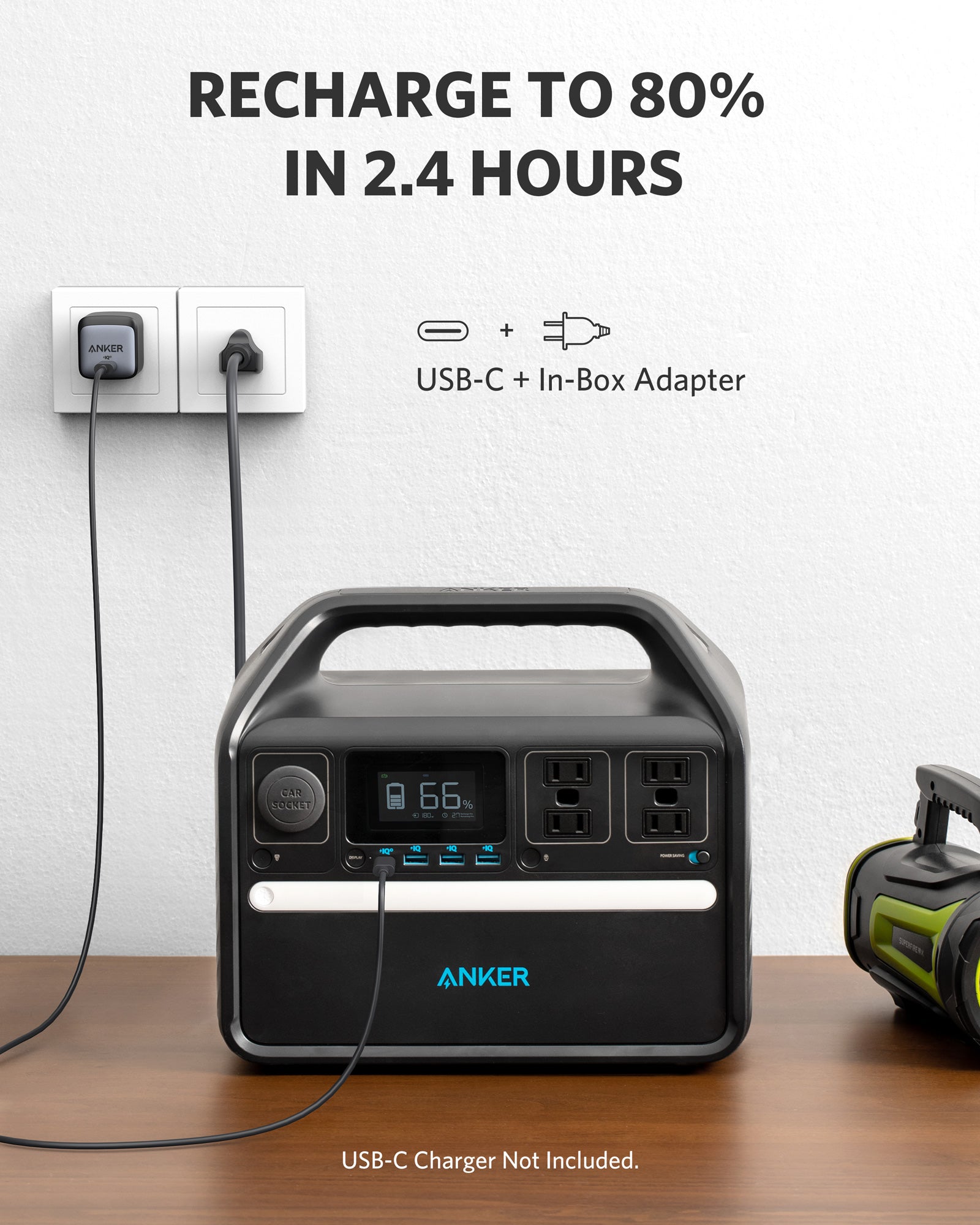
The listed package includes a 120 W AC adapter and a car-charging cable. The manual shows up to 120 W through the DC input from the adapter and up to 60 W through USB-C, with a combined 180 W charging diagram. Anker advertises an under-2.5-hour recharge to 80% using the adapter and USB-C together; that is a manufacturer claim, not a timed test.
Solar is limited to a compatible 11–28 V DC source at up to 10 A/120 W through the DC 7909-style input. The standalone box list does not include a solar panel or a solar lead, so add those only after checking the connector and electrical range. The included vehicle cable is another 120 W recharge option. Solar and vehicle charging are alternatives here; do not assume the two inputs can be used simultaneously.
Choose it only when the exact limits suit your gear
The 536 makes sense when your plan needs about half a kilowatt-hour of nameplate storage, 110 V AC at or below 500 W, a 60 W USB-C output, a 12 V socket or modest solar input, and a station body under 17 lb. It is the wrong match if 120 V is essential, an appliance needs over 500 W continuous, a 100 W USB-C port is necessary, or a solar panel or battery expansion must be included. Neither expansion support nor a waterproof rating is established.
Compare the nearby Anker 535 carefully: the published difference here is 508 versus 512 Wh, not a jump in AC output. The smaller Anker 521 gives up capacity and AC wattage for a lighter body; the C300 DC removes the AC inverter and is relevant only when your devices can use its DC outputs. If your load exceeds the 536's 500 W ceiling or needs a confirmed 120 V plan, compare a larger station whose manual explicitly supports that requirement. The manufacturer's listing showed the 536 as sold out when checked; availability can change, so verify the exact A1756 model and package before purchase.
Key details at a glance
| Nameplate battery capacity | 508 Wh |
|---|---|
| Rated AC output | 500 W |
| Maximum solar input | 120 W |
| Maximum USB-C output per port | 60 W |
| Listed weight | 16.75 lb |
| 12 V DC output | 120 W |
| Base warranty term | 5 years |
| AC outlet output | Yes |
| USB-C ports | 1 |
| USB-A ports | 3 |
| Solar input ports | 1 |
| 12 V car-style output | 120 W |
| Battery chemistry | LiFePO4 |
Use the exact model’s instructions for operating limits, supplied equipment and version differences.
Sources for this assessment
- Anker 536 PowerHouse - 508Wh | 500W (Anker SOLIX U.S. product page)
- Anker 536 Portable Power Station (PowerHouse 508Wh), Product Number A1756, User Manual V01, document 51005004422
- Anker Support manual route for Anker 536 PowerHouse 508Wh
- A1756111_TD06_V1.jpg, Anker 536 product-page marketing composite

A useful match starts with the loads that matter.
Use the finder for hard electrical requirements, then check appliance starting behavior, actual run time and the exact package in the full assessment.