
Your needs, this model
Does it fit your priorities?
Does your AC plan need at least 1,024 Wh of nameplate capacity and 1,000 W continuous output?
The A1760 standalone is listed at 1,024 Wh and 1,000 W continuous AC. The six sockets share that ceiling; the U.S. page and manual state 110 V, not a confirmed 120 V output. Capacity is not an AC runtime guarantee.
Explore this need in the finder →Can your plan include a 28.9 lb station for a car-to-site or short carry?
Anker lists the 555 at 28.9 lb. It is not a pocket-size station; a 29 lb limit fits the listed weight, while a lower lifting ceiling does not.
Explore this need in the finder →Do you need a panel in the box, or just a supported solar input?
The manual supports up to 200 W of solar input and lists the charging cable/connector in the box. The reviewed U.S. standalone offer does not list a panel, so an included-panel requirement is not met.
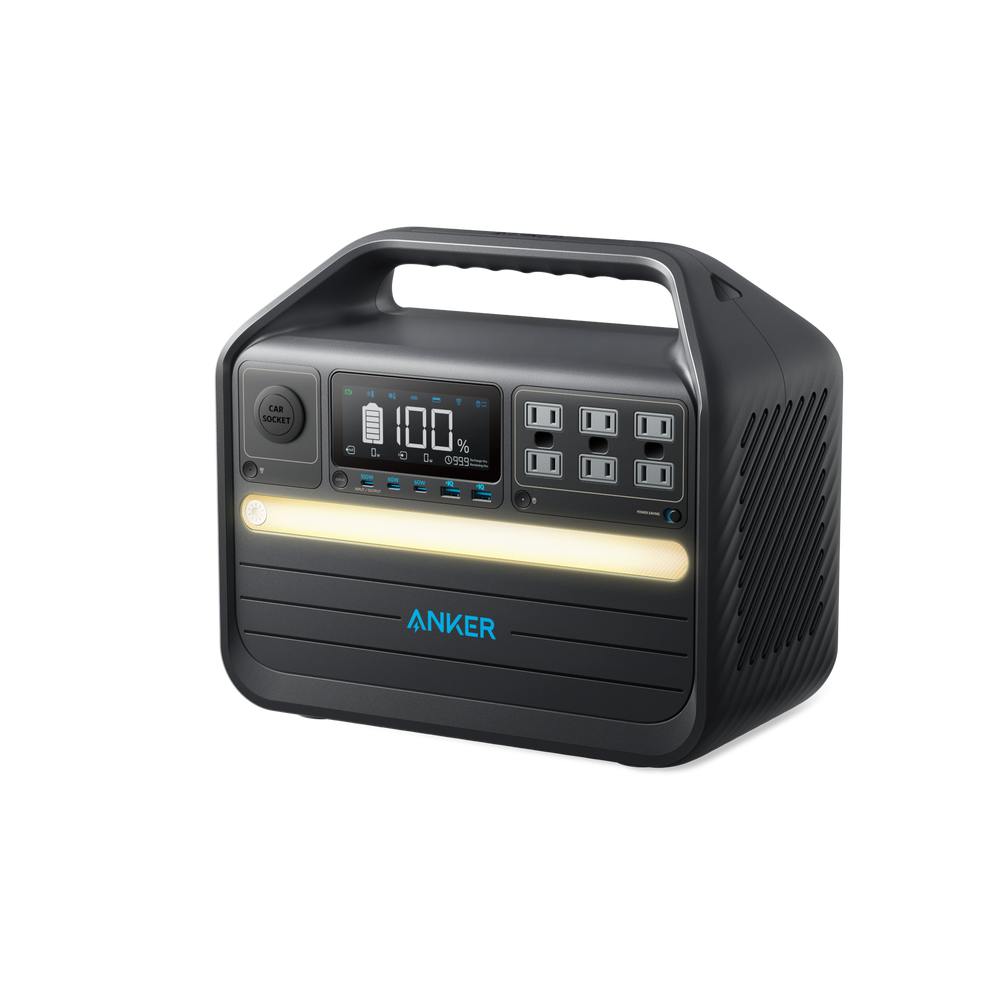
Explore this need in the finder →The Anker 555 PowerHouse (A1760, U.S. SKU A1760111) is a 1,024 Wh LiFePO4 station rated for 1,000 W of AC output. At 28.9 lb it is a car-camping or short-carry unit, not a pocket backup. Its U.S. page and manual describe 110 V AC, so I would not treat it as an exact 120 V match for a load whose voltage is essential. The listed AC receptacles share one 1,000 W ceiling; six sockets do not create six separate inverters.
Useful stored energy, but a firm output ceiling
One kilowatt-hour of nameplate capacity gives you more planning room than the 535 PowerHouse's 512 Wh, but it is still not a promise of 1,024 Wh delivered to an AC appliance. Inverter losses, reserve capacity, temperature, and the load itself reduce what reaches a device; Anker does not publish a load-specific AC-delivered-energy figure for this plan. Build your own watt-hour budget and leave a margin rather than converting the nameplate number directly into runtime.
The 1,000 W continuous rating is the number to compare with an appliance's operating draw. A kettle, heater, or other resistive load near that level can use a large share of the inverter allowance by itself. The page lists six AC receptacles, but their power is shared; adding a second appliance does not give you another 1,000 W. Check start-up demand separately for a compressor or motor, because a larger surge figure should not be treated as continuous power. The U.S. page does not publish a clear surge allowance in the specifications I reviewed, so I have not used one to qualify a load.
Several direct-charging ports, with a 28.9 lb carry
The U.S. page lists three USB-C ports—one up to 100 W and two up to 60 W—plus two USB-A ports and a 12 V car-style socket. The manual identifies USB-C input/output up to 100 W and a separate 60 W USB-C output rating. That mix suits a group charging laptops and smaller electronics without occupying AC outlets, though individual port maxima do not establish that every outlet can deliver its maximum at once. The car socket is rated at 12 V and 10 A, or 120 W. The manufacturer also lists a built-in light and an SOS mode.
At 28.9 lb, the 555 is manageable from a car to a picnic table or a nearby work area, but carrying it repeatedly across a large site is a different proposition. There are no wheels in the reviewed U.S. configuration. If one person must lift it regularly, compare the weight against your real route and grip rather than relying on the “portable” label.
Solar is an input path, not a panel in the box
The A1760 manual sets solar input at up to 200 W across 11–28 V and 10 A, and describes connecting up to two 100 W panels in parallel with the supplied solar charging cable and XT60-to-DC7909 connector. That is a narrow charging ceiling: panels with a higher combined label do not make the station accept more than its published input limit. Actual harvest also varies with sun, shade, orientation, temperature, and conversion losses.
The manual's box list includes a 200 W AC adapter, a solar charging cable, a car charging cable, and the XT60-to-DC7909 connector; it does not list a solar panel. The U.S. product page likewise describes charging cables rather than an included panel. Treat the panel as a separate purchase. Vehicle charging is another route, rated at up to 120 W; the USB-C port accepts up to 100 W. None of these maxima is a promise of a particular recharge time under real conditions.
Controls, storage, and safety boundaries
Power-saving mode can turn outputs off when connected devices stop drawing power. That is helpful for reducing idle drain, but may interrupt a low-draw device; the manual says to disable the mode for continuous low-power uses such as time-lapse photography. It also describes a light and SOS mode. For storage, Anker advises keeping the unit within its specified temperature range and cycling it from about 30% to 60% every three months. Follow the current manual rather than leaving the station in a hot vehicle or storing it nearly empty.
This is not an outdoor-weatherproof box: the manual says not to expose it to rain or snow and not to use it on aircraft. It also warns against use for medical equipment or data servers where a failure could seriously endanger life or property. A consumer power station is not a substitute for a protected, tested backup system for critical equipment.
Who should consider the 555?
It makes sense when your documented plan fits 1,000 W continuous AC, roughly 1,024 Wh of nameplate storage, the 200 W solar ceiling, and a 29 lb lifting limit. Its 110 V specification needs attention: if your essential appliance requires a confirmed 120 V supply, the evidence reviewed here does not establish that fit. For a higher AC ceiling and more stored energy, the Anker SOLIX F1500 A1772 is rated at 1,800 W and 1,536 Wh, but weighs 43.7 lb. The lighter 535 PowerHouse A1751 weighs 16.75 lb, but halves the 555's nameplate capacity and is rated at 500 W continuous. These are different compromises, not simple upgrades by one number.
The Anker U.S. product page showed “Sold Out” when checked on October 24, 2026. That is a snapshot, not a claim that every retailer is out of stock; compare the exact A1760/SKU A1760111 wording when shopping. No physical sample was measured for this assessment. The 3,000-cycle-to-80% statement and five-year warranty are manufacturer claims and terms, not independent durability results.
Key details at a glance
| Nameplate battery capacity | 1024 Wh |
|---|---|
| Rated AC output | 1000 W |
| Maximum solar input | 200 W |
| Maximum USB-C output per port | 100 W |
| Listed weight | 28.9 lb |
| 12 V DC output | 120 W |
| Maximum AC recharge input | 200 W |
| Base warranty term | 5 years |
| AC outlet output | Yes |
| USB-C ports | 3 |
| USB-A ports | 2 |
| Solar input ports | 1 |
| 12 V car-style output | 120 W |
| Vehicle charge input | 120 W |
| Battery chemistry | LiFePO4 |
| TT-30 RV outlet | No |
Use the exact model’s instructions for operating limits, supplied equipment and version differences.
Sources for this assessment
- Anker 555 PowerHouse - 1024Wh | 1000W (Anker SOLIX U.S.)
- Anker 555 Portable Power Station (PowerHouse 1024Wh), Product Number A1760, manual 51005003353 V03
- First image on the exact Anker 555 U.S. product page
- Anker Japan official A1760 product/support page (manual link provenance; Japan-market configuration only)

A useful match starts with the loads that matter.
Use the finder for hard electrical requirements, then check appliance starting behavior, actual run time and the exact package in the full assessment.