
Your needs, this model
Does it fit your priorities?
Is 2,000 W of rated continuous 120 V AC output essential?
The C1000 Gen 2 is rated at 2,000 W continuous; the original C1000 is rated at 1,800 W. Peak and SurgePad figures are not substitutes for the rated continuous requirement.
Explore this need in the finder →Does one USB-C port need to reach 140 W, with solar input also essential?
The A1763 has two USB-C ports rated at up to 140 W and one 15 W USB-C port, plus up to 600 W solar input. The 15 W port shares a 20 W ceiling with USB-A.
Explore this need in the finder →Would a listed station weight of 25 lb or less and no future expansion suit your plan?
The C1000 Gen 2 is 24.9 lb and has no compatible expansion battery; a 2,112 Wh minimum with expansion required rules it out.
Explore this need in the finder →The Anker SOLIX C1000 Gen 2 is the lighter sibling in this family: a 1,024 Wh LFP station rated for 2,000 W of continuous 120 V AC output and 600 W maximum solar input. The exact US product record identifies model A1763 and standalone SKU A17631A1. Unlike original C1000 A1761, the Gen 2 gives up battery expansion for a lighter body and higher continuous rating; that is a real choice, not a simple version bump.
Read the continuous limit first
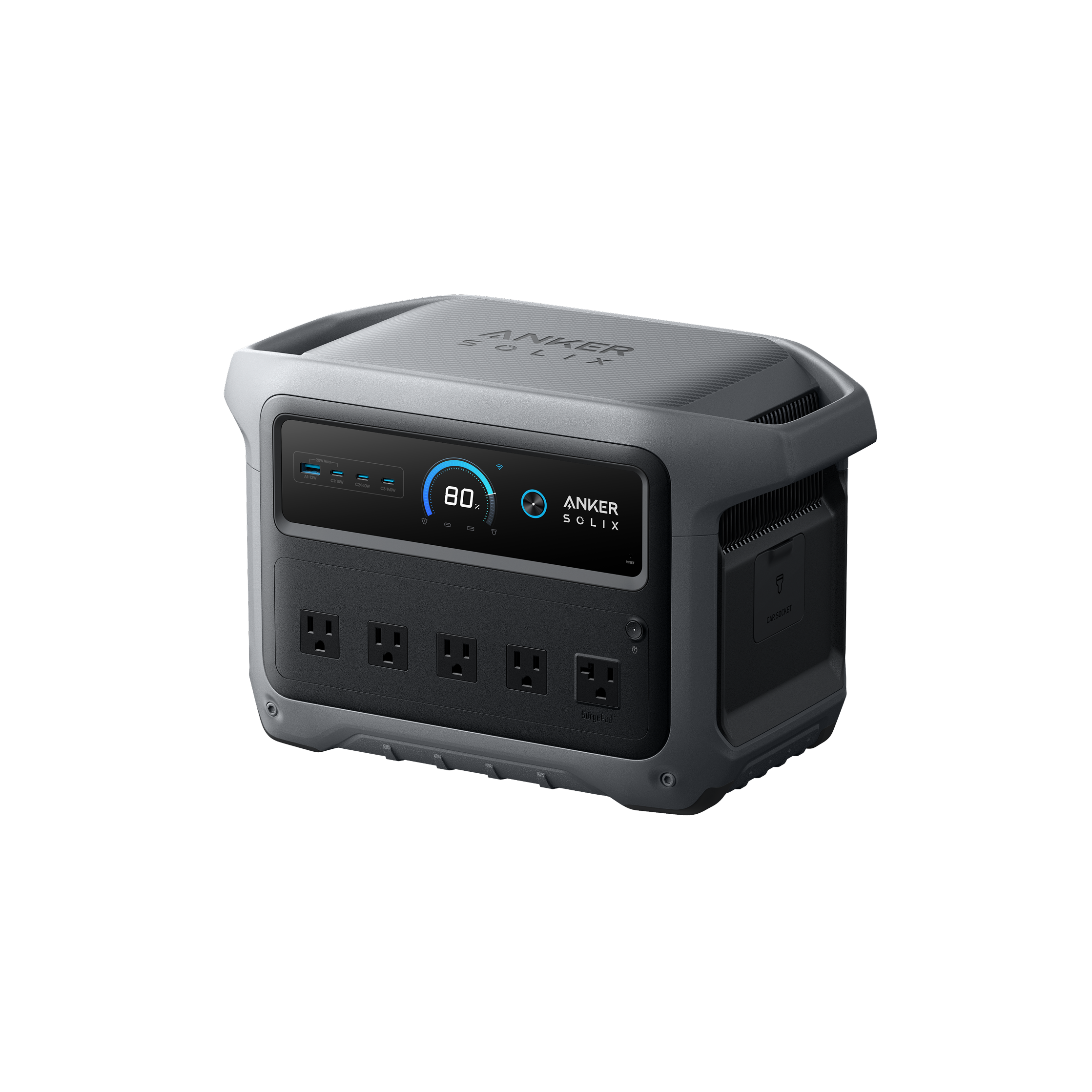
Five AC receptacles share the same 2,000 W continuous inverter ceiling. The product page also advertises a 3,000 W peak figure, while the A1763 manual describes SurgePad support up to 2,400 W and says it does not operate in bypass mode or suit precision equipment with strict voltage requirements. These are separate claims; neither replaces the 2,000 W rated limit. Size an essential appliance from its nameplate and startup requirements. It is a 120 V unit, not a 240 V or split-phase source.
On the front panel, Anker lists three USB-C outputs: two rated up to 140 W apiece and a smaller 15 W port. One USB-A port is rated at 12 W; the manual sets a 20 W combined ceiling for USB-A and the 15 W USB-C. The 12 V car-style socket is rated at 10 A / 120 W. Three ports help connect a laptop, tablet and smaller device, but only two are 140 W; ratings are not guaranteed simultaneously.
Energy and portability trade places with expansion
The 1,024 Wh figure is stored energy, not a promise of AC-delivered energy: inverter loss, idle draw, temperature and load cycling change runtime. Anker states up to 4,000 cycles to at least 80% capacity and a decade-long design claim; its US warranty policy lists model A1763 in the 60-month group. These are manufacturer terms, not independent testing or a guaranteed service life.
There is no supported extra-battery plan for this model. Anker says its capacity cannot be expanded, and the BP1000 is explicitly incompatible with C1000 Gen 2. If a 2 kWh reserve is essential, compare the original C1000 with its 2,112 Wh BP1000 plan or move to a larger system such as Anker's C2000 Gen 2. The Gen 2's advantage is a 24.9 lb body, about 3.5 lb lighter than the original C1000, not future growth.
The six-unit offer is not one larger station
Anker also lists a six-unit offer: 6,144 Wh across six C1000 Gen 2s, with a free 200 W panel advertised. This is a quantity package, not a single 6,144 Wh inverter or a shared-output system. The gift panel's exact model/SKU, carton details and connecting cable are not identified, so do not count it as a confirmed solar kit.
Wall, solar and car charging
The included AC cable supports standard input up to 1,200 W; app-enabled UltraFast mode raises the listed input to 1,600 W and, according to the manual, should be used only when needed. Anker's 49-minute full-recharge figure is under its own test conditions; household supply, temperature, starting state and app settings change the result.
Solar input is one XT60i port, 11–60 V, capped at 600 W. Anker's manual requires parallel panel connection, total open-circuit voltage no higher than 60 V and total short-circuit current no higher than 15 A. Stay within those limits and check the included cable and any branch connectors before relying on an array. The standalone SKU A17631A1 box does not include a panel. The manufacturer lists separate station-and-panel options: B17631A9 with a PS100 100 W panel, B17631AY with the 200 W PS200/AS320 option, and G17631A2 with a PS400 400 W panel. The 400 W package's contents list includes the station and PS400; the direct 200 W package route was unavailable, so its individual carton/cable contents remain unconfirmed. None changes the station's 600 W ceiling.
The unit also has a 12 V vehicle-recharging route with a suitable car cable. Its advertised 10 ms UPS figure is manufacturer-published. That is not a promise that every computer, pump or medical device will continue without interruption. Check the load maker's transfer tolerance and test the exact setup; use an approved transfer device for any home circuit rather than plugging the station into household wiring.
Daily handling and limits
At 15.12 × 8.19 × 9.61 in and 24.9 lb, the Gen 2 is easier to lift than a typical 2 kWh station, although it is not pocket-sized. The manual gives a charging range of 32–104°F and a discharging range of −4–104°F. Anker's separate B17631A5 package includes a Water Resistant Bag advertised as IP54; that rating belongs to the cover, not the power station chassis. The maker says the station can be used inside the cover, but that does not make it weatherproof or submersible. Follow the manual and protect connections from water.
Which answers change the shortlist?
The C1000 Gen 2 suits a household or camp setup whose essential 120 V loads stay within 2,000 W, that benefits from two 140 W USB-C outputs, wants 600 W solar input and needs the station body itself to stay around 25 lb. An answer requiring at least 2,000 W continuous can admit it while ruling out the original C1000's 1,800 W rating. A 2,112 Wh minimum with expansion required does the reverse: it rules the Gen 2 out because it has no supported battery add-on. The optional 2,400 W SurgePad feature and product-page peak claim do not alter either result.
Choose the original C1000 if an extra battery is more important than the lighter body and higher continuous output. Choose a larger model if your load exceeds 2,000 W continuously, requires 240 V, or needs more than 600 W of solar input. The C2000 Gen 2 offers 2,048 Wh, 2,400 W continuous and an expansion path, but is much heavier. Use appliance labels, startup behavior and a realistic recharge plan to make the final call.
Key details at a glance
| Nameplate battery capacity | 1024 Wh |
|---|---|
| Rated AC output | 2000 W |
| Manufacturer surge rating | 3000 W |
| Maximum solar input | 600 W |
| Maximum USB-C output per port | 140 W |
| Listed weight | 24.9 lb |
| Compatible extra-battery expansion | No |
| 12 V DC output | 120 W |
| Maximum AC recharge input | 1600 W |
| Manufacturer UPS transfer figure | 10 ms |
| Base warranty term | 5 years |
| AC outlet output | Yes |
| USB-C ports | 3 |
| USB-A ports | 1 |
| Solar input ports | 1 |
| 12 V car-style output | 120 W |
| Battery chemistry | LFP |
Use the exact model’s instructions for operating limits, supplied equipment and version differences.
Sources for this assessment
- Anker SOLIX C1000 Gen 2 US product page
- Anker SOLIX C1000 Gen 2 A17631A1 US User Guide
- Anker SOLIX US warranty policy
- Anker SOLIX BP1000 US product listing
- Anker SOLIX C1000 Gen 2 2× package page
- Anker SOLIX C1000 Gen 2 6× package page
- Anker SOLIX C1000 Gen 2 US station page with panel options
- Anker SOLIX 200 W C1000 Gen 2 legacy bundle route response
- Anker SOLIX 400 W C1000 Gen 2 legacy bundle route response
- Anker SOLIX C1000 Gen 2 + Water Resistant Bag package page
- Anker SOLIX C1000 Gen 2 + Alternator Charger offer
A useful match starts with the loads that matter.
Use the finder for hard electrical requirements, then check appliance starting behavior, actual run time and the exact package in the full assessment.