
Your needs, this model
Does it fit your priorities?
Do you want a supported way to add a second battery later, with a 1,800 W ceiling that does not increase?
The A1761 C1000 can use one compatible 1,056 Wh BP1000/BP1000X expansion battery. That doubles nameplate capacity to 2,112 Wh but does not raise the host's 1,800 W continuous AC limit; the C1000 Gen 2 cannot use this battery.
Explore this need in the finder →Must one operating plan supply at least 2,112 Wh of nameplate capacity at 120 V?
Only the C1000 plus one compatible BP1000 plan reaches 2,112 Wh. It remains a 1,800 W continuous station and the added battery weighs 19.97 lb.
Explore this need in the finder →Is a listed 600 W solar-input ceiling useful if your array stays within A1761's voltage-dependent current limits?
The C1000 has one 11–60 V input, up to 600 W, with 10 A max at 11–32 V and 12.5 A max at 32–60 V; panel wiring and cable still have to fit the manual.
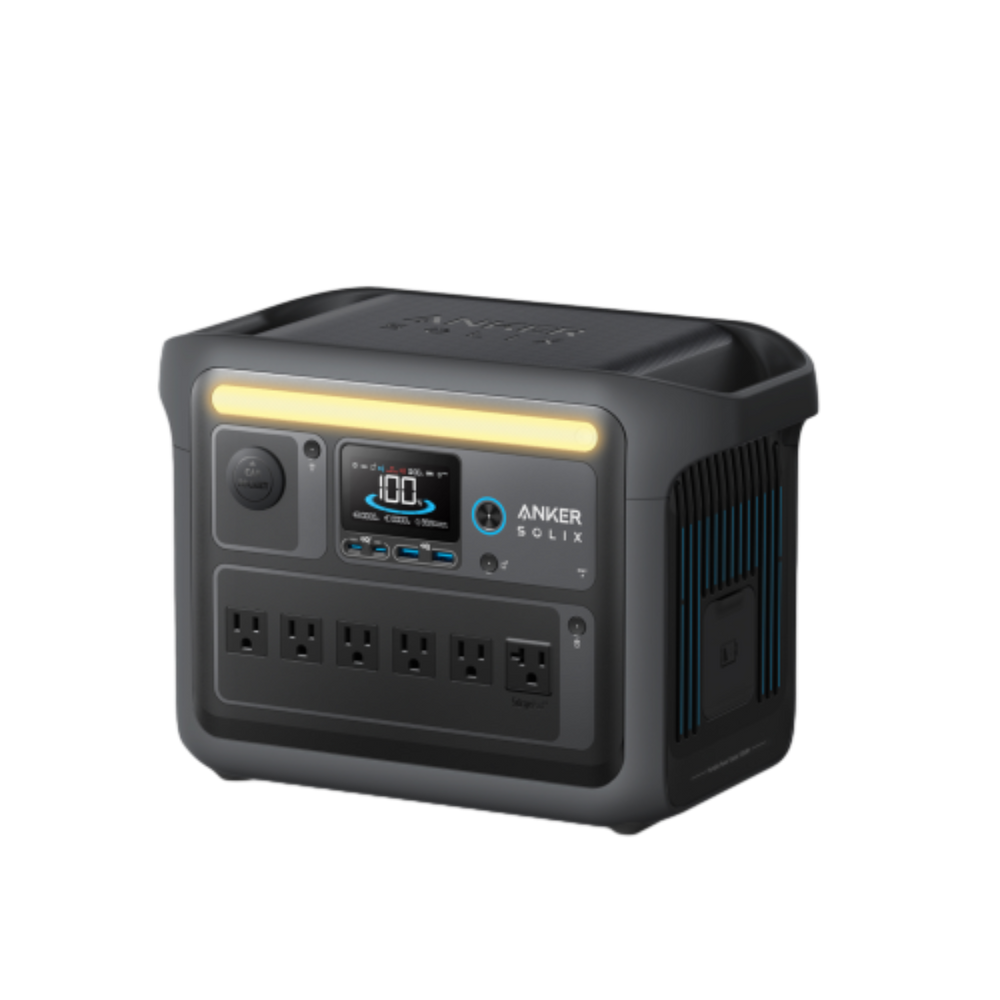
Explore this need in the finder →The Anker SOLIX C1000 is a 1,056 Wh, 120 V station rated for 1,800 W of continuous AC output. It can pair with one compatible BP1000 expansion battery to make a 2,112 Wh nameplate plan without raising that 1,800 W inverter rating. The current US product page uses the C1000X name for its A1761 body; Anker's US collection and guide also use C1000, so this assessment keeps both names attached to the same A1761 family rather than treating “X” as a higher-output model.
Do not plan around SurgePad as the rated output
Six household receptacles make it easy to plug in a few loads, but they all share the same inverter. Anker lists 1,800 W continuous and a 2,400 W SurgePad figure. The larger number is not a new continuous rating: check each appliance's running draw, compressor or motor start, and what else will be on at the same time. The product is 120 V only; multiple sockets do not create 240 V or split phase. If a 1,800 W load is essential, use its own nameplate and leave headroom rather than relying on a peak claim.
The rear-side layout matters as well as the AC row. The station has two USB-A ports rated up to 12 W each, one 100 W USB-C and one 30 W USB-C, plus a 12 V, 10 A car-style output. Those USB-C ratings are unequal; the C1000 is not the same charging hub as the newer Gen 2's two 140 W USB-C ports. A 120 W car socket is useful for a compatible cooler or vehicle accessory, but it is not a high-current Anderson or 12 V house-wiring connection.
A meaningful expansion option, with extra mass
The built-in LFP battery is rated at 1,056 Wh. That is stored nameplate energy, not a guaranteed 1,056 Wh at an AC appliance: inverter conversion, idle draw, temperature, reserve settings and the load's cycling all affect practical runtime. Anker publishes a 3,000-cycle-to-80% claim and a five-year warranty, neither of which is an independent lifespan test.
Unlike the C1000 Gen 2, the A1761 can connect to the BP1000/BP1000X 1,056 Wh expansion battery. The exact Anker package page identifies the C1000 plus expansion configuration as SKU B1761114 and lists 2,112 Wh total capacity. The battery must be connected to the C1000; it is not a separate AC source. Expansion increases the energy reserve, not the station's 1,800 W continuous output, 2,400 W SurgePad figure, 600 W solar ceiling or number of host outlets. The added module weighs 19.97 lb, so the two components together are about 48.4 lb before cables. Treat the package as two pieces to carry and store, not a suddenly light 2 kWh station.
Charging is flexible, but the input ceiling is fixed
Anker specifies one XT60 solar/DC input accepting 11–60 V and up to 600 W. The manual gives separate current caps across the voltage range: 10 A at 11–32 V and 12.5 A at 32–60 V. Check open-circuit voltage, current, connector and the wiring diagram for the exact panel arrangement; two panel labels that add to 600 W do not by themselves prove a compatible setup. Anker's documentation recommends its own compatible panels, but panel output will vary with sun, orientation, shade, temperature and cable loss.
For wall charging, the standard AC input is listed at 1,000 W and Anker's optional UltraFast mode reaches 1,300 W through the app. The manual recommends ordinary charging except when speed matters. A vehicle input is available through the included car charging cable; the separate 12 V car socket is an output for accessories, not the charging port.
Fit, handoff and backup limits
At 28.44 lb and about 14.8 × 8.07 × 10.5 in, it is movable but still a real two-handed lift. A garage shelf, car cargo area or RV storage spot with room for ventilation is more realistic than carrying it far every day. The expansion battery roughly adds another 20 lb and is the main reason to plan transport and storage before choosing the 2,112 Wh setup. The published charge-temperature window is 32–104°F and discharge window −4–104°F; keep charging plans inside the manual's operating limits.
Anker specifies a UPS transfer time under 20 ms. That number can help when comparing basic continuity options, but it does not prove compatibility with every desktop, router, aquarium pump or medical device. Confirm the equipment's transfer tolerance and test the actual combination; for essential medical equipment, follow the device supplier's backup guidance. The station is also not a home transfer switch. Use only an approved transfer arrangement and never energize household wiring through a wall outlet.
Who should compare it?
Shortlist the C1000 if your essential loads fit within 1,800 W continuous, you value six AC receptacles and a 120 W car socket, and you may later need more stored energy from one exact compatible BP1000. The expansion choice changes a questionnaire result: a 2,112 Wh minimum with expansion required can fit the documented second plan; a 2,112 Wh minimum on the standalone plan cannot. A strict under-30-lb limit may fit the host alone but not the expanded two-piece system, so compare total plan mass before treating expansion as essential.
Choose the C1000 Gen 2 instead if lighter carry weight and 2,000 W continuous output matter more than adding a battery later; it is slightly lighter and has two 140 W USB-C outputs, but no expansion feature. For a larger load and more solar headroom, compare the reviewed C2000 Gen 2: it offers 2,048 Wh, 2,400 W continuous and 800 W solar, but is a heavier class. No runtime measurement or physical sample inspection informed this assessment; calculate from your own appliance loads and use the source specifications as limits, not promises.
Key details at a glance
| Nameplate battery capacity | 1056 Wh |
|---|---|
| Rated AC output | 1800 W |
| Manufacturer surge rating | 2400 W |
| Maximum solar input | 600 W |
| Maximum USB-C output per port | 100 W |
| Listed weight | 28.44 lb |
| Compatible extra-battery expansion | Yes |
| 12 V DC output | 120 W |
| Maximum AC recharge input | 1300 W |
| Manufacturer UPS transfer figure | 20 ms |
| Base warranty term | 5 years |
| AC outlet output | Yes |
| USB-C ports | 2 |
| USB-A ports | 2 |
| Solar input ports | 1 |
| 12 V car-style output | 120 W |
| Battery chemistry | LFP |
Use the exact model’s instructions for operating limits, supplied equipment and version differences.
Sources for this assessment
A useful match starts with the loads that matter.
Use the finder for hard electrical requirements, then check appliance starting behavior, actual run time and the exact package in the full assessment.