
Your needs, this model
Does it fit your priorities?
Are all of your essential loads USB-powered, with no household AC outlet or 12 V car-style output required?
The C200 DC is direct-DC only, with 192 Wh and 200 W total output; it has USB outputs but no inverter or 12 V car outlet.
Explore this need in the finder →Would one 140 W USB-C port, 100 W solar input and a carry weight under five pounds meet your plan?
Its USB-C3 port supports up to 140 W, its solar input is capped at 100 W, and the listed station weight is 4.2 lb; these are published maxima and do not promise runtime or solar yield.
Explore this need in the finder →Do you need a vehicle recharge input, but not a 12 V accessory socket output?
The manual describes a separate vehicle-recharge cable and shared solar/car input, but provides no car-input wattage; the station does not provide a 12 V car-style output socket.
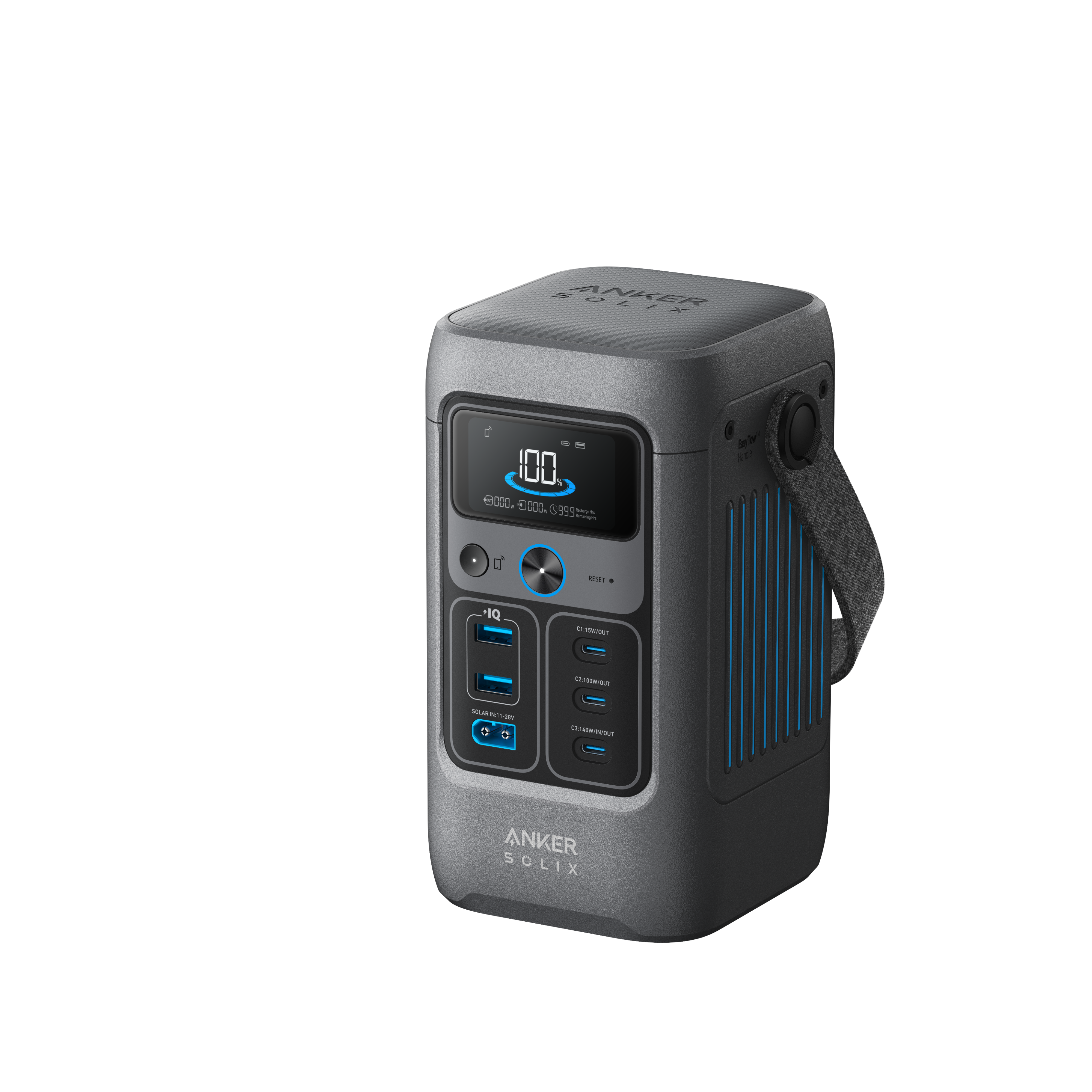
Explore this need in the finder →The Anker SOLIX C200 DC is a small direct-current station for USB equipment, not a miniature version of a household-outlet power station. Its exact US product listing identifies standalone SKU A17270Z1; the English A1727 guide calls the model C200 DC. It stores 192 Wh and is rated for 200 W maximum total output. At a listed 4.2 lb, it is easy to pack compared with a box that includes an inverter, but the trade is decisive: there is no AC outlet, and the unit has no 12 V car-style output socket. An AC plug adapter cannot change that. Consider it only after confirming each essential load can take the actual USB output.
A small reserve for devices, not appliances
The nameplate 192 Wh describes battery capacity, not the energy that a laptop or phone is guaranteed to receive. Conversion overhead, the device's own charging behavior, reserve you keep, temperature and simultaneous loads all affect how often the station needs a refill. It can be a sensible shared source for phones, tablets, a USB-C laptop or camera accessories when the demand is modest and can be scheduled. It is not an alternative to an AC inverter for an appliance with only a household plug, nor a substitute for a larger station when the load must run for a long time. Work from the device's input label and a realistic operating schedule; there is no useful universal “number of charges” promise from 192 Wh alone.
Check which of the five device ports does what
The guide identifies three USB-C ports and two USB-A ports. USB-C3 is the one bidirectional connection: it accepts up to 140 W for charging the station and can also deliver up to 140 W to a compatible device. USB-C2 is output-only at up to 100 W, USB-C1 is output-only at up to 15 W, and each of the two USB-A ports is listed up to 12 W. That is a useful range for a laptop and small electronics, but it is not five equivalent high-power outlets. Anker's port-distribution table also limits simultaneous loads: USB-C2 and USB-C3 together are listed as 100 W plus 100 W, and a three-group arrangement with the two larger USB-C ports and the small-port group is listed as 60 W plus 100 W plus 20 W. The aggregate ceiling remains 200 W. Do not add the single-port maxima and assume they are all available at once.
Solar and vehicle charging use inputs, not extra outputs
Its XT60 solar input accepts up to 100 W at 11–28 V and 8.2 A. Anker recommends 60 W or 100 W panels and warns against PS30, USB-C panels, PS200 and PS400. The input cable is sold separately. Use the voltage and connector limits rather than choosing a panel by its wattage alone; shade, angle and weather can keep real charging well below the ceiling. Anker's product page also offers a 60 W panel option, but the base station's box list does not include a panel or solar cable, and the reviewed page does not identify the panel's own model code. Treat that as a separate package choice, not as something included with every C200 DC.
The guide describes recharging from a vehicle with a separately sold car charging cable, but does not give a specific car-input wattage. The combined solar/car input is an input only: it does not make the C200 DC able to run a 12 V cooler or other car-socket load. If that output is essential, compare a model such as the Anker SOLIX C300 DC, which has a rated 120 W car outlet, or the EcoFlow TRAIL 300 DC. The TRAIL 200 DC is closer in size and battery capacity, but its cited configuration has no solar input or car socket.
Charging and day-to-day care
The C200 DC does not include a wall adapter. The product page says an 18 W-or-higher USB-C PD charger can recharge it, while a 140 W port is needed for full-speed charging; the included cable is rated for 140 W. Anker advertises a recharge to 80% in 1.3 hours over PD 3.1, a manufacturer claim rather than a guaranteed result with any adapter or outlet. The manual sets charging temperature at 0–40°C and discharge at -20–40°C; keep to the manual rather than expecting the unit to charge in freezing conditions. It also says to use and store the station upright, in a cool dry place, check charge weekly during storage, recharge if it drops below 30%, and return it to 100% every three months.
Who should choose it?
Shortlist the C200 DC when all essential devices charge by USB, weight matters, and a 100 W maximum solar input or a vehicle recharge route is useful. Its third USB-C port and solar/car inputs distinguish it from the EcoFlow TRAIL 200 DC, which has two USB-C ports and a higher 220 W total DC ceiling but no solar or vehicle input in the reviewed standalone plan. The Anker C300 DC moves up to 288 Wh, 300 W total DC and four USB-C ports, and adds a 120 W car socket, but is heavier. None of those DC-only models runs an AC-only appliance. For essential household AC, choose an inverter model instead.
The exact US product page snapshot checked for this review marked the standalone listing sold out; inventory can change, so confirm the offer before buying. Its 3-year warranty is a manufacturer-stated term. The included list names the station, a USB-C cable, safety instructions and warranty information; it does not list a wall charger, car cable, solar cable or panel. The official product rendering shows a shoulder strap, but Anker says the adjustable strap is sold separately. Confirm package contents rather than treating promotional imagery or a bundle selector as proof of included accessories. No independent sample inspection or runtime test is claimed.
For exact port limits and storage instructions, see the Anker SOLIX C200 DC A1727 English user guide and the Anker SOLIX US product page.
Key details at a glance
| Nameplate battery capacity | 192 Wh |
|---|---|
| Maximum solar input | 100 W |
| Maximum USB-C output per port | 140 W |
| Listed weight | 4.2 lb |
| Compatible extra-battery expansion | No |
| 12 V DC output | 0 W |
| Base warranty term | 3 years |
| Total rated DC output | 200 W |
| AC outlet output | No |
| USB-C ports | 3 |
| USB-A ports | 2 |
| Solar input ports | 1 |
| 12 V car-style output | 0 W |
| Battery chemistry | LFP |
Use the exact model’s instructions for operating limits, supplied equipment and version differences.
Sources for this assessment
A useful match starts with the loads that matter.
Use the finder for hard electrical requirements, then check appliance starting behavior, actual run time and the exact package in the full assessment.