
Your needs, this model
Does it fit your priorities?
Do you need the BP2000 already included and at least 4,096 Wh nameplate in one 120 V plan?
The exact package lists one C2000 Gen 2 and one BP2000 Gen 2; those modules form a 4,096 Wh nameplate plan with 2,400 W rated 120 V output.
Explore this need in the finder →Does the exact offer need to list at least 800 W of solar-panel nameplate wattage in the box?
The G17831AB “What’s in the Box” list states two 400 W solar panels, or 800 W combined nameplate. The page does not name the panel model or state that the station-side/parallel leads are in the kit; this is not a ready-to-connect guarantee.
Explore this need in the finder →Must the operating plan include two USB-C ports each rated up to 140 W?
The A1783 specification lists two USB-C ports at up to 140 W each; the third USB-C port is 15 W.
Explore this need in the finder →The Anker SOLIX C2000 Gen 2 + Expansion Battery + 2× 400 W Solar Panel package is a different offer from the single-panel bundle, not just a photograph variation. Its U.S. product page identifies SKU G17831AB, Shopify variant 63494587908426 and GTIN 194644369835. The “What’s in the Box” list names the A1783 C2000 Gen 2 station, one BP2000 Gen 2 expansion battery and two 400 W panels. It does not identify the panel submodel or itemize a solar-to-station cable. Those omissions matter because two panels’ combined nameplate rating is not by itself proof that the exact connectors and wiring are ready to use.
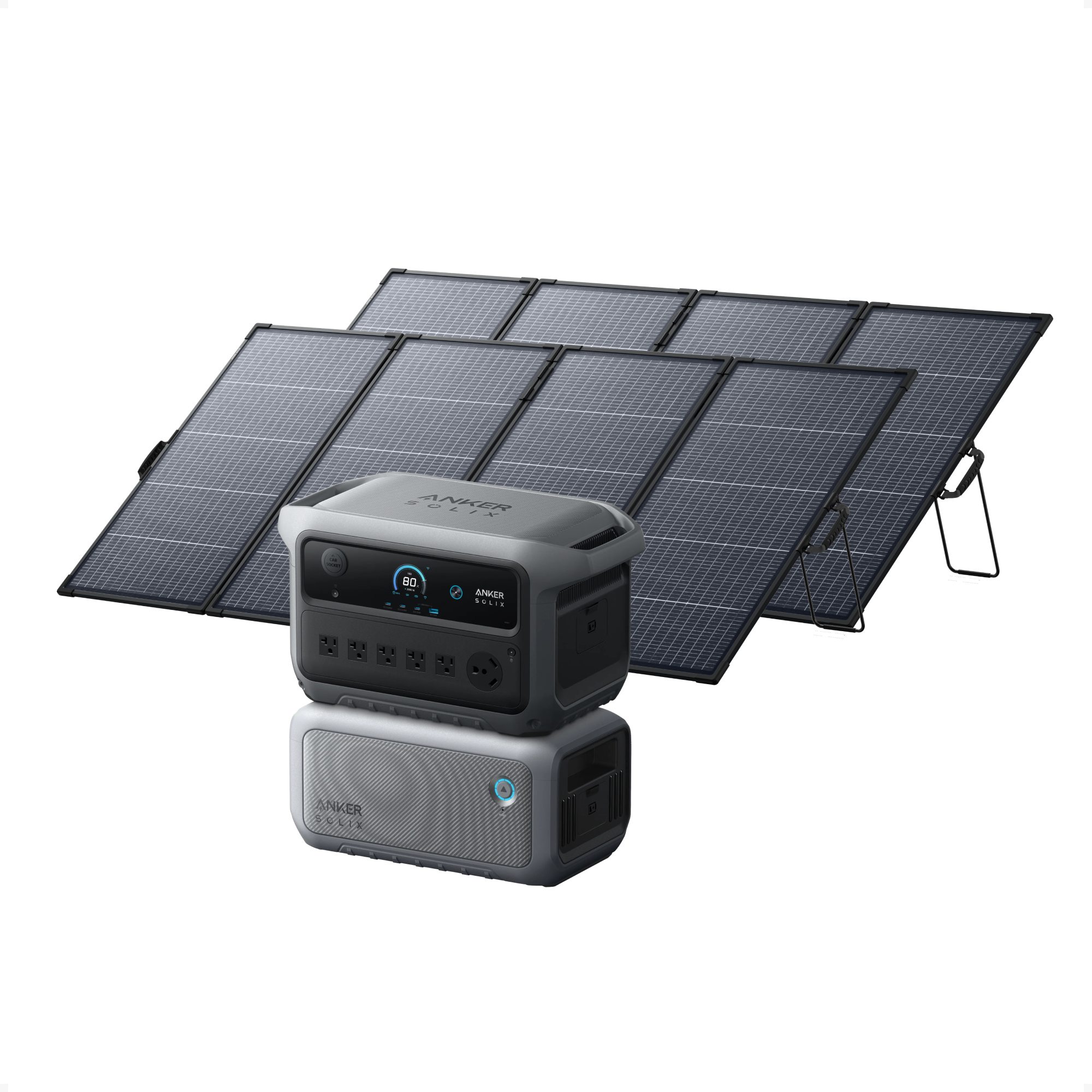
One large station plan, plus a substantial panel pair
The battery part is relatively straightforward. Anker states that one BP2000 Gen 2 adds 2,048 Wh to the C2000 Gen 2’s 2,048 Wh, for 4,096 Wh of nameplate storage in a single station-and-expansion configuration. The battery-to-host lead connects the battery to the station; it does not create a second inverter. The C2000 remains a 120 V station rated at 2,400 W AC. Station weight is listed at 41.7 lb and the battery at about 34 lb, so those two components total roughly 75.7 lb before panels. The page provides no total weight for the panel package, so plan for more bulk and lifting than the station-and-battery number suggests.
Two 400 W panel ratings add to 800 W on paper, matching the C2000’s published maximum solar-input wattage. That suits a cabin or outage plan, but does not guarantee 800 W will reach the battery: sun angle, weather, losses and the station’s input ceiling all matter. Solar does not increase stored capacity until energy is captured, and a sunny-day charging claim is not a runtime measurement.
Wiring needs verification before connection
The A1783 guide specifies one XT60i solar/DC input, 11–60 V, with current limited to 17 A and an 800 W maximum. It instructs users charging from multiple panels to connect them in parallel and keep voltage at or below 60 V. The G17831AB box list confirms two 400 W panels as package items, but the bundle page does not give their exact model, open-circuit voltage, connector, parallel harness or station-side lead. The separate Anker PS400 A2437 product is also 400 W, but a similar wattage label is not enough to prove that the panels in this bundle are A2437 units. Do not use the separate PS400 specifications to fill in the bundle’s missing component identity, and do not improvise a series connection; the manual’s voltage ceiling is a safety boundary.
If a ready-to-connect solar kit is essential, ask Anker or the seller to confirm the exact panel model and all needed leads for SKU G17831AB. The listing’s package name and itemized two-panel contents justify recording two 400 W panels as included, but the absent component and cable details should remain visible. The matcher can treat a panel-in-the-box requirement differently from a requirement for a confirmed station-side cable; unknown cable contents should not pass an essential cable filter.
Its outlet limits do not grow with the battery
The A1783 is rated for 2,400 W continuous AC at 120 V, with a 4,000 W peak claim. Its five household outlets and TT-30R draw from the same inverter ceiling. The TT-30R is listed at up to 20 A / 2,400 W, not full 30 A RV service; the C2000 does not output 240 V. The extra battery can support a longer load plan, but it cannot make a 2,401 W continuous appliance or a 240 V circuit suitable. Check both running demand and startup behavior for refrigerators, pumps and compressors. A manufacturer peak figure is not a substitute for this check.
There are three USB-C ports, two rated up to 140 W, one up to 15 W, plus a 12 W USB-A port and 120 W car-style 12 V output. Do not assume separate port maximums are simultaneously available. Anker’s 10 ms UPS figure is not tested assurance for every critical device, and manufacturer-published AC energy at a stated load is not available here.
Who benefits from the two-panel offer?
The two panels and BP2000 suit a buyer who wants a larger solar setup and 4 kWh-class nameplate storage in one offer, with space to deploy and protect the equipment. Package weight and daily solar harvest are not published. For a named panel and itemized leads, compare G17831A7’s one-PS400 package; it does not include a BP2000.
In the questionnaire, requiring 4,096 Wh in one station plan and an expansion battery in the package separates this offer from a standalone C2000. A 240 V need, more than 2,400 W AC, full 30 A TT-30 service or more than 4,096 Wh in one plan should exclude it. The two-panel box-list fact can match a panel-in-package need, but an essential station-side cable requirement should not pass until that lead is confirmed. This assessment uses manufacturer pages and the A1783 guide; no sample test, price or measured charge result is claimed.
Exact configuration: Anker SOLIX U.S. G17831AB / variant 63494587908426 / GTIN 194644369835. The bundle page explicitly lists two 400 W panels, but not their submodel or solar-lead contents. C2000 A1783 electrical limits and parallel-wiring precautions follow the U.S. guide.
Key details at a glance
| Nameplate battery capacity | 4096 Wh |
|---|---|
| Rated AC output | 2400 W |
| Manufacturer surge rating | 4000 W |
| Maximum solar input | 800 W |
| Included panels, combined nameplate | 800 W |
| Maximum USB-C output per port | 140 W |
| Listed weight | 41.7 lb |
| Compatible extra-battery expansion | Yes |
| 12 V DC output | 120 W |
| Maximum AC recharge input | 1800 W |
| Manufacturer UPS transfer figure | 10 ms |
| Base warranty term | 5 years |
| AC outlet output | Yes |
| USB-C ports | 3 |
| USB-A ports | 1 |
| Solar input ports | 1 |
| 12 V car-style output | 120 W |
| Battery chemistry | LFP |
| TT-30 RV outlet | Yes |
| Expansion battery in this package | Yes |
| Separate station units in offer | 1 |
| Solar panels in exact offer | 2 |
Use the exact model’s instructions for operating limits, supplied equipment and version differences.
Sources for this assessment
- Anker SOLIX US C2000 Gen 2 Portable Power Station
- Anker SOLIX C2000 Gen 2 Portable Power Station User Guide (A1783), United States
- Anker SOLIX BP2000 Expansion Battery (Gen 2), US product page
- Anker SOLIX BP2000 Expansion Battery (Gen 2) User Guide (A17831A1-85)
- Anker SOLIX C2000 Gen 2 + BP2000 + two 400 W panels
- Anker SOLIX PS400 Portable Solar Panel (separate U.S. product page)
- Anker SOLIX PS400 User Guide (A2437), separate panel context
A useful match starts with the loads that matter.
Use the finder for hard electrical requirements, then check appliance starting behavior, actual run time and the exact package in the full assessment.