
Your needs, this model
Does it fit your priorities?
Do you need the BP2000 already included and at least 4,096 Wh nameplate in one 120 V plan?
The exact package lists one C2000 Gen 2 and one BP2000 Gen 2; those modules form a 4,096 Wh nameplate plan with 2,400 W rated 120 V output.
Explore this need in the finder →Do you need the station to accept at least 800 W of solar input, while checking this bundle’s panel/lead contents separately?
The A1783 guide rates one XT60i solar/DC input up to 800 W at 11–60 V and 17 A. That is the station ceiling, not evidence that the advertised panel or a station-side lead is included.
Explore this need in the finder →Must the operating plan include two USB-C ports each rated up to 140 W?
The A1783 specification lists two USB-C ports at up to 140 W each; the third USB-C port is 15 W.
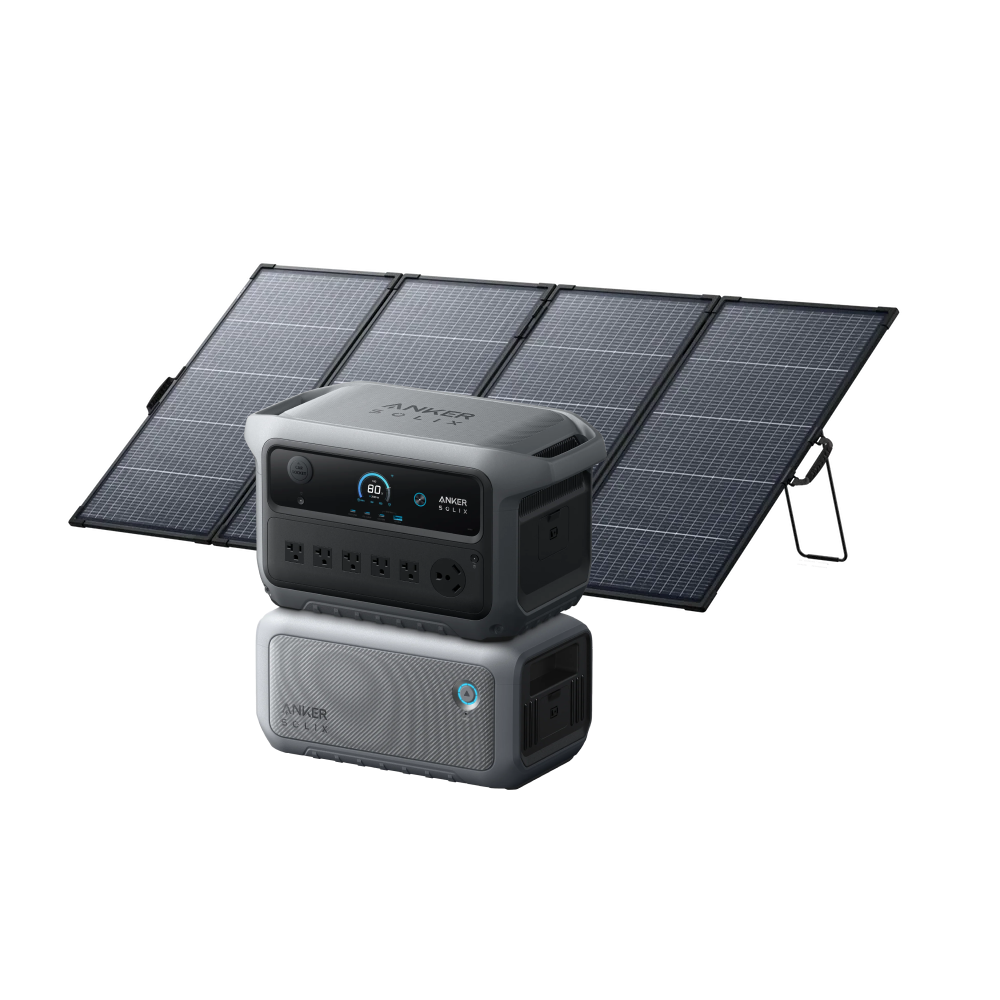
Explore this need in the finder →This is the Anker SOLIX C2000 Gen 2 plus BP2000 Gen 2 offer that is titled as including a 400 W portable solar panel. The U.S. product record identifies package SKU G17831A8, variant 63339875828042 and GTIN 194644368821. Its station is A1783 and the expansion battery is BP2000 Gen 2. The offer page’s title and selected option name a 400 W panel, but its “What’s in the Box” list does not list one. I would treat the panel as a manufacturer-listed bundle claim, not as a component whose box contents are fully reconciled; confirm it with the seller before relying on it.
The battery configuration is clearer than the solar carton
Anker’s page says the C2000 Gen 2 can reach 4 kWh with a BP2000 Gen 2, and its box list names both the A1783 station and BP2000. The battery is a 2,048 Wh LFP module that connects to the station with a battery-to-host cable; it is not an independent AC source. That makes this offer materially different from the standalone C2000: the supported single-station plan has 4,096 Wh of nameplate battery capacity, rather than 2,048 Wh. It does not make the inverter stronger. The manufacturer lists the battery module at about 34 lb and the station at 41.7 lb, so the station-and-battery pair alone is about 75.7 lb, before any panel or other accessories. The page does not give the total delivered-package weight.
That larger reserve suits a fixed backup spot, cabin, shed or long weekend where the equipment can stay in place and the load fits the station. Nameplate watt-hours do not guarantee energy delivered at an AC outlet; conversion losses, reserve settings, temperature and load cycles matter. Anker’s fridge runtime and recharge claims are internal test claims, not independent measurements.
Still one 120 V, 2,400 W station
The A1783 is specified for 2,400 W rated AC output at 120 V, with a 4,000 W peak figure. The five household outlets and TT-30R share that station-wide limit. Anker lists the TT-30R at 20 A / 2,400 W, not full 30 A service. There is no 240 V output. A motor or compressor may need a startup margin, so compare the appliance’s voltage, running watts and surge behavior with the manual rather than treating the peak number as a continuous rating. If a required load exceeds 2,400 W continuously, uses 240 V, or expects a full 30 A RV supply, the added battery does not fix the mismatch.
Two USB-C ports are rated up to 140 W each and a third up to 15 W; USB-A is rated to 12 W and the car-style 12 V outlet to 120 W. Check shared output and device needs rather than adding every port maximum together. The published 10 ms UPS figure is not a measured guarantee for every sensitive load.
Do not mistake a panel label for a complete charging setup
Anker specifies one XT60i solar/DC input, 11–60 V and up to 17 A, with an 800 W maximum. Its A1783 guide says multiple solar panels must be connected in parallel and warns that input voltage must not exceed 60 V. The G17831A8 page calls out a 400 W solar panel in its title and selected offer, but the box list omits it; the page does not itemize the panel model or a station-side solar lead. The separate PS400 product and A2437 guide establish that Anker sells a 400 W panel with its own cables, but the G17831A8 page does not identify the bundle panel as that exact model. Do not silently merge those separate records. If the panel itself or its connector cable is essential, verify the contents for the exact SKU before purchase.
This distinction changes the recommendation: a buyer who only needs the A1783’s published solar-input capability can consider it with compatible panels sourced separately. A buyer who needs a confirmed panel and station-side lead in the box should prefer a package whose exact contents list both, such as the separately reviewed C2000 Gen 2 plus PS400 offer, rather than assuming all C2000 bundles share parts. The 800 W station input ceiling is not the wattage of the panel advertised with this package, nor proof that an unidentified panel can safely use all of that headroom.
Who should shortlist this offer?
Choose this configuration when you specifically want one A1783 station and one compatible BP2000 expansion battery in the same offer and your loads fit 120 V / 2,400 W. Requiring the battery in the exact package distinguishes it from the standalone C2000 and the panel-only G17831A7 bundle. A 240 V need, full 30 A output, or more than 4,096 Wh in one station plan should remove it. A requirement for a confirmed solar panel or lead in the box should not pass while this listing’s title and box checklist disagree.
If you already have a compatible panel, compare the no-panel C2000 plus expansion package instead. If a verified solar kit is more important than bundled storage, compare the G17831A7 C2000-plus-PS400 review. In either case, check the precise selected SKU, not just the shared C2000 name. No sample was tested and no measured runtime, delivered AC energy or current price is claimed.
Exact configuration: Anker SOLIX U.S. G17831A8 / variant 63339875828042 / GTIN 194644368821. Station-side limits come from the C2000 Gen 2 A1783 guide; the BP2000 Gen 2 identity and capacity come from Anker’s product page and guide. The bundle’s solar-panel and cable contents remain qualified as described above.
Key details at a glance
| Nameplate battery capacity | 4096 Wh |
|---|---|
| Rated AC output | 2400 W |
| Manufacturer surge rating | 4000 W |
| Maximum solar input | 800 W |
| Maximum USB-C output per port | 140 W |
| Listed weight | 41.7 lb |
| Compatible extra-battery expansion | Yes |
| 12 V DC output | 120 W |
| Maximum AC recharge input | 1800 W |
| Manufacturer UPS transfer figure | 10 ms |
| Base warranty term | 5 years |
| AC outlet output | Yes |
| USB-C ports | 3 |
| USB-A ports | 1 |
| Solar input ports | 1 |
| 12 V car-style output | 120 W |
| Battery chemistry | LFP |
| TT-30 RV outlet | Yes |
| Expansion battery in this package | Yes |
| Separate station units in offer | 1 |
Use the exact model’s instructions for operating limits, supplied equipment and version differences.
Sources for this assessment
- Anker SOLIX US C2000 Gen 2 Portable Power Station
- Anker SOLIX C2000 Gen 2 Portable Power Station User Guide (A1783), United States
- Anker SOLIX BP2000 Expansion Battery (Gen 2), US product page
- Anker SOLIX BP2000 Expansion Battery (Gen 2) User Guide (A17831A1-85)
- Anker SOLIX C2000 Gen 2 + BP2000 + 400 W panel offer
- Anker SOLIX PS400 Portable Solar Panel (separate U.S. product page)
- Anker SOLIX PS400 User Guide (A2437), separate panel context
A useful match starts with the loads that matter.
Use the finder for hard electrical requirements, then check appliance starting behavior, actual run time and the exact package in the full assessment.