
Your needs, this model
Does it fit your priorities?
Do you need at least five separate, independently usable 120 V stations?
The exact U.S. offer page identifies five A1783 C2000 Gen 2 stations. Each can serve a separate load group; no combined output arrangement is documented.
Explore this need in the finder →Must each individual load fit one 2,048 Wh / 2,400 W A1783 station at 120 V?
Each station has that nameplate capacity and rated AC limit. The five units are not represented as one 10,240 Wh or 12,000 W load plan.
Explore this need in the finder →Do you need an 800 W solar input on each station?
Each A1783 guide specifies one 11–60 V / 17 A / 800 W solar input. The promotional 400 W panel label does not establish its exact panel identity, box contents or wiring.
Explore this need in the finder →The five-unit Anker SOLIX C2000 Gen 2 offer is a deployment choice, not a larger single power station. The exact U.S. offer page names five C2000 Gen 2 units under SKU G17831AA and its product art shows five separate A1783 housings. Anker lists 10,240 Wh as the summed nameplate capacity and 2,400 W as the station output. Those numbers describe five 2,048 Wh stations at their individual ratings; they do not describe one 10,240 Wh battery or a shared 12,000 W AC source.
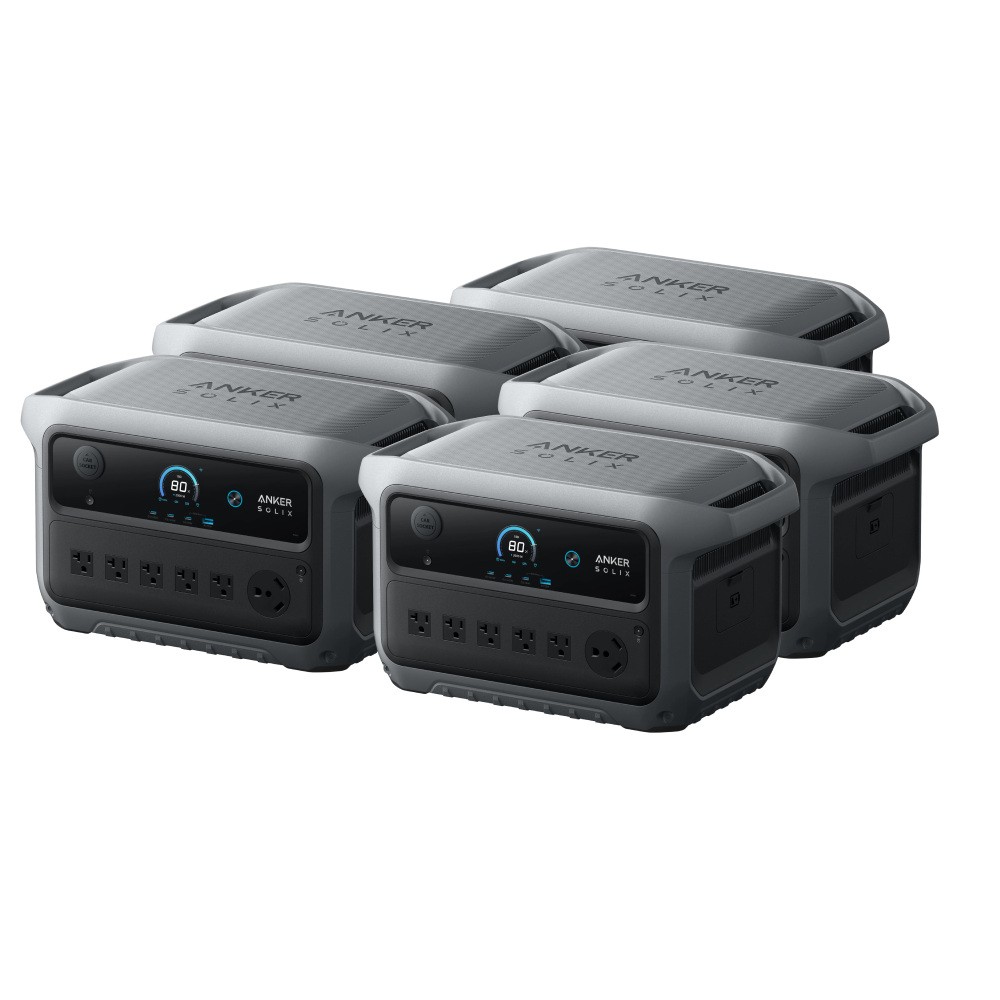
Five useful destinations, five independent plans
The package makes sense only when several independent stations are genuinely useful. A field organization might stage one at each of several work locations; a property with separate outbuildings may want each unit kept near the loads it serves; or a group may assign a station to each mobile kit. In all of these examples, the station travels to its own appliance group. The page and the reviewed A1783 manual do not establish a supported parallel link, common battery system, synchronized outputs or 120/240 V split-phase setup. If your design requires one source to feed a central panel or a single load that needs more than 2,400 W continuously, a five-pack does not meet that need just because its energy totals 10,240 Wh across five batteries.
Each station weighs 41.7 lb according to Anker. Five station bodies therefore represent 208.5 lb before cartons, cables or any promotional accessory. The benefit is that no single A1783 has to be as large as that total; the cost is storage space, inventory management and repeated lifting. Label each unit, keep its own charging cable with it, and decide how each one will be stored and charged. The exact package page does not provide an itemized box list or a total shipment weight, so included accessory quantities should be confirmed before relying on a cable-per-unit assumption.
Capacity and output remain unit-specific
One A1783 supplies 120 V AC from a 2,048 Wh LFP battery, with 2,400 W rated output and up to 4,000 W peak. Its five household outlets share that 2,400 W ceiling with the TT-30R. The TT-30R is rated at 20 A / 2,400 W in this station, not 30 A of RV power. Decide which devices will be connected to each unit and check both their running watts and startup demands. Battery nameplate Wh is not the same as usable AC energy; allow for conversion losses and for the possibility that a high load may run beyond the station’s continuous rating. No independent sample, runtime or output test is claimed here.
Anker’s product selector showed a “free 400 W solar panel” promotion with the five-unit choice at the time of this page inspection. However, the exact G17831AA offer data and its hero image identify the station quantity, not the panel’s exact model, number, cable, wiring or complete carton contents. The promotional text is not enough to establish a ready-to-use solar configuration. Each A1783 has one solar/DC input rated 11–60 V, up to 17 A and 800 W; that station-side ceiling cannot substitute for the missing panel electrical specifications. Do not count the promotion toward a required solar input or charge plan without written confirmation of the exact panel and leads.
Charging five stations is a logistics problem
The A1783 product page lists 1,800 W maximum AC charging input and 100 W car charging per unit. Those limits are for each station, not an instruction to connect five chargers to an arbitrary household circuit. Work out the charging sequence, source, outlet/circuit capacity and cable inventory rather than assuming every station can be replenished at once. A separate 800 W alternator charger is advertised for the model, but the exact five-station offer does not establish that one is included or that it charges the whole group. Likewise, the package does not show a common solar controller or a combined-input arrangement.
Each station can be paired with one compatible BP2000 Gen 2 expansion battery when more nameplate energy is needed behind that station’s inverter. That accessory is not verified as part of the G17831AA offer. One A1783 plus one compatible battery makes a 4,096 Wh station plan at the same 2,400 W AC limit; adding batteries to several stations would be a separate purchase and several separate setups, not one connected 10 kWh system.
Is five more useful than one or three?
Choose five only if you can identify five independent destinations, backup kits or teams that need their own station. It is a much larger quantity than the three-unit package and a single C2000 Gen 2, but the engineering limit of each station remains the same. If only one critical load group needs more stored energy, compare a single C2000 with an expansion battery. If two or three separate locations are enough, a smaller quantity avoids storing, charging and maintaining units that have no assigned role. If you need a unified 240 V supply, seek a model whose manual describes that exact configuration instead.
The most useful five-pack assessment is therefore operational: can you name five users or locations, keep each load below one station’s limit, and support five separate charging/storage routines? If yes, the count can simplify distributing equipment. If not, the extra units do not improve a single load’s voltage, continuous power or runtime. The free-panel promotion, exact accessories, cable quantities, shipment weight and any shared electrical topology are not confirmed by the offer evidence reviewed here.
Key details at a glance
| Nameplate battery capacity | 2048 Wh |
|---|---|
| Rated AC output | 2400 W |
| Manufacturer surge rating | 4000 W |
| Maximum solar input | 800 W |
| Maximum USB-C output per port | 140 W |
| Listed weight | 41.7 lb |
| Compatible extra-battery expansion | Yes |
| 12 V DC output | 120 W |
| Maximum AC recharge input | 1800 W |
| Manufacturer UPS transfer figure | 10 ms |
| AC outlet output | Yes |
| USB-C ports | 3 |
| USB-A ports | 1 |
| Solar input ports | 1 |
| 12 V car-style output | 120 W |
| Battery chemistry | LFP |
| Expansion battery in this package | No |
| Separate station units in offer | 5 |
| Aggregate nameplate capacity across independent units | 10240 Wh |
Use the exact model’s instructions for operating limits, supplied equipment and version differences.
Sources for this assessment

A useful match starts with the loads that matter.
Use the finder for hard electrical requirements, then check appliance starting behavior, actual run time and the exact package in the full assessment.