
Your needs, this model
Does it fit your priorities?
Do you need at least three separate, independently usable 120 V stations?
The exact U.S. offer lists three A1783 C2000 Gen 2 housings. They can be used as separate station plans; no shared electrical connection is documented.
Explore this need in the finder →Must each planned load fit one 2,048 Wh / 2,400 W A1783 station at 120 V?
Each individual station has that nameplate capacity and rated AC limit. Do not add the three station ratings into one plan.
Explore this need in the finder →Do you need an 800 W solar input on each station?
The A1783 guide specifies one 11–60 V / 17 A / 800 W solar input for each unit. The offer does not identify the promotional panel or lead as a compatible included item.
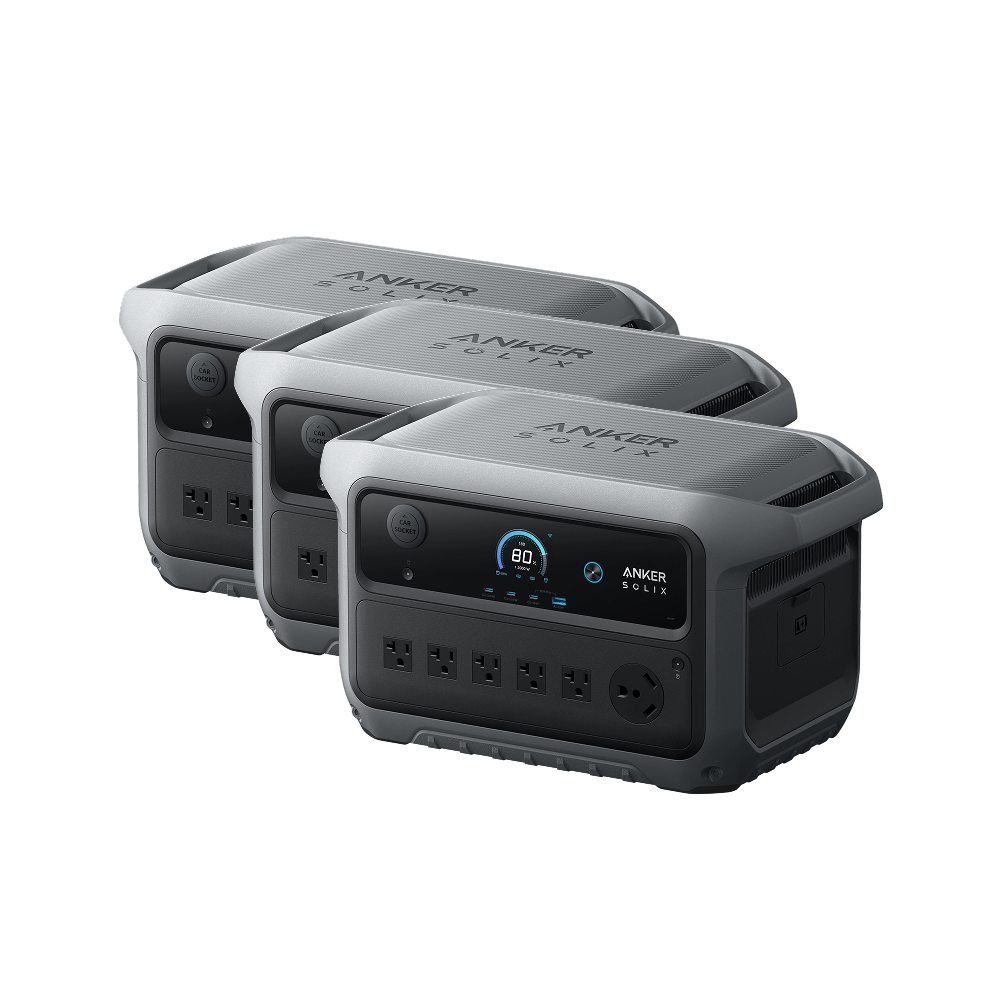
Explore this need in the finder →The three-unit Anker SOLIX C2000 Gen 2 offer is best understood as a small fleet of portable stations for separate places or load groups. It is not one 6,144 Wh power bank, and it does not provide a single 7,200 W inverter. The exact U.S. listing identifies three C2000 Gen 2 units under offer SKU G17831A9 and shows three distinct station housings. Its 6,144 Wh figure is the arithmetic sum of three 2,048 Wh nameplate batteries; the page gives 2,400 W AC output for the station model, not a documented shared system.
What the three count changes
Each A1783 is a 120 V station with a 2,048 Wh LFP battery, 2,400 W rated AC output and a 4,000 W peak figure. The practical reason to buy three is independent placement: one station could serve a particular appliance group in a prepared outage area, another could go to a detached work space, and a third could remain mobile or charged as a spare. Those are separate use plans. Anker’s reviewed U.S. station guide and this package page do not document a parallel connection, a shared battery bus, synchronized AC output, or split-phase operation between these units. The three capacity figures therefore cannot be added to size a single appliance load, and the three inverters cannot be combined to run one 7,200 W device.
At 41.7 lb apiece, the stations alone add up to 125.1 lb of station hardware before any packaging or accessories. That is an important ownership tradeoff: a fleet can be distributed, but moving or storing it means handling three separate boxes, not rolling one larger cabinet. Think through where each unit will live, which person will move it, and how it will be charged before treating the quantity discount as a benefit.
Use one station’s limit for each load
The C2000 Gen 2 has five household receptacles and a TT-30R, but the receptacles on a particular unit share that station’s 2,400 W inverter ceiling. The TT-30R is listed at 20 A and 2,400 W, not full 30 A service. A plug that fits does not make this an unlimited RV hookup. For every planned use, check the appliance’s normal draw and startup demand against one A1783, then account for the energy it needs over the outage. The 2,048 Wh figure is battery nameplate capacity, not a promise of 2,048 Wh delivered at an AC outlet. If a single load needs 240 V or more than 2,400 W continuous from one source, this multi-unit offer does not solve that requirement.
Each station has one XT60i solar input rated 11–60 V, up to 17 A and 800 W. The main C2000 page displayed a promotional “free 200 W solar panel” label beside the three-unit choice during this review, but the exact G17831A9 page’s captured offer details do not identify that panel’s model, count, wiring, connector lead, or box contents. Its exact hero image shows stations only. The panel should not be assumed as a compatible or included part of the package until the seller confirms the specific option and box list. The 800 W figure is the station-side input ceiling; it is not an included panel’s rating. No solar charging lead is counted in this assessment.
Charging and expansion are also per station
Anker lists up to 1,800 W AC input and a separate 100 W car-charging route for the A1783. A higher-power 800 W alternator charger is an optional external charging system, not something established as included with this quantity offer. Multiple units do not mean one source can recharge all three at once; each input belongs to one station, and safe charging depends on the actual circuit, source and accessories. Plan charging access as carefully as placement.
The model supports one compatible BP2000 Gen 2 expansion battery. Adding that separately to one of the three stations can make that station’s documented capacity plan 4,096 Wh while leaving its AC output at 2,400 W. It does not join the three offered stations, and that battery is not identified as part of SKU G17831A9. If one location needs longer runtime, compare this separate expansion plan with a three-station package: the former adds stored energy to one inverter; the latter gives you more independently placed power sources.
Who should consider the three-pack?
It suits a household, work crew or property with a real need for three portable 120 V sources—for instance, separate buildings or equipment areas where carrying one station between them would defeat the plan. It also gives more placement flexibility than the two-unit offer. It is a poor fit if the goal is to power one central panel or one high-wattage appliance from a larger combined battery. Verify each critical load separately, and use a properly specified transfer arrangement rather than an improvised connection.
Choose one C2000 Gen 2 if you need one load group, or compare the one-station-plus-BP2000 configuration if the priority is more battery nameplate capacity behind the same 2,400 W output. A documented 240 V system is the right direction if your essential load requires split phase. For this three-pack, the defensible advantage is three independent stations—not an unverified whole-home system. The possible 200 W promotion, exact cables, total package weight and any shared-output arrangement remain unconfirmed in the reviewed offer evidence.
Key details at a glance
| Nameplate battery capacity | 2048 Wh |
|---|---|
| Rated AC output | 2400 W |
| Manufacturer surge rating | 4000 W |
| Maximum solar input | 800 W |
| Maximum USB-C output per port | 140 W |
| Listed weight | 41.7 lb |
| Compatible extra-battery expansion | Yes |
| 12 V DC output | 120 W |
| Maximum AC recharge input | 1800 W |
| Manufacturer UPS transfer figure | 10 ms |
| AC outlet output | Yes |
| USB-C ports | 3 |
| USB-A ports | 1 |
| Solar input ports | 1 |
| 12 V car-style output | 120 W |
| Battery chemistry | LFP |
| Expansion battery in this package | No |
| Separate station units in offer | 3 |
| Aggregate nameplate capacity across independent units | 6144 Wh |
Use the exact model’s instructions for operating limits, supplied equipment and version differences.
Sources for this assessment

A useful match starts with the loads that matter.
Use the finder for hard electrical requirements, then check appliance starting behavior, actual run time and the exact package in the full assessment.