
Your needs, this model
Does it fit your priorities?
Do you need two separate 120 V stations for independent locations or load groups?
The exact offer lists two A1783 stations. Each runs its own 120 V output plan; the page and guide do not establish a shared or split-phase system.
Explore this need in the finder →Must at least one supported station plan provide 2,048 Wh and 2,400 W at 120 V?
Each A1783 independently has that nameplate battery capacity and rated AC limit. Do not add the second station to meet a single load threshold.
Explore this need in the finder →Do you need two units, each with an 800 W maximum solar-input plan?
The A1783 guide specifies one 11–60 V / 17 A / 800 W solar input per station. The offer page does not list a solar panel or solar lead, so neither is counted as included.
Explore this need in the finder →The Anker SOLIX C2000 Gen 2 two-unit offer is for a buyer who needs two substantial, separately useful stations—not a single station with twice the power. The exact U.S. offer page identifies two C2000 Gen 2 units under bundle SKU G17831A5 and lists two stations, an AC charging cable, a car charging cable, quick-start and safety material, and a warranty card. Each station is the A1783 model. The page does not describe an electrical connection between the units, so plan each load around one station at a time.
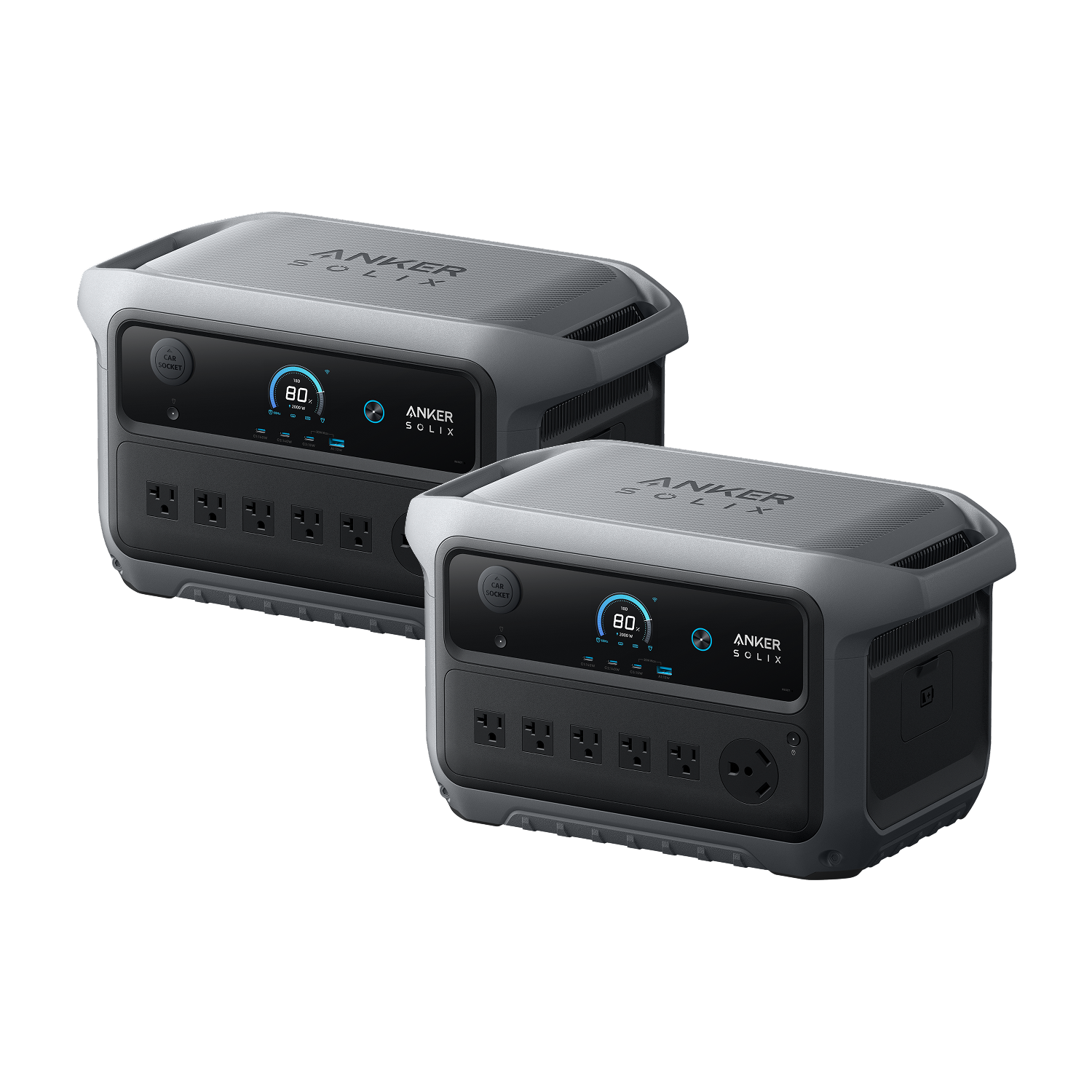
Two 2,048 Wh stations, not one 4,096 Wh bank
The distinction is practical. Two stations can serve two independent places or load groups: for example, one can stay with a refrigerator and network gear while the other is carried to a workshop, campsite, or another room. You can keep a second charged unit available while using the first. But Anker’s A1783 guide does not document a parallel link, shared battery bus, split-phase mode, or coordinated AC output for this two-pack. Adding the nameplate capacities gives 4,096 Wh across the offer; that arithmetic does not make 4,096 Wh available to one appliance. Nor should you add the two 2,400 W ratings and treat 4,800 W as one load rating.
For each station, Anker lists a 2,048 Wh LFP battery, 2,400 W of rated 120 V AC output, and up to 4,000 W peak. The five household outlets and the TT-30R are all on the same station-wide inverter limit. The TT-30R is listed at 20 A / 2,400 W, not full 30 A RV service. If you are powering two unrelated circuits, stay within each unit’s own limits and follow the applicable electrical and transfer-switch requirements; do not connect the two stations together or feed a home circuit with an improvised cord.
Check the load against one A1783
At 41.7 lb per station, each unit is portable in the sense that one person can move it, but neither is a featherweight. The two bodies together mean repeated lifting and storage for two sizable boxes, not one compact 4 kWh enclosure. Each has three USB-C ports, including two rated up to 140 W and a third rated 15 W, one USB-A port, a 120 W car-style 12 V outlet, and five 120 V household receptacles. The station’s AC receptacles share their 2,400 W ceiling; USB and DC ports also have individual or shared limits. Don’t assume every port can deliver its separate maximum at once.
The C2000 Gen 2 is a 120 V model. Its surge figure is not a substitute for checking an appliance’s normal running draw and startup behavior. For an RV or appliance with a TT-30 plug, the connector is useful, but the 20 A / 2,400 W cap still governs. If a required load needs more than one unit can supply, this package does not fix that mismatch simply by including a twin.
Charging and what the bundle does not include
Each A1783 has one XT60i solar/DC input rated for 11–60 V, up to 17 A and 800 W. The station page also lists up to 1,800 W AC input and a 100 W car-charging path. Those are station limits, not proof that both units can be charged simultaneously from one source. The exact offer’s contents list names AC and car charging cables but does not state how many of each cable are supplied. It does not list a solar panel or solar lead. Treat those accessories as unconfirmed for this bundle and check the current box contents before depending on a particular quantity or charging arrangement.
Anker’s separate A1783 material documents compatibility with one BP2000 Gen 2 expansion battery. That can make one station’s supported plan 4,096 Wh while leaving its AC output at 2,400 W; the extra battery is not part of this two-station offer. This is a different way to add runtime than buying a second whole station. It may suit one larger load better, although the station-plus-battery assembly is heavier to move. The manufacturer’s published recharge and appliance-runtime claims are internal test results, not measurements of the two-unit package in real use.
Who should choose this configuration?
Choose it when separate units are genuinely useful: two locations, two independent device groups, or a charged spare that can be deployed without relocating the other station. Before choosing, list each load and verify its voltage, running and startup watts, and likely energy use against a single A1783. Then decide whether the second unit solves a placement problem or whether an extra battery on one unit is the more relevant option.
Choose a single C2000 Gen 2 if one 2,048 Wh, 2,400 W station is sufficient and you would rather avoid owning and storing a second heavy unit. Consider the documented C2000 Gen 2 plus one BP2000 plan if one 120 V load needs more stored nameplate energy while staying within 2,400 W output. If your requirement is 240 V, split phase, or a single load above 2,400 W continuous, look for a configuration whose manufacturer documentation supports that exact output; two A1783 stations in this offer are not a substitute.
The short version: this is a useful two-location purchase when both stations will be used independently. Its extra capability is redundancy and placement flexibility. The batteries and inverters remain separate, solar panels are not listed in the box, and the included cable quantities are not specified on the offer page.
Key details at a glance
| Nameplate battery capacity | 2048 Wh |
|---|---|
| Rated AC output | 2400 W |
| Manufacturer surge rating | 4000 W |
| Maximum solar input | 800 W |
| Included panels, combined nameplate | 0 W |
| Maximum USB-C output per port | 140 W |
| Listed weight | 41.7 lb |
| Compatible extra-battery expansion | Yes |
| 12 V DC output | 120 W |
| Maximum AC recharge input | 1800 W |
| Manufacturer UPS transfer figure | 10 ms |
| AC outlet output | Yes |
| USB-C ports | 3 |
| USB-A ports | 1 |
| Solar input ports | 1 |
| 12 V car-style output | 120 W |
| Battery chemistry | LFP |
| Expansion battery in this package | No |
| Separate station units in offer | 2 |
| Aggregate nameplate capacity across independent units | 4096 Wh |
Use the exact model’s instructions for operating limits, supplied equipment and version differences.
Sources for this assessment

A useful match starts with the loads that matter.
Use the finder for hard electrical requirements, then check appliance starting behavior, actual run time and the exact package in the full assessment.