
Your needs, this model
Does it fit your priorities?
Do you need a TT-30R RV receptacle, while keeping its 20 A/2,400 W ceiling in view?
The C2000 Gen 2 lists one 120 V TT-30R output rated to 20 A and 2,400 W. It is not a full 30 A RV source; check the RV's total load and startup requirements.
Explore this need in the finder →Must the solar input reach at least 800 W on one station?
The US station has one XT60i solar/DC input with an 11–60 V window, current limits and an 800 W maximum; panels and cables must fit the manual's limits.
Explore this need in the finder →Do you want an expandable 4,096 Wh nameplate plan without higher AC output?
One separately purchased compatible BP2000 Gen 2 doubles nameplate capacity from 2,048 Wh to 4,096 Wh. The AC output stays at 2,400 W and the added battery weighs 34 lb.
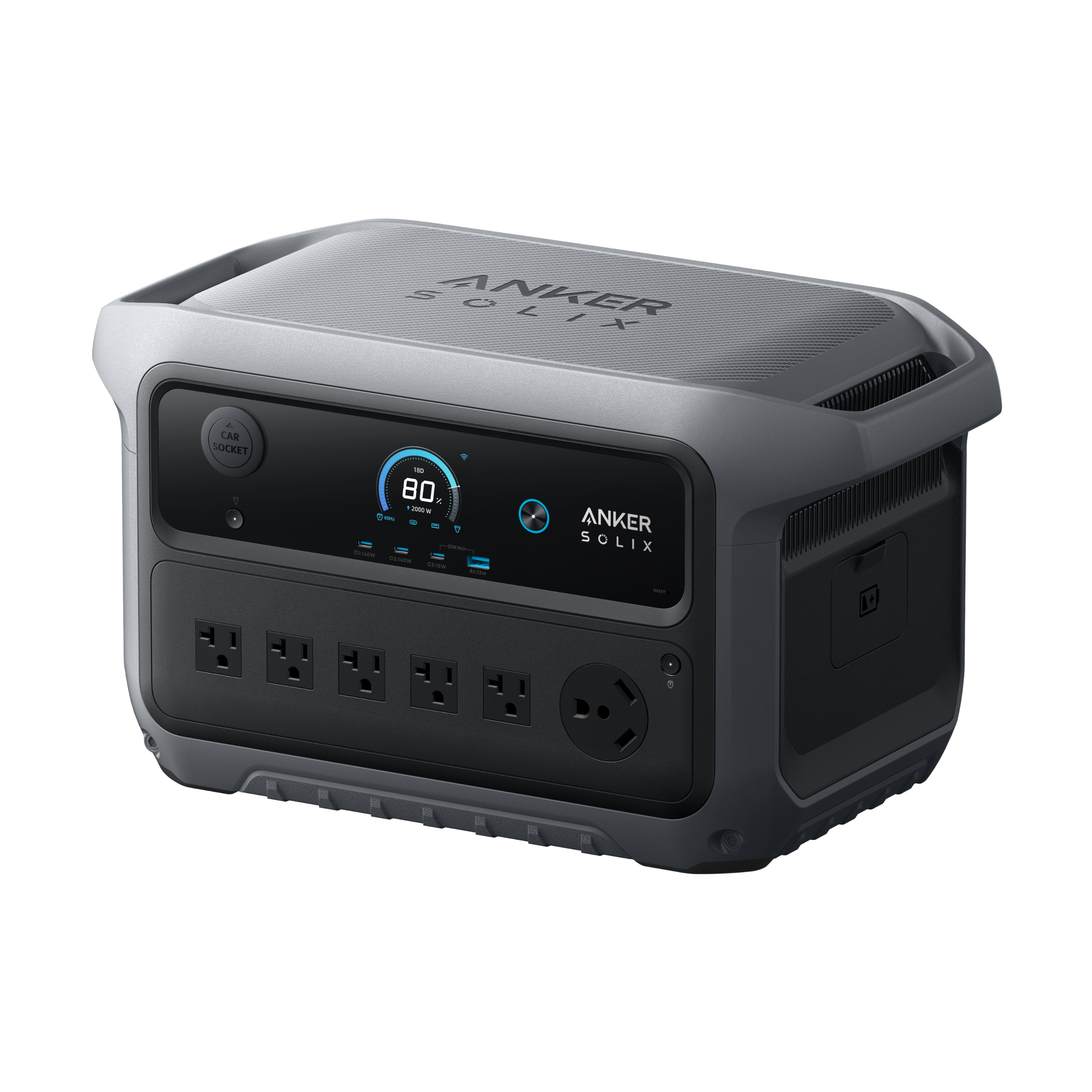
Explore this need in the finder →The Anker SOLIX C2000 Gen 2 is a 2,048 Wh, 120 V station pairing 2,400 W rated AC output, an RV-style TT-30 receptacle and an 800 W solar-input ceiling in a 41.7 lb body. The US standalone SKU is A17831A1; its user guide identifies product model A1783.
Anker also lists a separate refurbished offer, SKU A17831A1-F0, which was marked sold out in the catalogue snapshot checked for this assessment. This review covers the hardware, not refurbished condition, warranty or availability.
Understand the TT-30 before choosing it
Anker lists one TT-30R outlet alongside five standard 120 V AC receptacles. the manufacturer specifies 120 V at up to 20 A and 2,400 W for the TT-30 output, not a full 30 A/3,600 W source. It may suit an RV whose load fits, but the connector alone cannot establish whether an air conditioner, microwave, water heater or simultaneous loads fit. Check the RV’s input requirements and operating loads, including compressor starting demand. All AC outlets draw on the same 2,400 W inverter ceiling; five household sockets plus the TT-30 do not create separate 2,400 W supplies.
Its AC is 120 V only. Its 4,000 W peak is transient, not continuous, and does not make it suitable for 240 V or split-phase loads. If you need 240 V, compare a station specifically documented for that output, such as the larger EcoFlow DELTA Pro 3 family, and budget for the additional weight and installation planning.
Two kilowatt-hours, optionally four
The built-in LFP battery is rated at 2,048 Wh. That is stored nameplate capacity, not a promise that an AC appliance receives 2,048 Wh at its plug; inverter losses, temperature, reserve settings and the appliance’s cycling all affect usable runtime. Start with each essential device’s normal watts, likely startup demand and hours of use, then leave a reserve. The reviewed product information does not provide a general load-specific AC-energy figure.
One compatible BP2000 Expansion Battery (Gen 2), model A17831A1-85, can raise the system’s nameplate capacity to 4,096 Wh. The expansion battery is a separate 34 lb component, so the combined components total about 75.7 lb, even though they can be moved separately. It has to connect to the station with its battery cable and is not a stand-alone output source. Expansion increases stored energy, not the C2000’s 2,400 W AC limit, TT-30 current rating or solar input. Choose the add-on only if longer operation is more important than the extra cost, mass and storage space.
Recharge paths and controls
The station has one XT60i DC/solar input. The manual gives an 11–60 V input window and up to 800 W, with current limits that vary by voltage. Panel wiring must stay within those electrical limits; summing panel nameplate watts is not enough to establish a compatible array. The AC charging input is listed at up to 1,800 W. Its published 58-minute combined charge and three-hour solar-only time are test claims; sunlight, temperature, outlet and starting charge change results. A 400 W panel option is shown, but contents are package-specific; the page also offers two-, three- and five-station quantities without an exact combined system plan.
For vehicle charging, the manual identifies a separate-cable car-input route; Anker lists 100 W for that input. The product page also advertises an 800 W alternator-charging route, which depends on an external compatible charger and is not the base station’s car input. Confirm that charger and its cable separately before planning around it. App modes include Time-of-Use scheduling, Storm Guard and a fast-charging plan; their usefulness depends on settings and connectivity.
What it is like to own
At 18.1 × 9.8 × 10.1 in and 41.7 lb, this is compact for a 2 kWh class station, but it remains a substantial lift. A car trip, RV storage bay, workshop shelf or a planned backup spot makes more sense than frequent long carries. The output mix is unusually flexible: two USB-C ports are rated up to 140 W each, a third USB-C port is 15 W, the USB-A port is 12 W, and the 12 V car socket is rated at 10 A/120 W. The manual notes that the 15 W USB-C and 12 W USB-A outputs share a 20 W total. The headline port maximums should not be assumed to occur simultaneously.
Anker specifies a 10 ms UPS switchover and LFP cells rated for up to 4,000 cycles to 80% capacity. Treat these as manufacturer ratings, not independent tests. A transfer figure is not a guarantee that every computer, aquarium pump or medical device will ride through a cut; check the equipment maker’s requirements and test the exact load. For storage, Anker’s guide says to keep the unit cool and dry, check charge monthly, and recharge to full at least every three months during extended storage.
Who should shortlist it?
Shortlist the C2000 Gen 2 if you need a fairly light-for-class 2 kWh station, have 120 V loads below 2,400 W, value an RV-style outlet that can serve a lower-demand TT-30 setup, or want the option to double capacity with one exact battery. Its 800 W solar ceiling gives more input headroom than the 500 W EcoFlow DELTA 3 Max, which has the same 2,048 Wh and 2,400 W base ratings; compare their connector layouts and expansion evidence rather than assuming the shared capacity makes them interchangeable. The C2000 is a poor fit when full 30 A service, 240 V output, a higher continuous AC rating or a sub-40 lb carry limit is essential. Change the size class or power architecture rather than counting on peak wattage, adapters or an unverified bundle. No sample or independent test was used.
Key details at a glance
| Nameplate battery capacity | 2048 Wh |
|---|---|
| Rated AC output | 2400 W |
| Manufacturer surge rating | 4000 W |
| Maximum solar input | 800 W |
| Maximum USB-C output per port | 140 W |
| Listed weight | 41.7 lb |
| Compatible extra-battery expansion | Yes |
| 12 V DC output | 120 W |
| Maximum AC recharge input | 1800 W |
| Manufacturer UPS transfer figure | 10 ms |
| Base warranty term | 5 years |
| USB-C ports | 3 |
| USB-A ports | 1 |
| Solar input ports | 1 |
| 12 V car-style output | 120 W |
| Battery chemistry | LFP |
| TT-30 RV outlet | Yes |
Use the exact model’s instructions for operating limits, supplied equipment and version differences.
Sources for this assessment
- Anker SOLIX US C2000 Gen 2 Portable Power Station
- Anker SOLIX C2000 Gen 2 Portable Power Station User Guide (A1783), United States
- Anker SOLIX BP2000 Expansion Battery (Gen 2), US product page
- Anker SOLIX BP2000 Expansion Battery (Gen 2) User Guide (A17831A1-85)
- Anker SOLIX C2000 Gen 2 + Expansion Battery US package offer
- Anker SOLIX C2000 Gen 2 refurbished US offer
- Anker SOLIX C2000 Gen 2 + Expansion Battery + 400 W Solar Panel
- Anker SOLIX C2000 Gen 2 + Expansion Battery + 2 × 400 W Solar Panels
- Anker SOLIX 3 × C2000 Gen 2 US package
- Anker SOLIX 5 × C2000 Gen 2 US package
A useful match starts with the loads that matter.
Use the finder for hard electrical requirements, then check appliance starting behavior, actual run time and the exact package in the full assessment.