
Your needs, this model
Does it fit your priorities?
Can all essential devices run from direct USB or 12 V DC, without a household outlet?
The C300 DC has no inverter. Its documented plan provides USB-C/USB-A outputs and one 12 V car socket; a wall-plug-only appliance cannot run from it.
Explore this need in the finder →Do you need four USB-C ports but want to stay below seven pounds?
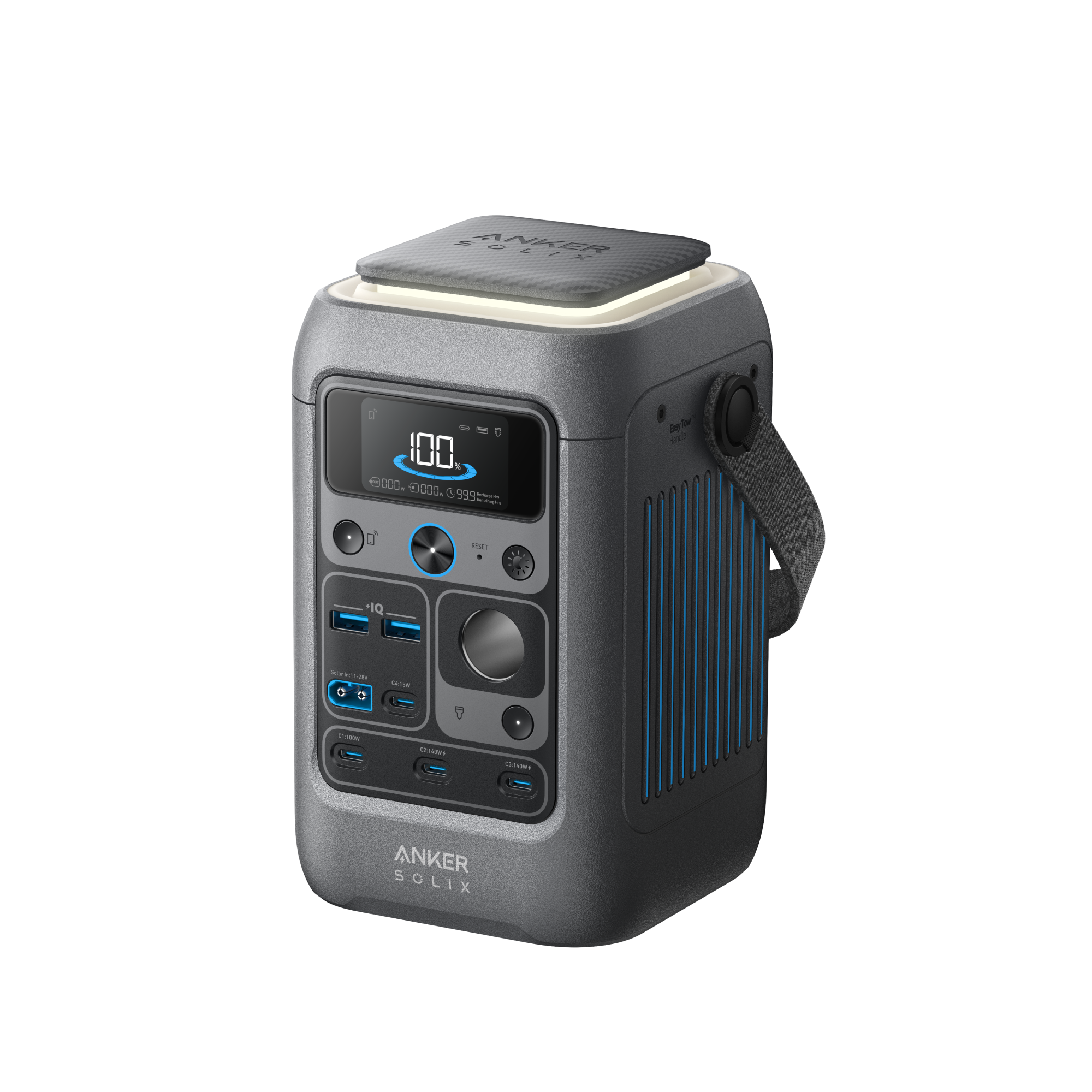
The A1726 guide lists four USB-C ports and a 6.17 lb station. The answer depends on port roles: only C2/C3 are bidirectional 140 W ports; C1 is 100 W output and C4 is 15 W output.
Explore this need in the finder →Must a compact DC-only station support at least 100 W solar and 300 W total DC output?
The C300 DC is rated for 100 W maximum solar input and 300 W total DC output. Solar voltage must remain in its 11–28 V input window and port maxima are not all simultaneous.
Explore this need in the finder →The Anker SOLIX C300 DC is the compact branch of Anker’s 288 Wh C300 family, but its defining feature is the missing inverter. Its exact US model is A1726, standalone SKU A17260Z1. It sends power directly to USB-C, USB-A and a 12 V car-style socket instead of providing household AC. The manufacturer lists 300 W total DC output, four USB-C ports, two USB-A ports, a 120 W car socket, a retractable light and a 100 W maximum solar input. At 6.17 lb, it is about three pounds lighter than the AC-equipped C300. That distinction makes it an excellent fit for the right collection of devices and a hard stop for AC-only equipment.
Start with the no-inverter limitation
The C300 DC has no 120 V receptacle. A wall plug adapter cannot create AC power from its USB or car outputs. Before considering weight, capacity or fast charging, check whether every essential load can take direct USB or 12 V DC power from its actual port. A laptop may work from USB-C if it accepts the available USB Power Delivery profile; a device with only a household AC plug will not. If an AC outlet is essential, the C300 is the related model to compare: it adds three 120 V receptacles, a 300 W rated inverter and a manufacturer-described 600 W SurgePad feature, but weighs 9.1 lb and does not share the DC model’s USB layout.
The C300 DC’s 288 Wh is nameplate battery capacity, not guaranteed energy at the device. USB conversion and cable losses, reserve settings, temperature and the connected equipment’s draw all influence runtime. It is more naturally a charging hub for laptops, phones, camera batteries, lights or modest 12 V equipment than a long-duration appliance supply. Write down the load’s input rating and expected hours. For a device that cycles or starts with a high current, verify its actual requirements rather than estimating from a single average-watt figure.
Four USB-C ports, but not four identical ones
The model has four USB-C connections: C2 and C3 each support up to 140 W both in and out; C1 is output-only and rated up to 100 W; C4 is a 15 W output. The two 140 W ports can accept up to 280 W of combined USB-C input when both are used with suitable chargers and cables. The manual’s USB power table also shows that simultaneous port combinations have their own limits. The two USB-A ports are each listed up to 12 W, but their combined output with the small USB-C4 port is capped at 20 W. The station’s overall output ceiling remains 300 W, so do not add every printed maximum and assume they can all be delivered together.
That layout can serve a multi-device desk, as long as the combined draw stays within 300 W and port-sharing limits. One car socket supplies 12 V at 10 A, or 120 W. It can serve a suitable 12 V accessory, but the plug, fuse and device current must match. If the main goal is one small 120 V appliance, a similar-capacity AC station is more versatile despite its added weight.
Solar and vehicle charging are separate inputs
Anker rates the XT60 solar input at 100 W maximum, 11–28 V and 8.2 A. The solar cable is sold separately. The C300 DC product page recommends Anker’s 60 W or 100 W panels and explicitly says the station is not compatible with the PS30 or USB-C panels such as PS200 and PS400. Panel voltage and connector compatibility matter more than an advertised wattage alone. The page’s charging claims should not be treated as a guaranteed result in shade, cold weather or a short winter day.
Two bidirectional USB-C ports provide the alternative 280 W input path. The manual says to use the appropriate 140 W adapters and cables for full speed. Anker also describes charging from a car but sells the car charging cable separately and does not establish a car-input wattage in the reviewed guide, so there is no exact vehicle recharge-rate estimate here. The product page’s box list names the station, a USB-C-to-C cable, safety material, warranty information and the user manual; it does not list the solar or vehicle cable.
Handling, light and ownership details
At 6.17 lb and about 4.89 × 4.72 × 7.87 in, the C300 DC is easier to pack and lift than its AC sibling. It has a pop-out retractable light and app connectivity. Its adjustable strap is sold separately; confirm the selected offer includes it if hands-free carrying matters. Anker lists LiFePO4 cells and more than 3,000 cycles to 80%; these are manufacturer claims, not independent cycle-life results. The manual says to keep the unit upright, store it in a cool, dry place, check its charge weekly, recharge if it falls below 30% during storage and bring it to 100% every three months. Do not leave it exposed to rain; no weatherproof rating was found in the reviewed exact model record.
Who should shortlist this DC-only model?
Shortlist the C300 DC if your devices all accept direct DC, you want four USB-C ports with two high-power bidirectional ports, or a sub-seven-pound carry weight matters more than having wall outlets. In the finder, a DC-only answer plus four USB-C ports and a 100 W solar-input floor fits its documented plan; a 101 W solar requirement or a 6 lb maximum carry limit rules it out. If you require even the 120 V output from a small station, select household AC and compare the C300, but remember its 300 W continuous ceiling. If you want a still-lighter DC plan with fewer USB-C ports, compare the EcoFlow TRAIL 300 DC’s two 140 W USB-C ports and 110 W solar rating. The official Anker US page showed this C300 DC listing as sold out in the checked snapshot; verify current exact-model availability. No sample or independent output test was used.
Key details at a glance
| Nameplate battery capacity | 288 Wh |
|---|---|
| Maximum solar input | 100 W |
| Maximum USB-C output per port | 140 W |
| Listed weight | 6.17 lb |
| Compatible extra-battery expansion | No |
| 12 V DC output | 120 W |
| Total rated DC output | 300 W |
| AC outlet output | No |
| USB-C ports | 4 |
| USB-A ports | 2 |
| Solar input ports | 1 |
| 12 V car-style output | 120 W |
| Battery chemistry | LFP |
Use the exact model’s instructions for operating limits, supplied equipment and version differences.
Sources for this assessment
A useful match starts with the loads that matter.
Use the finder for hard electrical requirements, then check appliance starting behavior, actual run time and the exact package in the full assessment.