
Your needs, this model
Does it fit your priorities?
Need 120 V AC output with at least 768 Wh and 1,200 W continuous
One A1755 host has a published 768 Wh nameplate capacity and 1,200 W rated 120 V AC output. The 1,600 W SurgePad figure is not the continuous limit.
Explore this need in the finder →Need a panel of at least 100 W included with the station
The exact B1755116 bundle title specifies one 100 W panel. The panel model and station-side cable inclusion remain unknown, so a requirement for a specific panel or fully confirmed connection kit is not met by that wattage statement alone.
Explore this need in the finder →Need the included 100 W panel and the station's full 300 W solar-input ceiling
The offer names a 100 W panel, while the A1755 guide lists a maximum 300 W station solar input. It is a 100 W bundle panel, not a 300 W panel, and no full-kit recharge rate is claimed.
Explore this need in the finder →The Anker SOLIX C800X + 100W Solar Panel pairs a 768 Wh, 120 V portable station with a small folding panel in the offer Anker lists as B1755116. The station's useful distinction is not a new inverter class: its rated AC output is 1,200 W. Instead, this is a mid-size camp-and-home kit that combines familiar household outlets with a built-in light, storage for compatible camping lights and a 100 W panel. The offer title and image identify the panel wattage, not its exact model or every cable in the carton.
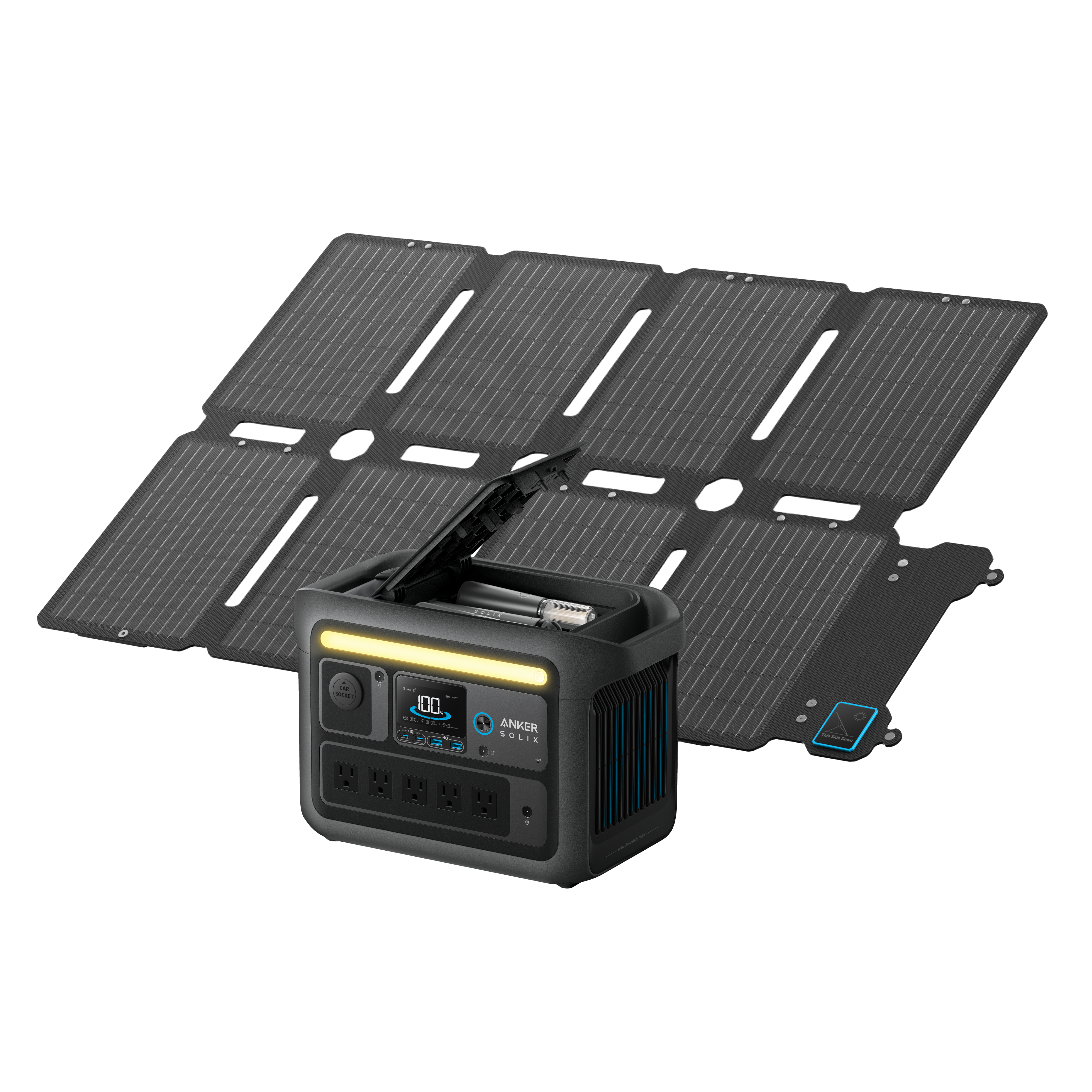
Enough for ordinary 120 V loads, not an open-ended backup source
The station stores 768 Wh of nameplate battery capacity and provides up to 1,200 W of rated 120 V AC output across its five household outlets. Those figures answer different questions: watt-hours describe the battery's rated storage, while watts cap the load the inverter can support. Nameplate capacity is not a promise of that much delivered AC energy; conversion losses, reserve settings, temperature and the connected load all matter. Add the actual loads you intend to run, and check their start-up requirements as well as the label wattage.
Anker advertises SurgePad operation up to 1,600 W, but the user guide separately lists 1,200 W as the maximum rated AC output. Do not treat the SurgePad figure as permission to run a 1,600 W appliance continuously. It is not a general guarantee that a compressor, pump or other motor will start. If your essential appliance requires more than 1,200 W continuously, or needs 240 V, this configuration does not satisfy that plan. The larger SOLIX C1000 Gen 2, for example, is listed at 2,000 W and 1,024 Wh, but it does not bring the C800X bundle's built-in light-storage feature or this named 100 W panel offer.
The included panel and the station's input are not the same rating
The exact B1755116 offer is named C800X plus a 100 W solar panel. The station can accept up to 300 W of solar input through its XT60 input, within an 11–60 V and 10 A limit. That 300 W figure is the station's ceiling, not the output of the supplied panel. The package's panel may be convenient for topping up at camp, but a 100 W nameplate does not predict daily energy or a particular recharge time; sunlight, orientation, shade and temperature change what a panel actually contributes.
The sources establish the bundle's panel wattage but do not establish the panel's exact model or confirm the station-side solar lead in the box. That matters if you need a complete plug-and-play kit or want to match the panel's voltage and connector against the station input. Treat the cable as unconfirmed rather than assuming it is missing or included. A requirement for a verified cable therefore should not be counted as met. For a solar plan that needs the station to accept more than 300 W, this C800X cannot meet that input threshold even if you bring a larger compatible array.
A campsite-oriented feature set, with practical limits
The A1755 guide describes an ambient light and SOS mode, plus a compartment that can store and charge two compatible AK-01 camping lights. The light and charging compartment can be useful at a tent or work area. The guide documents space and charging for two AK-01 lights, but the B1755116 box list does not establish that the lamps themselves are included.
For personal electronics, the station has two USB-C outputs rated at 100 W and 30 W, two USB-A ports, and a 12 V / 10 A car-style outlet. The 100 W USB-C port is useful for a compatible laptop, while the 30 W port serves lower-power devices; the guide says the USB-C ports are output-only. The manufacturer's 20 ms UPS figure may help describe its switching mode, but it is not an independently measured transfer time or a compatibility guarantee for a computer, medical device, network appliance or other sensitive load. Test the equipment using its own requirements and keep a separate backup plan for anything that cannot tolerate interruption.
The station body is listed at 24.03 lb and measures about 14.61 × 8.07 × 9.84 inches; total station-and-panel kit weight is unknown. Charging is specified from 0 to 40 °C and discharging from −20 to 40 °C, so outdoor branding is not permission to charge in any weather.
Who this exact bundle suits
Choose the C800X bundle when your plan centers on 120 V loads whose continuous demand fits within 1,200 W, the 768 Wh nameplate capacity suits your intended duration, and the included 100 W panel plus lighting/storage features are useful. It is less suitable if you need 240 V, a verified total kit weight, more than 300 W station-side solar input, or a fully confirmed panel-and-cable combination before purchase. For longer backup or a higher continuous load, compare a larger station on its own operating limits rather than treating a panel bundle as an upgrade to battery or inverter capacity.
In a finder, selecting 120 V, a 768 Wh capacity floor, 1,200 W AC output and an included panel of at least 100 W is a supported fit. Raising the continuous-output minimum above 1,200 W, the capacity floor above 768 Wh, the panel floor above 100 W, or asking for 240 V should remove it. A solar-panel requirement can be met at the documented 100 W level, but a required station-side cable remains unknown and must not be assumed.
Specifications and operating limits are from the Anker SOLIX C800X A1755 user guide and the exact U.S. B1755116 product offer. The listed offer was marked sold out in the captured store snapshot; availability can change.
Key details at a glance
| Nameplate battery capacity | 768 Wh |
|---|---|
| Rated AC output | 1200 W |
| Maximum solar input | 300 W |
| Included panels, combined nameplate | 100 W |
| Maximum USB-C output per port | 100 W |
| Listed weight | 24.03 lb |
| 12 V DC output | 120 W |
| Maximum AC recharge input | 1100 W |
| Manufacturer UPS transfer figure | 20 ms |
| AC outlet output | Yes |
| USB-C ports | 2 |
| USB-A ports | 2 |
| Solar input ports | 1 |
| 12 V car-style output | 120 W |
| Battery chemistry | LiFePO4 |
| Home Power Panel in this package | No |
Use the exact model’s instructions for operating limits, supplied equipment and version differences.
Sources for this assessment
A useful match starts with the loads that matter.
Use the finder for hard electrical requirements, then check appliance starting behavior, actual run time and the exact package in the full assessment.