
Your needs, this model
Does it fit your priorities?
Is a documented 4,608 Wh nameplate F2600 expansion setup enough if the station still supplies only 120 V at 2,400 W continuous?
The exact B178111K page lists one F2600 + BP2000 package at 4,608 Wh / 2,400 W. The battery increases stored capacity, not the inverter ceiling.
Explore this need in the finder →Does your essential connection require a 120 V TT-30R or 240 V output?
The F2600 station in the bundle lists one TT-30R and 120 V output. The connector does not increase the 2,400 W station-wide AC rating; a 240 V load is incompatible.
Explore this need in the finder →Can your placement handle the two components’ combined listed weight?
The F2600 is 69.7 lb and the A1780111-85 manual lists the 2,048 Wh expansion unit at 45.6 lb: 115.3 lb by component-weight sum, separated into two lifts.
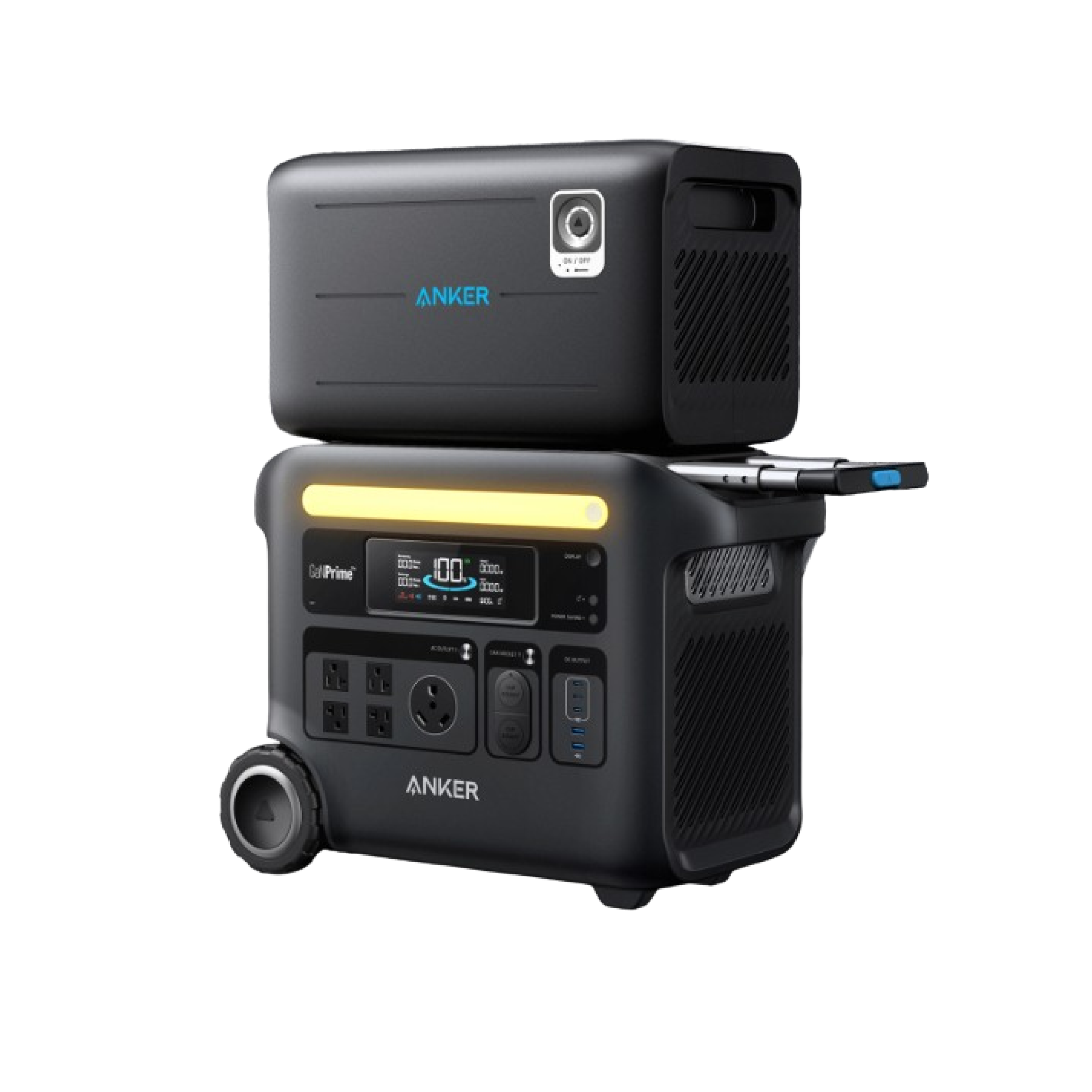
Explore this need in the finder →The U.S. listing for the Anker SOLIX F2600 + BP2000 package identifies a 4,608 Wh, 2,400 W configuration and a No Panel offer under package SKU B178111K. It combines an F2600 station with an expansion battery. That extra battery increases the stated stored energy, but it does not add another inverter or raise the station’s 120 V AC ceiling.
4,608 Wh is stored energy, not an AC runtime promise
Anker’s exact bundle-page title states 4,608 Wh and 2,400 W; the selected U.S. option is “No Panel.” The captured offer was sold out, so recheck exact-SKU availability. Its 2,560 Wh F2600 is paired with a 2,048 Wh LFP expansion battery, producing the stated nameplate sum. That is stored energy, not a promise of AC-delivered energy after inverter losses, idle draw, temperature, and load behavior. No runtime test or package-specific delivered-energy figure is published.
The station is rated for 2,400 W continuous AC output and 2,800 W surge. The expansion unit adds stored capacity, not an inverter. This is still a 120 V plan, not 240 V or split phase. A TT-30R outlet is listed, but its connector shape is not a promise of 30 A continuous supply: the station’s 2,400 W total remains the limit across the AC outputs. If an RV, pump, refrigerator, or tool has a large starting surge, compare its documented startup demand and simultaneous load with the station’s rating rather than assuming that a larger battery solves an output shortfall.
There is also an outlet-detail uncertainty worth treating plainly. The F2600 page’s visible specification and its structured outlet field disagree about the subtype of four household receptacles, while the A1781 manual uses generic NEMA-20R wording. The four household outlets and TT-30R are documented, but confirm the actual blade pattern with Anker if a specific plug is essential.
Confirm the exact expansion-battery route
The product-page title identifies the offer as F2600 plus BP2000. Yet Anker’s separate BP2000 page names the F2000 and F2600 as hosts in its heading, then says “Only Anker SOLIX F2000 compatible” in its FAQ and refers to the “760 Expansion Battery” in feature copy. The Anker-hosted manual for component number A1780111-85 is titled “Anker 760 Portable Power Station Expansion Battery (2048Wh).” It confirms the battery cannot be used alone and includes a host cable, but does not list the F2600 as a host. The B178111K package listing is clear; compatibility of separately purchased units is not. If assembling your own system, have Anker confirm the exact station and battery numbers before buying.
The manual describes connecting the battery with its host cable, checking for the battery icon on the host display, and switching the module off before disconnecting. It says the expansion battery supplies loads first, then the station takes over. Follow the current instructions for your exact units.
Plan around two heavy pieces and a panel sold separately
The F2600 station is listed at 69.7 lb. The A1780111-85 manual lists the 2,048 Wh expansion component at 45.6 lb, so the published component weights sum to 115.3 lb. That sum is not a measured carton weight and the two modules are separate lifts, not a single 115 lb box. The F2600 has wheels and a handle, but that does not make the expansion module light; plan for stairs, storage, cable reach, ventilation, and a stable place for each component. For frequent carrying or a long walk from a car, a smaller one-piece station may be more practical even if it has less reserve.
“No Panel” means no solar panel. The F2600 manual specifies one station-side solar input up to 1,000 W, within an 11–60 V range and voltage-dependent current limits. That is a ceiling, not a guaranteed solar harvest. Anker does not publish a complete bundle carton list, so verify in-box charging leads. AC and vehicle input are other recharge routes; do not assume every input can be combined at its maximum.
Where the choices change the recommendation
Choose this package when the standalone F2600’s 2,560 Wh is insufficient, your loads stay within 2,400 W at 120 V, and there is room for a second heavy module. A 4,608 Wh minimum fits; 4,609 Wh does not. Neither a 2,401 W continuous requirement nor 240 V is met. A combined component-weight cap below 115.3 lb also rules it out.
Compare the F2600 + BP2600 if you need its 5,120 Wh nameplate plan; it keeps the same 2,400 W inverter ceiling and also requires a second heavy module. The standalone F2600 avoids that module but stores less. For 240 V, a home transfer arrangement, or more continuous AC power, evaluate a system whose exact U.S. setup documents it—never treat a portable outlet as a household-wiring connection. Search the exact terms “Anker SOLIX F2600 BP2000 B178111K” and verify bundle contents, availability, and compatibility before purchase. No live price or stock claim is made.
Key details at a glance
| Nameplate battery capacity | 4608 Wh |
|---|---|
| Rated AC output | 2400 W |
| Manufacturer surge rating | 2800 W |
| Maximum solar input | 1000 W |
| Maximum USB-C output per port | 100 W |
| Listed weight | 69.7 lb |
| Compatible extra-battery expansion | Yes |
| 12 V DC output | 120 W |
| Maximum AC recharge input | 1440 W |
| AC outlet output | Yes |
| USB-C ports | 3 |
| USB-A ports | 2 |
| Solar input ports | 1 |
| 12 V car-style output | 120 W |
| Battery chemistry | LiFePO4 |
Use the exact model’s instructions for operating limits, supplied equipment and version differences.
Sources for this assessment
- Anker SOLIX F2600 + BP2000 Expansion Battery - 4608Wh | 2400W (Anker SOLIX U.S.)
- Anker SOLIX BP2000 Expansion Battery product page (Anker SOLIX U.S.)
- Anker SOLIX F2600 Portable Power Station - 2560Wh | 2400W (Anker SOLIX U.S.)
- Anker SOLIX F2600 User Manual, Product Number A1781, 51005003812 V03
- Anker 760 Portable Power Station Expansion Battery (2048Wh), Product Number A1780111-85, 51005003646 V01
- First image on exact Anker SOLIX B178111K package page

A useful match starts with the loads that matter.
Use the finder for hard electrical requirements, then check appliance starting behavior, actual run time and the exact package in the full assessment.