
Your needs, this model
Does it fit your priorities?
Need both the BP3800 expansion battery and Smart Home Power Kit
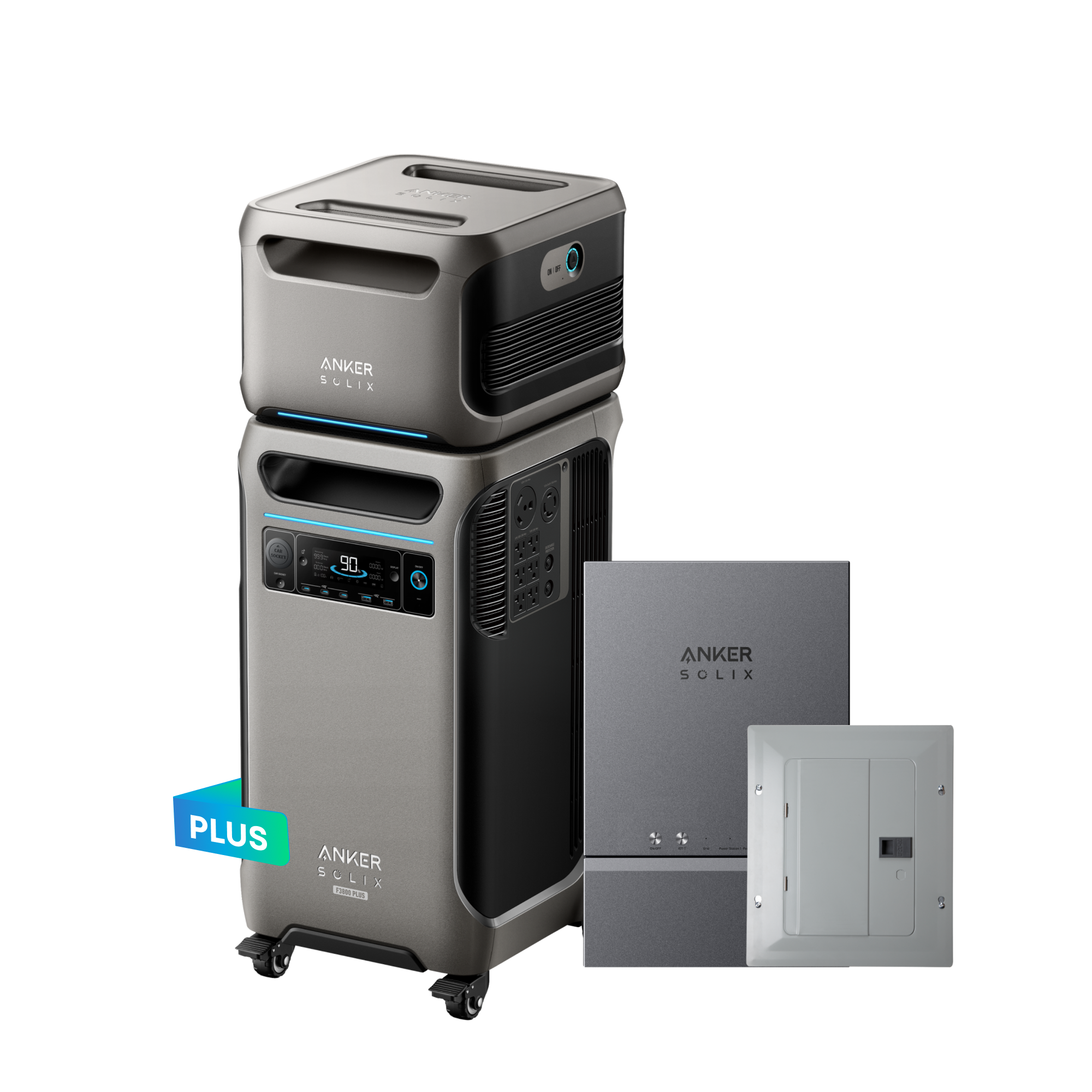
The exact B1790112Q offer includes the 3,840 Wh host, 3,840 Wh BP3800 and Home Power Panel kit. It combines 7,680 Wh nameplate storage with an installed 120/240 V service route.
Explore this need in the finder →The included panel in the expansion bundle serves 120/240 V split phase
B1790112Q includes the A17B1 panel kit and supports the manufacturer-documented 120/240 V topology; it is not a 120/208 V package.
Explore this need in the finder →The exact single-BP3800 package clears a 7,680 Wh floor
B1790112Q combines the 3,840 Wh F3800 Plus with one 3,840 Wh BP3800. This exact one-battery package does not meet 7,681 Wh.
Explore this need in the finder →The Anker SOLIX F3800 Plus + Expansion Battery + Smart Home Power Kit is the most integrated of the four F3800 Plus offers assessed here: one F3800 Plus, one BP3800 module and Anker's Home Power Panel kit. The exact U.S. bundle page names the configuration as SKU B1790112Q. The station and battery make a 7,680 Wh nameplate pair; the panel adds a household connection and energy-management route, not another battery or inverter.
More stored energy, still one station's output
Anker lists the F3800 Plus at 3,840 Wh and the BP3800 at 3,840 Wh. Its bundle page shows the paired system at 7,680 Wh. The expansion battery is an accessory module that cannot be used by itself; it connects to the compatible station. It raises the available nameplate storage but does not increase the F3800 Plus's 6,000 W total AC output. Likewise, the Home Power Panel's own 12,000 W maximum output specification describes the panel's system capability; this exact offer contains only one station, so it does not create a 12 kW inverter source.
For endurance planning, begin with a measured or manufacturer-listed load and reserve margin. A fridge that cycles, a well pump with startup demand and a router plus lights all use different amounts over time. A 7,680 Wh nameplate battery does not equal 7,680 Wh of AC service at the wall. Conversion loss, load level, inverter overhead, temperature and battery reserve change the result. This guide gives no field runtime figure. Anyone requiring a guaranteed overnight or multi-day duration should verify actual appliance consumption and design a charging plan rather than matching only on the largest energy number.
The panel changes system purpose and installation needs
The Home Power Panel connects the station to household utility and rooftop-solar operation; Anker's app supports modes for self-consumption and time-of-use scheduling. Those capabilities matter for a house with the right service, compatible solar equipment and a reason to cycle storage as part of daily energy use. They do not make savings automatic, nor are they a substitute for sizing the backed-up loads. The HPP is a permanently installed product that includes a subpanel, circuit breaker and ground bar in the manufacturer's kit description. It is not a piece of camping gear that is included only to add another outlet.
Anker's support documents say installation requires an electrician or a professional with an electrician certificate. The Home Power Panel supports 120/240 V split-phase service but not 120/208 V. Its user guide describes a careful breaker-off setup, designated connection cables, app initialization, firmware attention and a system test. A qualified installer must determine whether the home's service, panel, load center and solar setup are appropriate, and handle permits and local code. This is a high-stakes electrical boundary; do not install the panel or connect a house through an improvised cord.
Port, input and handling constraints
F3800 Plus output should be treated by connector. The standard 120 V receptacles are rated up to 2,400 W, TT-30R up to 3,000 W, and L14-30R is the 120/240 V route listed up to 6,000 W. That does not mean every outlet can simultaneously supply its maximum. The two solar inputs accept up to 1,600 W each within 11–165 V and 17 A, 3,200 W combined. The unit lists 1,800 W maximum 120 V AC charge input. Its dedicated HPP/generator port supports the higher charging route, but the optional 240 V bypass uses Anker's generator adapter and works only with a single F3800 Plus. Anker also says 240 V output is unavailable while charging from 120 V AC. The BP3800 adds no way around those restrictions.
Handling is a major downside. Anker's U.S. product page lists the station at 136.7 lb, while its technical brief lists 135.6 lb. The BP3800 product page lists 72.8 lb, while its guide rounds to 72 lb. Those source conflicts prevent a reliable combined-mass figure; the full kit weight is not published. The modules may be moved separately, but this is not a convenient portable kit. The modules may be moved separately, but that does not make this an easy portable kit. A fixed home installation is the natural use; for a lighter outage box, compare the standalone F3800 Plus or a more compact 120 V unit.
When this bundle earns the complexity
Choose the B1790112Q package when both a larger one-station battery reserve and professionally installed grid/rooftop-solar integration matter. The expansion-only B17901121 bundle provides the same 7,680 Wh storage and 6 kW station ceiling without the Home Power Panel. The B1790112P package adds the panel but keeps the one-station 3,840 Wh storage. The manual transfer-switch offer is a different path for an electrician-selected circuit group, with manual operation rather than the HPP's grid/energy-management role.
The finder can distinguish “expansion battery included” from “Home Power Panel included”; selecting both should retain this exact combination. A request above 7,680 Wh, above 6,000 W from this one station, or for 120/208 V HPP service should reject it. If your need is less than the standalone station's storage, buying a battery-plus-panel package may add cost, mass and installation effort without solving another requirement. Make the choice on the load plan and service compatibility, not because one offer has more components in its title.
Exact bundle SKU B1790112Q, station A1790P, BP3800 specifications and the Home Power Panel A17B1 documentation were individually checked. The bundle page did not publish a GTIN or total whole-package weight.
Key details at a glance
| Nameplate battery capacity | 7680 Wh |
|---|---|
| Rated AC output | 6000 W |
| Maximum solar input | 3200 W |
| Maximum USB-C output per port | 100 W |
| Compatible extra-battery expansion | Yes |
| 12 V DC output | 120 W |
| Maximum AC recharge input | 1800 W |
| Base warranty term | 5 years |
| AC outlet output | Yes |
| Solar input ports | 2 |
| 12 V car-style output | 120 W |
| Battery chemistry | LiFePO4 |
| Expansion battery in this package | Yes |
| Home Power Panel in this package | Yes |
| HPP 120/240 V split-phase | Yes |
| HPP 120/208 V compatible | No |
Use the exact model’s instructions for operating limits, supplied equipment and version differences.
Sources for this assessment
- Anker SOLIX F3800 Plus U.S. product page, A1790P
- Anker SOLIX F3800 Plus Technical Brief V1.1
- Anker SOLIX BP3800 expansion battery U.S. product page
- Anker SOLIX BP3800 Expansion Battery User Guide
- Anker SOLIX F3800 Plus + BP3800 + Smart Home Power Kit U.S. product page
- Anker SOLIX Smart Home Power Kit component page
- Anker SOLIX Home Power Panel User Guide
A useful match starts with the loads that matter.
Use the finder for hard electrical requirements, then check appliance starting behavior, actual run time and the exact package in the full assessment.