
Your needs, this model
Does it fit your priorities?
Need 7,680 Wh with an included expansion battery and 6,000 W 240 V capability
The exact B17901121 package includes the 3,840 Wh F3800 Plus and 3,840 Wh BP3800, for 7,680 Wh nameplate. One host remains rated up to 6,000 W; the extra battery does not add inverter output.
Explore this need in the finder →Need a dual-window solar input at the full 3,200 W published ceiling
The F3800 Plus technical brief specifies two independent solar inputs, each up to 1,600 W, with 3,200 W total. This is an input ceiling, not a harvest or recharge-time promise.
Explore this need in the finder →One included BP3800 meets a 7,680 Wh nameplate requirement
The exact B17901121 package includes a 3,840 Wh F3800 Plus and one 3,840 Wh BP3800; a 7,681 Wh threshold is one Wh beyond this reviewed bundle.
Explore this need in the finder →The Anker SOLIX F3800 Plus + Expansion Battery is best understood as a two-module storage package, not a higher-output inverter. Anker identifies the U.S. offer as SKU B17901121 and names the add-on separately as the BP3800 expansion battery. The station remains the F3800 Plus; the battery adds stored energy, not a second AC inverter.
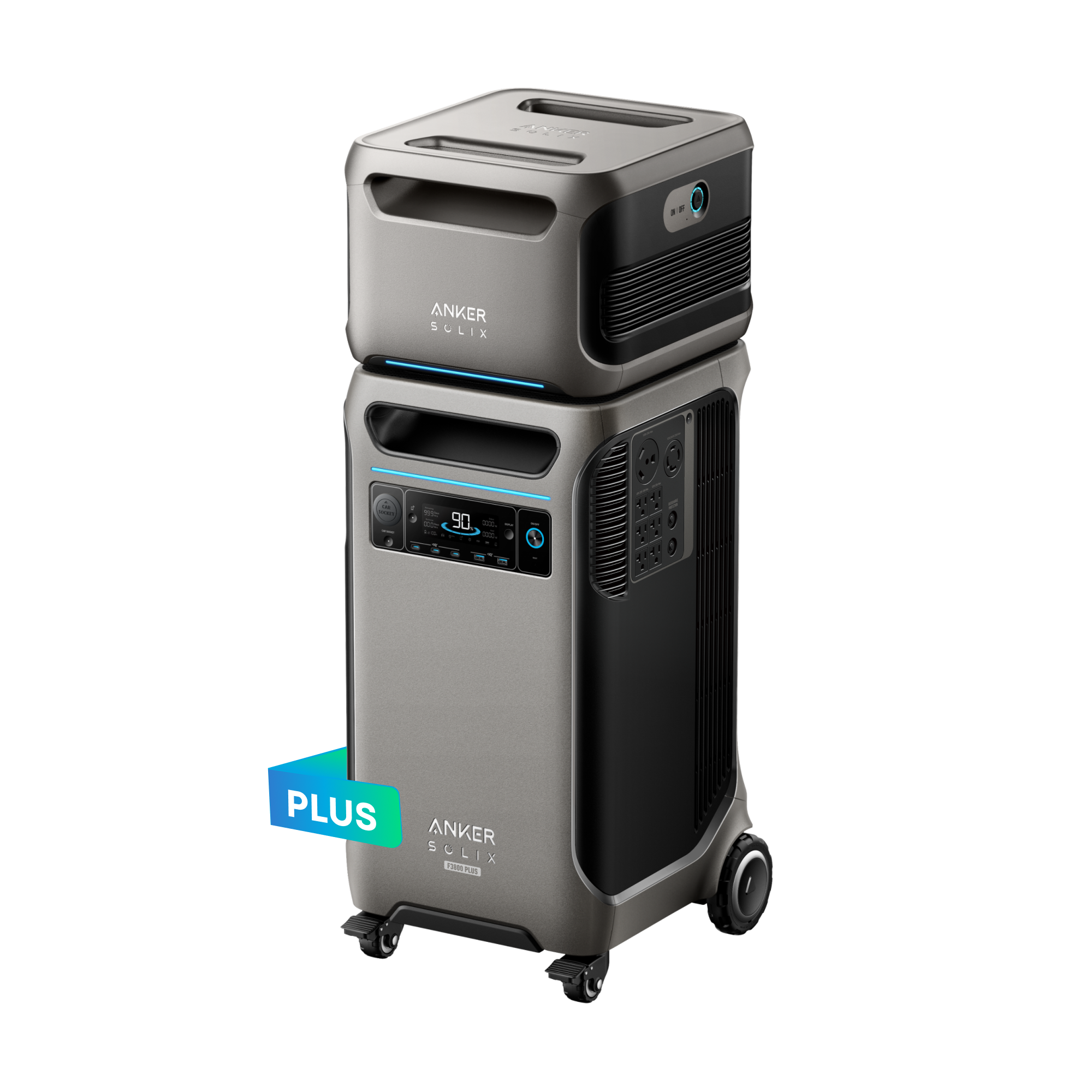
What the extra module changes
The base station is rated at 3,840 Wh. Anker's BP3800 page and guide identify a 3,840 Wh LFP module compatible with the F3800 and F3800 Plus; the bundle page labels the pair at 7,680 Wh. That is a clean nameplate sum, not a promise of 7,680 Wh delivered to AC appliances. Conversion losses, inverter overhead, load shape, temperature and the reserve level all affect usable runtime. No independent runtime test is claimed here.
The F3800 Plus remains the limiting conversion stage. It is rated for 6,000 W total AC output, with standard 120 V receptacles capped at 2,400 W and its TT-30R route at 3,000 W; the L14-30R outlet is the dual-voltage 120/240 V route, rated up to 6,000 W. The extra battery does not double those output figures. Anker's own specs list two solar inputs, each up to 1,600 W with an 11–165 V range and 17 A maximum, for a combined 3,200 W ceiling. Panel voltage and current still have to fit the input limits: a panel's headline wattage alone does not establish compatibility or actual charging speed.
Useful for longer loads, but not light to handle
This combination fits a household outage plan with loads that need more endurance than one 3.84 kWh station can offer, while staying within one 6 kW inverter. It can also suit a fixed RV or workshop arrangement that uses a documented 120/240 V connection. The decision should start with a load list: continuous watts, any starting surge, which outlets are needed, and how long the loads must run. The 120 V standard receptacles, TT-30R and L14-30R are not interchangeable ways to claim one unrestricted 6 kW output. Check a device's actual plug and voltage requirement, and do not aggregate separate outlet ratings as though each can deliver its maximum simultaneously.
Portability is a two-person planning question. The F3800 Plus product page lists 136.7 lb, while Anker's technical brief lists 135.6 lb; the BP3800 page lists 72.8 lb while its guide rounds to 72 lb. Those conflicts prevent a reliable combined-mass figure. The units remain separate modules, not one combined lift, but this is still a large home-backup system rather than a convenient one-person campsite unit. The station’s wheels and handles do not make stairs, thresholds or vehicle loading effortless. Measure the storage route and decide where each module can sit with adequate clearance before buying.
Charging and system limits
The F3800 Plus supports AC charging up to 1,800 W and 3,200 W maximum solar input. It also has a dedicated generator/Home Power Panel port, but the optional 240 V bypass route requires Anker's generator adapter and is limited to a single F3800 Plus unit. Importantly, Anker says 240 V output cannot be used while charging through 120 V AC. The added battery increases reserve; it does not remove these input/output mode limits. Match any generator, transfer gear, panel wiring and charging plan to the exact manual and product revision.
The BP3800 manual says the expansion battery cannot be used on its own: it must connect to the compatible power station for charging and discharging. It also instructs the user to turn the station off before making or breaking the battery connection. With the extra module installed, treat the two connected units as one supported system and follow the manual sequence rather than hot-plugging the cable. The battery's exact mass is not settled across Anker sources; its separate enclosure still makes storage and handling part of the setup plan.
How questionnaire choices change the fit
Choose a minimum capacity through 7,680 Wh to recognize this exact bundle, but remember the finder uses nameplate capacity, not expected AC runtime. A request above that figure should reject this exact one-battery package, even though the F3800 Plus family supports further expansion in separately documented setups. A 120 V or 240 V requirement can match the appropriate port plan; a hard output floor over 6,000 W cannot. Selecting “battery included now” separates this B17901121 offer from a standalone F3800 Plus or a model that merely supports future expansion. A maximum carry-weight requirement must account for the station and battery separately and should not be treated as proof of easy lifting.
Compare the F3800 Plus + Smart Home Power Kit if your priority is installed grid/rooftop-solar coordination rather than an extra battery, and compare the transfer-switch package only if an electrician has confirmed a manual circuit-transfer installation. The standard F3800 Plus is the simpler choice when its 3,840 Wh storage is sufficient. This bundle's real advantage is more nameplate energy attached to the same powerful inverter; its cost in practice is mass, floor space and a larger charging plan.
Identity and limits are based on Anker SOLIX U.S. SKU B17901121, the F3800 Plus A1790P product specification and the BP3800 A1790111-85 guide. No measured runtime or field test is claimed.
Key details at a glance
| Nameplate battery capacity | 7680 Wh |
|---|---|
| Rated AC output | 6000 W |
| Maximum solar input | 3200 W |
| Maximum USB-C output per port | 100 W |
| Compatible extra-battery expansion | Yes |
| 12 V DC output | 120 W |
| Maximum AC recharge input | 1800 W |
| Base warranty term | 5 years |
| AC outlet output | Yes |
| Solar input ports | 2 |
| 12 V car-style output | 120 W |
| Battery chemistry | LiFePO4 |
| Expansion battery in this package | Yes |
| Home Power Panel in this package | No |
| HPP 120/240 V split-phase | No |
Use the exact model’s instructions for operating limits, supplied equipment and version differences.
Sources for this assessment
A useful match starts with the loads that matter.
Use the finder for hard electrical requirements, then check appliance starting behavior, actual run time and the exact package in the full assessment.