
Your needs, this model
Does it fit your priorities?
Need Smart Home Panel service compatible with 120/240 V split phase
The exact bundle contains the Smart Home Power Kit, which Anker documents for 120/240 V split-phase—not 120/208 V service. An electrician must confirm site compatibility and commissioning.
Explore this need in the finder →Home Power Panel service matches a 120/240 V split-phase site
The official panel FAQ identifies 120/240 V split phase as the supported service; it does not document compatibility with 120/208 V.
Explore this need in the finder →Need the home panel but no included expansion battery
This exact B1790112P bundle includes the Smart Home Power Kit and the 3,840 Wh host, not the BP3800. It meets a 3,840 Wh floor but not an expansion-included need.
Explore this need in the finder →The Anker SOLIX F3800 Plus + Smart Home Power Kit combines one 3,840 Wh F3800 Plus with Anker's Home Power Panel package. This is the grid-and-rooftop-solar integration route, not merely an extra battery. The exact U.S. bundle is SKU B1790112P. Anker's separate kit listing names the Home Power Panel, subpanel, circuit breaker and ground bar; the system is intended for fixed household wiring and professional installation.
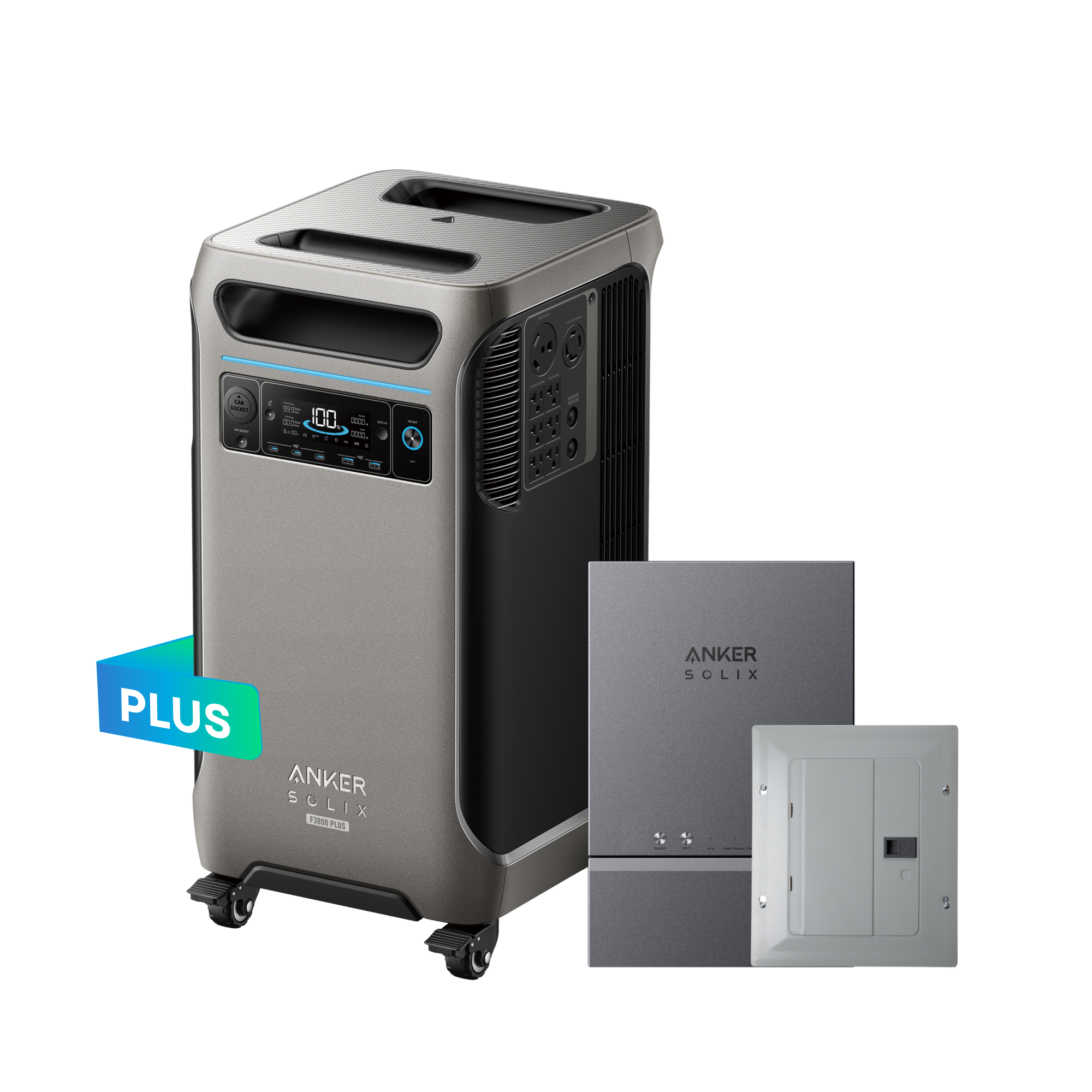
What the Home Power Panel adds
Anker describes the panel as connecting the F3800 Plus with utility power and rooftop solar. In addition to backup, the app supports household energy plans such as self-consumption and peak/valley schedules. That can be useful where a household already has a suitable solar system, wants an integrated reserve and has a reason to coordinate grid charging and battery use. It is not a guarantee of a specific bill reduction: results depend on the home's tariff, solar output, loads, settings and installation. Ignore promotional savings claims unless the underlying local assumptions match your own situation.
The panel package changes the way the station connects to a home; it does not add battery energy. Anker lists 3,840 Wh for the F3800 Plus in this one-station package. The station remains limited to its own 6,000 W maximum AC output, while the Home Power Panel's separate hardware specification lists 6,000 W maximum input and up to 12,000 W maximum output for the panel system. Do not transfer that 12 kW panel figure to a single station: the product bundle itself identifies only one F3800 Plus, and its own output is the limiting source. The F3800 Plus may also be paired with compatible expansion batteries in other configurations, but none is named in B1790112P.
Installation and service compatibility
This is not a self-installation project. Anker's U.S. support documentation states that installation of the F3800 and Home Power Panel requires an electrician or a professional with an electrician certificate. The panel's user guide describes shutting off breakers, connecting the station with the designated cable, commissioning through the Anker app, updating firmware and completing a system test. Those directions presume a correctly installed system; they are not permission to wire a load center without professional help.
Check the home's service before treating the kit as an option. Anker's Home Power Panel specification says it supports 120/240 V split-phase service and does not support 120/208 V. An apartment, commercial service or unusual utility configuration may therefore be a poor fit even if the station itself has a dual-voltage outlet. The electrician should confirm service type, panel fit, backed-up loads, local permits, system commissioning and the installation quote. The kit's page identifies a subpanel and breaker components, but this assessment does not assume that every home's branch circuits or rooftop PV inverter is automatically compatible.
Limits of the portable station remain visible
The F3800 Plus has two solar MPPT inputs rated for up to 1,600 W each, 11–165 V and 17 A, for 3,200 W total. Its 120 V AC charging maximum is 1,800 W; the dedicated HPP/generator port is listed for up to 6,000 W at 120/240 V. Anker says 240 V output cannot be used while charging via 120 V AC. The 120 V household receptacles and TT-30R have their own lower ceilings, so a load should be matched to the connector and its circuit rather than the 6 kW headline alone. If the household needs a specific 240 V appliance during an outage, the electrician must validate the exact system route and load.
Anker's F3800 Plus page lists 136.7 lb, but the technical brief lists 135.6 lb, so this assessment does not use an exact weight limit. Even either figure describes a very heavy station before the fixed home panel; this is not an easy-to-carry solar generator. The F3800 Plus has wheels, but the home panel is installed equipment, not part of a mobile kit. This profile is best evaluated as an installed backup/energy-management system that happens to use a moveable battery station. For a campsite or a simple plug-in outage plan, the standalone F3800 Plus or a smaller station is a more direct comparison.
How this differs from the other packages
Select this option if you need grid and rooftop-solar coordination, app-based household energy scheduling and a professionally integrated backup connection. Select the ten-circuit manual transfer-switch bundle if you want a simpler manual source switch for a limited, electrician-selected set of loads and do not need home-energy scheduling. Select the F3800 Plus + BP3800 package if runtime reserve, not panel integration, is the priority. The smart-home kit includes no expansion battery in this exact SKU, and its 3,840 Wh floor should not satisfy a higher-capacity requirement.
In the questionnaire, choose “Home Power Panel included” only for a package with the installed panel kit; a station's HPP-compatible port is not the same as the component being in the box. A 120/208 V service or a capacity minimum above 3,840 Wh rejects this one-station bundle. Compare the site-specific installation with the manual-transfer option before choosing based on the word “whole-home.”
Bundle identity B1790112P and station limits are from Anker SOLIX U.S.; the Home Power Panel A17B1 guide and Anker installation documentation support the commissioning and professional-installation boundaries.
Key details at a glance
| Nameplate battery capacity | 3840 Wh |
|---|---|
| Rated AC output | 6000 W |
| Maximum solar input | 3200 W |
| Maximum USB-C output per port | 100 W |
| Compatible extra-battery expansion | Yes |
| 12 V DC output | 120 W |
| Maximum AC recharge input | 1800 W |
| Base warranty term | 5 years |
| AC outlet output | Yes |
| Solar input ports | 2 |
| 12 V car-style output | 120 W |
| Battery chemistry | LiFePO4 |
| Expansion battery in this package | No |
| Home Power Panel in this package | Yes |
| HPP 120/240 V split-phase | Yes |
| HPP 120/208 V compatible | No |
Use the exact model’s instructions for operating limits, supplied equipment and version differences.
Sources for this assessment
A useful match starts with the loads that matter.
Use the finder for hard electrical requirements, then check appliance starting behavior, actual run time and the exact package in the full assessment.