
Your needs, this model
Does it fit your priorities?
Need a 10-circuit manual transfer switch with a 240 V capable host
The exact bundle includes the 10-circuit manual switch; F3800 Plus supplies 120/240 V output up to 6,000 W. The switch requires a qualified electrician, and its own rating is not the station's inverter rating.
Explore this need in the finder →The included manual transfer switch has at least ten circuits
The exact B1790113F package is associated with the 10-circuit A17B3 switch, confirmed by its component page and technical brief; an 11-circuit requirement would exceed it.
Explore this need in the finder →An essential 6,000 W continuous plan fits the F3800 Plus inverter ceiling
One F3800 Plus is rated at up to 6,000 W. The switch's 50 A rating does not increase the station's inverter capability; a 6,001 W request does not fit.
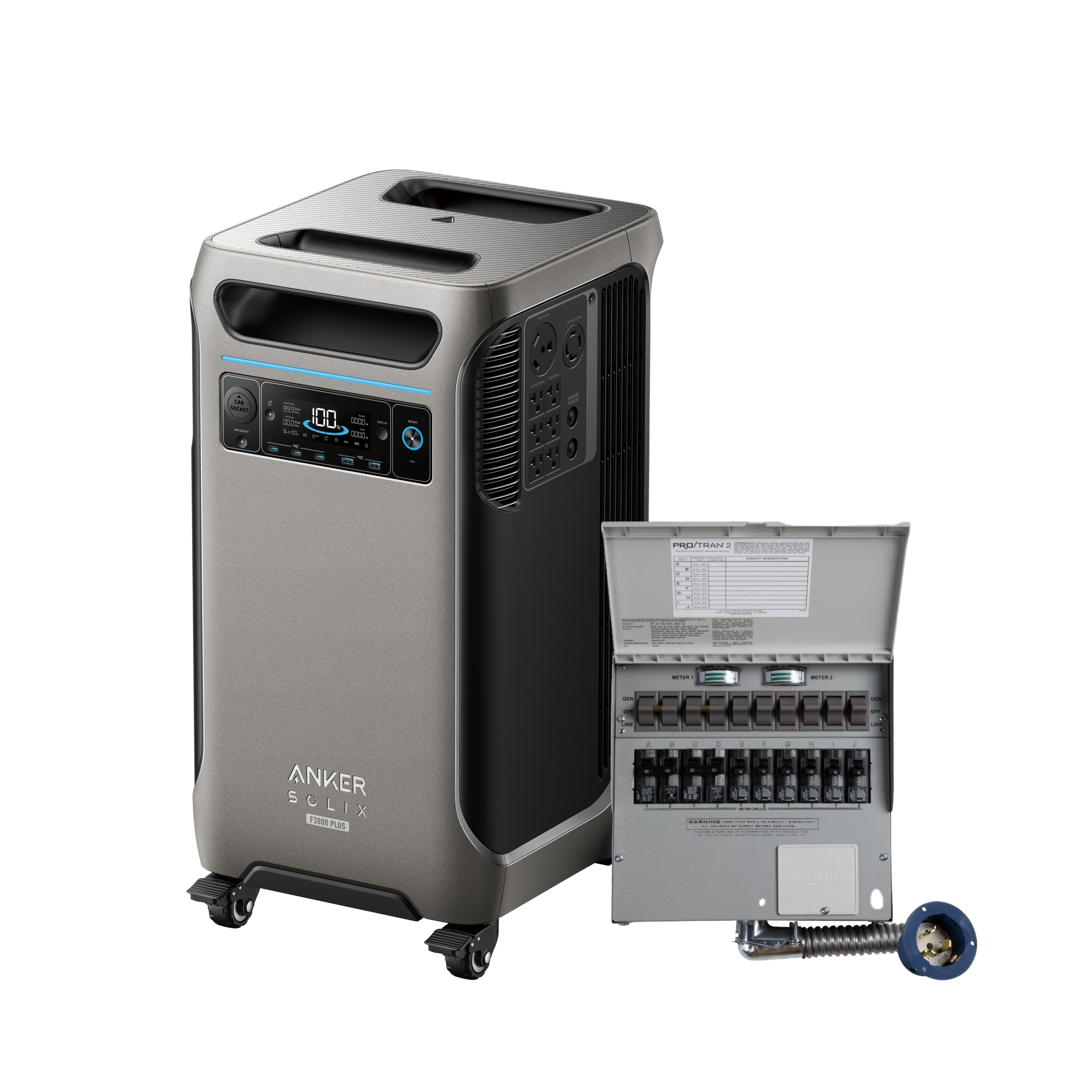
Explore this need in the finder →The Anker SOLIX F3800 Plus + 10-Circuit Manual Transfer Switch is a station-and-home-circuit package, not just a large battery with an extra outlet. The exact U.S. offer is SKU B1790113F. Its transfer hardware is the Anker-listed 10-circuit, 50 A, 120/240 V manual switch, a Reliance PRO/TRAN 2 family product. That makes this a fixed electrical installation decision: a qualified electrician must assess and install the transfer equipment under applicable code.
A manual path to selected household circuits
The transfer switch is intended to select up to ten circuits for backup, not to energize every branch circuit in a house automatically. Anker's component page specifies six 15 A single-pole circuits, one 20 A two-pole circuit and one 30 A two-pole circuit; it also lists a 50 A input rating and 120/240 V operation. Those are specifications of the transfer hardware, not the station's inverter output. A single F3800 Plus remains a 6,000 W station. Its ordinary 120 V receptacles are capped at 2,400 W, its TT-30R at 3,000 W, and the L14-30R route provides the documented dual-voltage connection. The switch's 50 A rating must never be read as a 50 A battery source.
Whether ten circuits are useful depends on the electrician's load review, not a count of appliances on a wish list. A refrigerator, furnace blower, lights, communications and a selected pump may be plausible priorities, but motors can draw a startup surge and simultaneous loads add together. Anker does not state that the switch makes all ten circuits independently available at the station's full rating. Ask the installer which circuits can be backed up, what wiring and inlet arrangement are suitable, and what the source-selection steps are. A manual switch requires an intentional changeover; it is not an automatic seamless backup panel.
Why the installation boundary matters
Reliance's PRO/TRAN 2 installation and operating instructions warn that improper installation can cause electrocution or fire and require a qualified electrician working to applicable electrical codes. This is not a plug-in kit for a homeowner to wire into a breaker panel. The manual discusses live parts in the load center and the hazards of generator placement; Anker's own support documents also say installation of the F3800/Home Power Panel equipment requires an electrician or a professional with an electrician certificate. Have the electrician confirm compatibility with the home's panel, neutral/ground arrangement, chosen loads and local requirements before relying on the system.
The product should be stored and operated as a portable station where its ventilation and safety instructions can be followed, then connected to the installed transfer system only with the specified connection path. Never backfeed a house through a normal wall receptacle or use a homemade cord. This review does not give wiring advice because the installation is site-specific and potentially hazardous. A qualified installer should hand over a clear, labeled circuit plan and operating instructions.
Battery, output and charging are still station limits
The exact package page identifies one F3800 Plus with 3,840 Wh nameplate storage and 6,000 W maximum AC output. Anker says the compatible F3800 Plus family can expand with BP3800 batteries, but this B1790113F offer is the transfer-switch bundle; do not count a battery as included unless the selected package specifically says so. A switch cannot increase the station's storage, inverter capacity or runtime. A 3,840 Wh nameplate figure is not the amount of AC energy guaranteed at a load; actual delivered energy varies with conversion, temperature, reserve settings and load profile.
The station's two MPPT inputs accept up to 3,200 W combined, with each input limited to 11–165 V and 17 A/1,600 W. AC charging is listed at up to 1,800 W. The generator/Home Power Panel port can handle up to 6,000 W for the stated bypass use, but Anker requires its adapter and limits bypass to one F3800 Plus. The manufacturer also notes that 240 V output cannot be used when the station is charging via 120 V AC. These are operational restrictions to carry into the transfer plan, not fine print to assume away.
Who should choose this configuration?
This package is for a homeowner who wants a manual, electrician-installed connection to a defined set of circuits and has already confirmed the circuit plan. It is less compelling if you only want to run a few appliances from their cords, because the station can power those loads directly without hardwiring a transfer switch. It is also not the right answer if you require automatic whole-home transfer, a load above the station's published output, or a battery capacity greater than 3,840 Wh included in the exact offer. The higher switch rating does not change any of those conditions.
The finder treats this offer as a 3,840 Wh, 6,000 W station configuration with a manual transfer switch included and ten circuits available on that switch. Choose the manual-transfer option only if fixed circuits are a real need. A request for a home energy panel, grid/solar self-consumption or time-of-use operation instead points to the Smart Home Power Kit. If you want a longer outage reserve, compare the expansion-battery package; it increases storage while keeping the same F3800 Plus inverter. Those are distinct ways to build backup, not interchangeable accessories.
The exact package SKU and host specifications come from Anker SOLIX U.S. product pages. Switch ratings and installation warnings come from Anker's B17B31A1 component page and the Reliance PRO/TRAN 2 manual; local electrical suitability remains for a qualified electrician to determine.
Key details at a glance
| Nameplate battery capacity | 3840 Wh |
|---|---|
| Rated AC output | 6000 W |
| Maximum solar input | 3200 W |
| Maximum USB-C output per port | 100 W |
| Compatible extra-battery expansion | Yes |
| 12 V DC output | 120 W |
| Maximum AC recharge input | 1800 W |
| Base warranty term | 5 years |
| AC outlet output | Yes |
| Solar input ports | 2 |
| 12 V car-style output | 120 W |
| Battery chemistry | LiFePO4 |
| Expansion battery in this package | No |
| Home Power Panel in this package | No |
| Included transfer-switch circuits | 10 circuits |
| HPP 120/240 V split-phase | No |
Use the exact model’s instructions for operating limits, supplied equipment and version differences.
Sources for this assessment
A useful match starts with the loads that matter.
Use the finder for hard electrical requirements, then check appliance starting behavior, actual run time and the exact package in the full assessment.