
On this page
Your needs, this model
Does it fit your priorities?
Do you want one panel advertised at 200 W included with an AC180?
The exact selected option names a 200 W solar kit and includes one panel by the package label, while the revision remains unresolved.
Explore this need in the finder →Does the AC180’s 1,152 Wh and 1,800 W 120 V output fit the load plan?
The included station remains a single AC180; the panel does not change its battery or inverter rating.
Explore this need in the finder →Must the supplied panel model and its full electrical compatibility be confirmed?
BLUETTI’s selected media names SP200L while other current navigation points to PV200D; the exact revision is unknown, so all-panel compatibility cannot be treated as established.
Explore this need in the finder →Do you need a supported 240 V output plan?
This is one AC180, with 120 V outlets; there is no 240 V plan.
Explore this need in the finder →Is a separately verified panel arrangement acceptable if the exact 200 W model is unknown?
The package supplies one advertised 200 W panel, but the buyer should identify it before wiring an array.
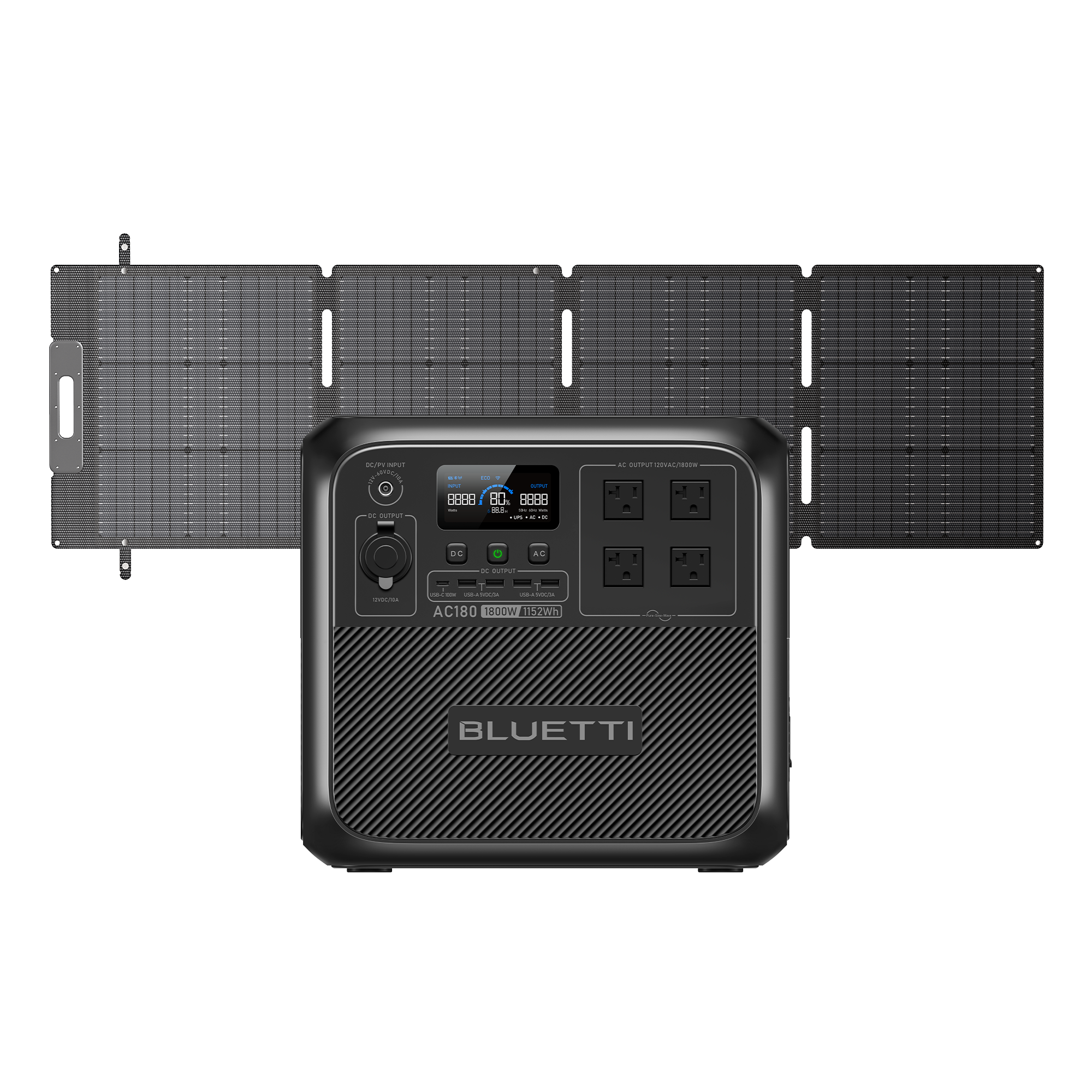
Explore this need in the finder →This exact BLUETTI offer is AC180 + 200 W Solar, variant 45427542491355 / SKU AC180-2-71-SPFUS-00. The manufacturer’s U.S. selection identifies one 200 W solar panel with the 1,152 Wh, 1,800 W AC180. The station and advertised panel rating are clear; the precise panel model is not. The selected-option image file is associated with an SP200L name, while a separate current BLUETTI navigation image points to PV200D for the same AC180 + 200 W family. Without a package list resolving that difference, this review treats the panel model and exact cable contents as unknown rather than merging generations.
One included 200 W panel, within a 500 W station ceiling
The AC180’s manual lists 500 W maximum solar input at 12–60 V DC and 10 A, with a warning not to exceed 60 V open-circuit voltage. One panel rated 200 W is below the station’s wattage ceiling, but the conflicting panel-model references leave its exact voltage, current and connector bridge unconfirmed for this selected package. The offer is still an exact retail configuration: its selected option lists a 200 W panel, its U.S. variant ID and SKU are recorded, and the product image visibly presents the station and panel together. What remains unknown is which panel revision is in the box and whether its published electrical values are the ones previously documented for SP200L or PV200D.
That distinction matters for someone who plans to assemble a particular array or wants every panel to operate at its full rating. This assessment can support the ordinary needs “a panel is included” and “the offer names 200 W of panel,” but it does not mark an all-panel electrical plan as verified. A solar input on the AC180 is established; the selected option’s exact panel wiring and full-rating behavior are not. Use the current manual and confirm the panel model printed on the package before connecting it. Do not treat a wattage label as a complete compatibility specification.
The inverter and battery are still the AC180’s
For AC loads, this kit remains one 120 V station with four receptacles sharing 1,800 W continuous output. A 2,700 W surge rating is not a continuous target; refrigerators and motors should be checked for startup demand. The 1,152 Wh battery rating is nameplate storage, not energy delivered to the outlet or a measured run time. One USB-C port reaches up to 100 W, and the DC layout includes a regulated 12 V car-style outlet. Those are useful for a small outage or campsite load plan, but this is not a 240 V system or a whole-home transfer setup.
Compared with the 100 W SP100L bundle, this offer advertises twice the panel nameplate wattage while leaving the model ambiguity unresolved. Compared with the 350 W PV350D option, it advertises less panel wattage but avoids that model’s documented current-limit question. If you need a named solar panel whose electrical figures can be checked against the AC180 limit, the SP100L kit is easier to evaluate. If you already own panels and only need the station, the AC180 standalone option avoids buying duplicate equipment.
Who should shortlist this selection
This is a reasonable option for a buyer who wants a one-panel 200 W package, understands that real solar output varies, and is willing to verify the panel revision and lead before use. It is less suitable when the exact panel SKU, array wiring, all-panel full-rating operation or included-cable requirement is essential. The AC180 itself weighs about 36 lb; the foldable panel adds another item to carry and set up, so the kit is most practical where a vehicle or stationary location is available. Panel placement needs open sun and should follow the manufacturer’s safety instructions.
BLUETTI’s product page and the selected-option art confirm the commercial package, not an actual charge rate or the panel’s identity. No hands-on test, runtime trial, noise observation or ownership experience is claimed here. The manual’s ≤20 ms UPS transfer specification is not evidence that sensitive electronics will behave correctly; test the intended equipment. Keep the station dry, remain below its input limits, and never connect its off-grid AC output to grid wiring.
Use BLUETTI’s exact AC180 + 200 W selection and the AC180 manual as the starting point. Ask the manufacturer to identify the included panel model and station-side lead for SKU AC180-2-71-SPFUS-00 if those details determine your setup.
Key details at a glance
| Nameplate battery capacity | 1152 Wh |
|---|---|
| Rated AC output | 1800 W |
| Manufacturer surge rating | 2700 W |
| Maximum solar input | 500 W |
| Included panels, combined nameplate | 200 W |
| Maximum USB-C output per port | 100 W |
More specifications and setup details
| Listed weight | 36.16 lb |
|---|---|
| 12 V DC output | 120 W |
| Maximum AC recharge input | 1440 W |
| Manufacturer UPS transfer figure | 20 ms |
| AC outlet output | Yes |
| USB-C ports | 1 |
| USB-A ports | 4 |
| Solar input ports | 1 |
| 12 V car-style output | 120 W |
| Battery chemistry | LiFePO4 |
| Separate station units in offer | 1 |
| Aggregate nameplate capacity across independent units | 1152 Wh |
| Solar panels in exact offer | 1 |
Use the exact model’s instructions for operating limits, supplied equipment and version differences.
Sources for this assessment

A useful match starts with the loads that matter.
Use the finder for hard electrical requirements, then check appliance starting behavior, actual run time and the exact package in the full assessment.