
On this page
Your needs, this model
Does it fit your priorities?
Do you want two supplied panels with 400 W combined nameplate?
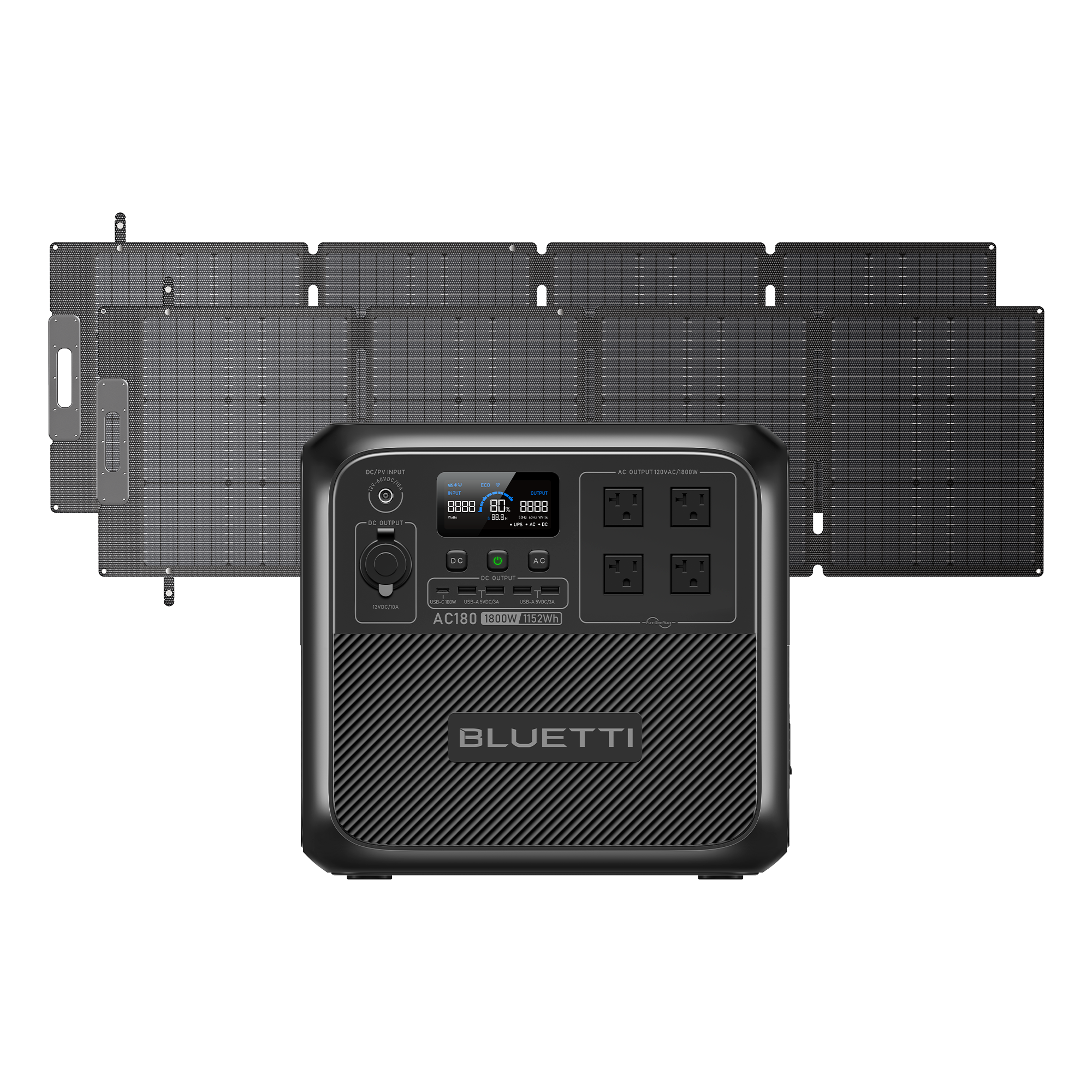
The selected option is named 2 × 200 W / 400 W kit and its image shows two panels; exact revisions and wiring remain unknown.
Explore this need in the finder →Is one AC180 with 1,152 Wh and 1,800 W at 120 V enough?
Two panels do not add a second station or increase the AC180 battery/inverter rating.
Explore this need in the finder →Must both supplied panels be confirmed within the station input limits at full ratings?
The AC180 input is 500 W/10 A/12–60 V, while exact panel revision and package wiring are not resolved; this condition cannot pass.
Explore this need in the finder →Do you need 240 V from the station?
The AC180 is a single 120 V station; adding panels does not change output voltage.
Explore this need in the finder →Would one identified, lower-wattage panel bundle be simpler?
The SP100L package has one named panel with published current/voltage inside the AC180 input envelope; the two-panel bundle has more setup and unresolved wiring.
Explore this need in the finder →The BLUETTI AC180 + 2 × 200 W Solar selection is the highest-panel-count AC180 offer in the current U.S. product record: variant 45791800885467 / SKU AC180-3-55-SPFUS-00. The option is explicitly named as a 400 W solar kit and the selected image depicts two foldable panels with one AC180. That resolves the listed package count and combined panel nameplate. It does not resolve the panel revision or the exact series/parallel lead and wiring in the box: saved BLUETTI media references both SP200L and PV200-family images for AC180 200 W combinations.
400 W of listed panels is not a 400 W charging promise
The AC180 accepts up to 500 W of solar input at 12–60 V DC and 10 A. Two 200 W panels total 400 W of panel nameplate, so the wattage total is below the station’s stated 500 W ceiling. But voltage and current depend on the exact panels and how they are connected. A series string adds panel voltage; parallel wiring adds current. The AC180 manual allows series or parallel arrays only when they remain within the station’s voltage, current and power limits. Here, the source images do not settle the exact panel revision, and the captured product-option materials do not establish the supplied wiring plan. The product is an official offer, but a correct full-rating array cannot be inferred from its image alone.
For that reason, the two-panel count and 400 W nameplate are useful for choosing a package, but this review does not mark an all-panels-at-published-ratings plan as verified. Do not connect two panels based only on the “400 W kit” label. Confirm the panel model, open-circuit voltage, current at maximum power, cable type and manufacturer-recommended series or parallel arrangement for this exact SKU. A single incorrectly wired array can cross an input limit even when its combined wattage is below 500 W. Actual solar production will also vary with shade, orientation, weather and temperature; the nameplate is not a charge-time estimate.
More set-up, same single-station output
This configuration does not double the AC180’s battery or inverter. It remains one station with 1,152 Wh nameplate capacity, 1,800 W continuous AC output at 120 V and four outlets that share the total. The 2,700 W surge figure is not continuous output. Check appliance starting demand, especially for compressors and motors. The battery rating is not delivered AC energy or a guaranteed outage runtime. USB, 12 V and AC outputs belong to this one station; there is no 240 V split-phase path.
The practical attraction is having a two-panel package associated with a station that can accept more solar input than a single 200 W panel. The tradeoff is carrying, unfolding and positioning two panels, then safely routing their leads. The AC180 weighs about 36 lb before the panels and cables; this is better suited to a campsite, vehicle, work area or stationary outage spot than a long walk. A one-panel 200 W kit is simpler if you want a smaller setup, though its exact panel revision is also not settled. The SP100L bundle trades panel power for a confirmed 100 W panel identity and a simpler input match.
Shortlist only if you will verify the array
This is a candidate for buyers who specifically want a two-panel 400 W kit and have time to obtain the exact configuration instructions. It is not the right recommendation if “both supplied panels must be confirmed to work at their published ratings” is an essential requirement until the model and wiring bridge are confirmed. A model that has a lower, documented panel arrangement is safer for a buyer who cannot check those details. If your priority is 240 V equipment, expansion storage or higher continuous inverter power, choose a different station family instead of adding panels to this AC180.
BLUETTI’s AC180 manual warns against exceeding 60 V open-circuit input and limits current to 10 A. Its transfer-switch figure is a published value, not tested evidence for your equipment. Keep the station dry and never connect the AC output to grid wiring. This is an original source-based assessment, not a physical test or ownership report; it makes no solar-harvest, runtime, noise or endurance claim.
Before use, consult BLUETTI’s exact 2 × 200 W AC180 selection and the AC180 manual. Ask BLUETTI to identify the included panels and their approved wiring for SKU AC180-3-55-SPFUS-00; do not substitute a cable assumption for that answer.
Key details at a glance
| Nameplate battery capacity | 1152 Wh |
|---|---|
| Rated AC output | 1800 W |
| Manufacturer surge rating | 2700 W |
| Maximum solar input | 500 W |
| Included panels, combined nameplate | 400 W |
| Maximum USB-C output per port | 100 W |
More specifications and setup details
| Listed weight | 36.16 lb |
|---|---|
| 12 V DC output | 120 W |
| Maximum AC recharge input | 1440 W |
| Manufacturer UPS transfer figure | 20 ms |
| AC outlet output | Yes |
| USB-C ports | 1 |
| USB-A ports | 4 |
| Solar input ports | 1 |
| 12 V car-style output | 120 W |
| Battery chemistry | LiFePO4 |
| Separate station units in offer | 1 |
| Aggregate nameplate capacity across independent units | 1152 Wh |
| Solar panels in exact offer | 2 |
Use the exact model’s instructions for operating limits, supplied equipment and version differences.
Sources for this assessment

A useful match starts with the loads that matter.
Use the finder for hard electrical requirements, then check appliance starting behavior, actual run time and the exact package in the full assessment.