
On this page
Your needs, this model
Does it fit your priorities?
Do you want one 120 V AC180 with Charger 2 named in the same offer?
The exact U.S. selected variant is named AC180 + Charger 2 and the AC180 itself is rated 1,800 W at 120 V.
Explore this need in the finder →Is one 1,152 Wh station enough if vehicle-charger integration is checked separately?
The AC180 provides one 1,152 Wh battery; the exact Charger 2 adapter bridge is not established by the saved option evidence.
Explore this need in the finder →Can you accept an unverified Charger 2 to AC180 cable bridge?
The exact offer includes Charger 2, but the manuals use different station connectors and the variant evidence does not show the adapter.
Explore this need in the finder →Must a solar panel be included in this selection?
This option names Charger 2 but no solar panel; the AC180’s own solar input remains available with a separately selected compatible panel.
Explore this need in the finder →Is a 120 V off-grid station acceptable rather than a 240 V output system?
The AC180 is a 120 V station; Charger 2 does not change its AC voltage or inverter rating.
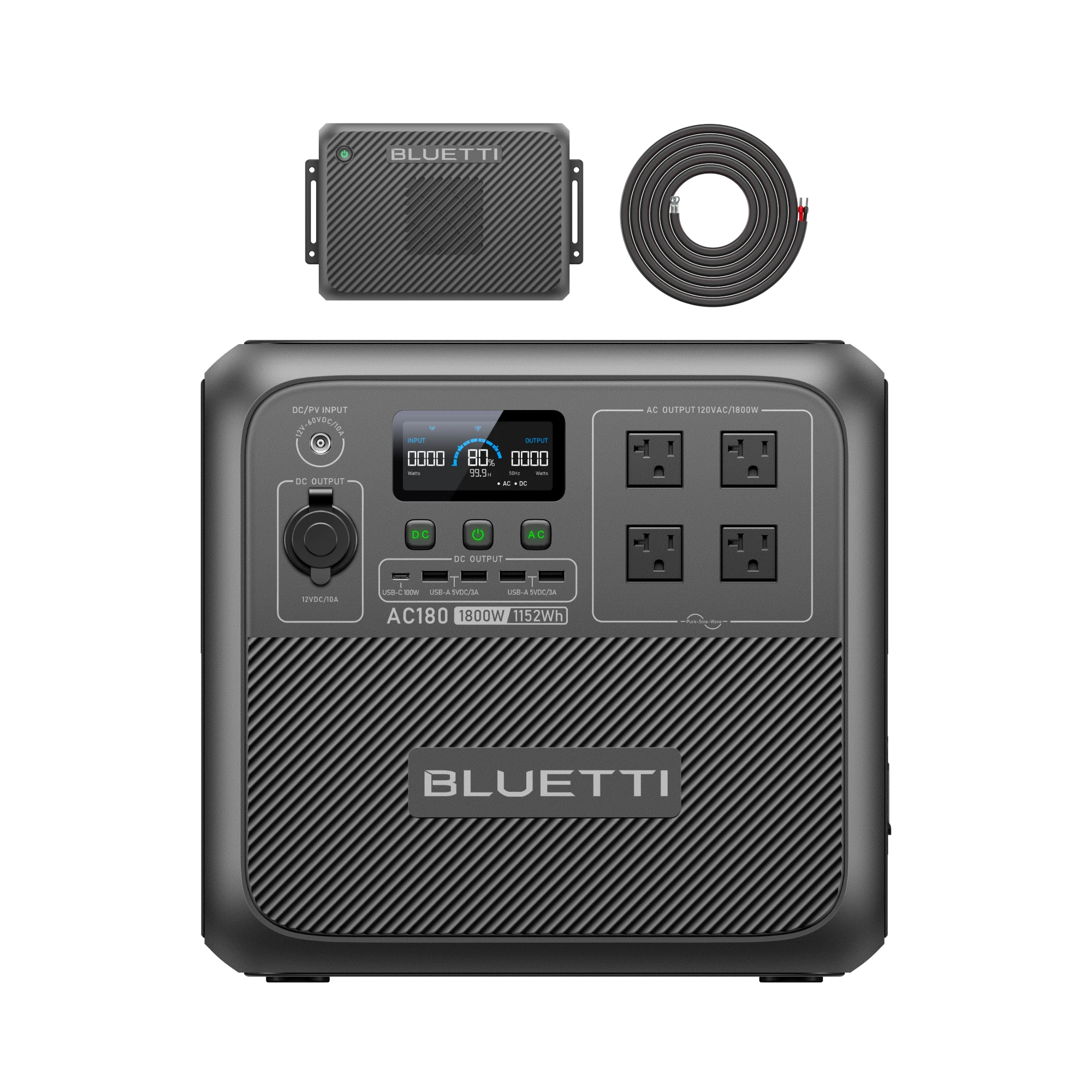
Explore this need in the finder →This exact U.S. selection is the BLUETTI AC180 with Charger 2, Shopify variant 48115658752219 / SKU AC180-2-150-SPFUS-00. It combines a 1,152 Wh, 1,800 W AC180 with a separately named vehicle-and-solar DC charger. The station remains a 120 V, single-unit power source; the included charger does not add battery capacity, AC outlets, inverter wattage or a 240 V output plan. The package is most relevant to a vehicle-based setup, but its station-side connection deserves confirmation before purchase.
The station stays familiar; the charging add-on changes the installation
The AC180 itself has four 120 V receptacles sharing 1,800 W, a 12 V/10 A car outlet, USB ports, and 1,152 Wh of LiFePO₄ storage. Those limits—not the presence of Charger 2—set what it can run. A refrigerator, compressor or tool still needs a startup check, and the battery capacity is a nameplate figure rather than a promised runtime. If you want the AC180’s basic portable backup capability and will recharge from a wall outlet or ordinary vehicle socket, the standalone offer may already cover the operating plan.
Charger 2 is a hard-wired DC-DC charging unit intended to use a vehicle starter battery and solar input. Its manual calls for a 12 V or 24 V vehicle source, a 75 A fuse, secure wiring and ventilation; its wiring is not equivalent to simply plugging an accessory into the AC180’s 12 V car socket. The manual describes a combined vehicle-and-solar input path for Charger 2, but its output to a portable station is shown through an MC4 cable and an XT60 solar lead. By contrast, the AC180 manual identifies a DC7909 charging input and the station’s own solar lead. The package selection confirms that the retailer offers AC180 and Charger 2 together, but the saved exact-option evidence does not show the adapter or complete package box list that bridges those connectors.
Do not buy the charger on an assumed cable match
This is a useful example of why a bundle title is not a wiring diagram. Charger 2 may be the right component for a vehicle installation, but the manuals and option image do not establish which station-side conversion cable is included with this exact AC180 SKU. Confirm the exact BLUETTI-approved AC180 connection lead and package contents before planning to use its charging output. Until that bridge is confirmed, this assessment treats the charger as included in the offer but does not assign a vehicle-charging wattage or a combined alternator-and-solar operating plan to the AC180. The AC180’s own ordinary car-input method remains a separate documented path, and its product page does not provide a maximum vehicle-input wattage.
Installation also changes who should consider the bundle. Charger 2 is a fixed vehicle-system component rather than a grab-and-go solar panel. The manufacturer manual directs careful wiring, fuse protection and ventilation, and calls for qualified automotive installation. It is a poor choice if you need a plug-in setup, do not want work on a vehicle battery, or need a guaranteed charging rate without a verified station cable. A standalone AC180 plus its standard charging lead is simpler; an AC180 paired with a correctly documented Charger 1 package may be easier to evaluate for a straightforward AC180 input connection, but that is a different bundle and should not be conflated with this one.
Who might choose it
Consider this offer only if you already want the AC180’s 120 V/1,800 W and roughly 1.15 kWh profile, have a vehicle installation plan, and are willing to verify the adapter and wiring with BLUETTI before relying on Charger 2. It is not a larger AC180, not an expansion-battery kit and not proof that both solar and vehicle charging can be applied to the station at once. The exact package page’s image shows an AC180 and a separate Charger 2 enclosure, but artwork cannot establish cable compatibility or charging performance.
The AC180 remains a portable 36 lb device with one station’s inverter limit, while Charger 2 adds separate vehicle hardware and install work. Do not connect the AC180’s AC output to household wiring, assume UPS suitability for sensitive loads, or extrapolate runtime from nameplate capacity. The manual’s transfer specification is not a test result. This assessment reports manufacturer documentation only and includes no sample, electrical, runtime or charging test.
Check BLUETTI’s exact AC180 + Charger 2 selection, the AC180 manual, and BLUETTI’s Charger 2 manual together. The exact connection details, not a generic Charger 2 maximum, should determine whether this kit fits your vehicle.
Key details at a glance
| Nameplate battery capacity | 1152 Wh |
|---|---|
| Rated AC output | 1800 W |
| Manufacturer surge rating | 2700 W |
| Maximum solar input | 500 W |
| Included panels, combined nameplate | 0 W |
| Maximum USB-C output per port | 100 W |
More specifications and setup details
| Listed weight | 36.16 lb |
|---|---|
| 12 V DC output | 120 W |
| Maximum AC recharge input | 1440 W |
| Manufacturer UPS transfer figure | 20 ms |
| AC outlet output | Yes |
| USB-C ports | 1 |
| USB-A ports | 4 |
| Solar input ports | 1 |
| 12 V car-style output | 120 W |
| Battery chemistry | LiFePO4 |
| Separate station units in offer | 1 |
| Aggregate nameplate capacity across independent units | 1152 Wh |
| Solar panels in exact offer | 0 |
Use the exact model’s instructions for operating limits, supplied equipment and version differences.
Sources for this assessment

A useful match starts with the loads that matter.
Use the finder for hard electrical requirements, then check appliance starting behavior, actual run time and the exact package in the full assessment.