
On this page
Your needs, this model
Does it fit your priorities?
Do you need at least two separately usable U.S. 120 V station units?
The exact offer contains two AC180 units, each operating independently; it does not create one 240 V or shared-output system.
Explore this need in the finder →Does one 1,152 Wh AC180 with 1,800 W continuous output meet each individual load plan?
Each station is separately rated at 1,152 Wh and 1,800 W at 120 V; do not combine the figures for a single load.
Explore this need in the finder →Can you lift and store both stations if the complete two-unit plan is needed?
Each AC180 is listed at about 36.16 lb; the two-unit station hardware totals about 72.32 lb before packaging.
Explore this need in the finder →Is a standard 120 V output enough, with no 240 V requirement?
The reviewed plan is two separate 120 V stations, not a split-phase or 240 V configuration.
Explore this need in the finder →Is a solar panel optional rather than essential in this two-unit offer?
The selected offer identifies two stations but no included solar panel; choose a separately verified panel plan if solar is essential.
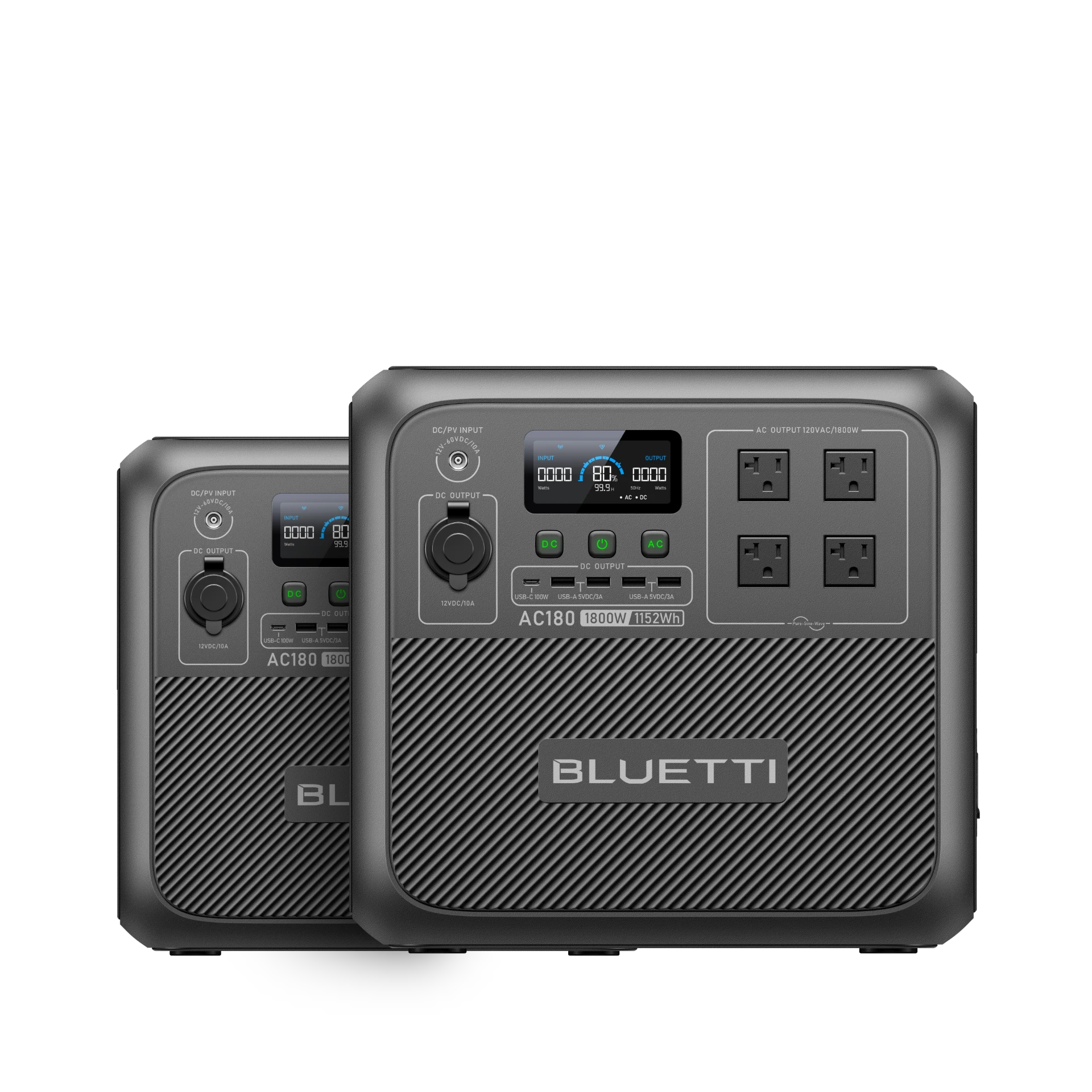
Explore this need in the finder →The BLUETTI AC180 × 2 is a two-unit offer, not a larger AC180 with one shared 2,304 Wh battery or a 3,600 W inverter. The official U.S. product record identifies two AC180 stations under variant 48975305965787 / SKU AC180-2-165-SPFUS-00. Each unit retains the AC180’s own 1,152 Wh LiFePO₄ battery, 1,800 W total 120 V AC output and set of output ports. This distinction is the most important reason to choose—or reject—the package.
Two stations solve a distribution problem, not a 240 V problem
For two separate places or load groups, this bundle can put one AC180 near a refrigerator or networking gear and a second at another location, campsite, or work area. Each station has its own four 120 V outlets, one 12 V/10 A car-style outlet, USB ports, and battery. The offer does not turn those outlets into a shared circuit: BLUETTI’s AC180 documentation does not establish a supported AC-output linking or 240 V split-phase plan for this pair. Do not join their AC outputs, treat the pair as one 3,600 W inverter, or add the two capacities when a single device must run from one station. The combined 2,304 Wh is only the nameplate total of two independent batteries; each individual operating plan remains 1,152 Wh and 1,800 W.
That can be useful during an outage when loads are physically apart, or on a trip where two people want separate stations. It is less attractive if you only need one outlet cluster: one standalone AC180 avoids buying, charging and storing a second complete unit. It also will not satisfy a requirement for 240 V equipment or a connected home circuit. A properly configured station built for a documented 120/240 V plan, such as BLUETTI’s Apex 300 family, is a better starting point for that need; the pair is not a substitute.
Plan for two lifts, two charge routines and two load limits
BLUETTI lists the AC180 at about 36 lb per station. The two-unit order therefore means moving roughly 72 lb of station hardware in total before cables or packaging, usually as two separate lifts. That flexibility is real: a single person can move one station at a time and leave the other in place. But each 1,800 W ceiling is still shared across that unit’s four AC receptacles. A refrigerator compressor, pump or power tool may need more startup power than its running label suggests, and the manual’s 2,700 W surge figure is not a continuous rating. The battery’s 1,152 Wh nameplate figure also is not delivered AC energy at the wall or a measured runtime.
The two AC180s are charged as separate stations. Their standard manual lists AC, solar and vehicle charging; the base AC180 has a 500 W, 12–60 V, 10 A solar input, with a warning not to exceed 60 V open-circuit voltage. No panel is identified in this ×2 selection. If you plan to use panels, check each station and array independently rather than assuming a shared solar connection or a 1,000 W combined charging input. A 12 V car-style charging path is available per station, but the reviewed specification does not provide a vehicle-input wattage for a precise recharge estimate.
Where this package is a fit—and where it is not
It makes sense for a household or camper that has two independent 120 V load areas, can store two roughly 36 lb units, and prefers distributing ready-to-use battery stations rather than wiring a single system. It may also be convenient to keep one at home and one in a vehicle, although the package then carries the weight and cost of two units. For a simple campsite setup, the standalone AC180 is the less cumbersome choice. For one larger reserve, choose a single model with a documented expansion or higher-capacity plan rather than treating a second AC180 as an expansion battery.
There is no reviewed evidence that the pair provides UPS-grade continuity for every device. The AC180 manual’s transfer figure is a manufacturer specification, not an independent test, and BLUETTI tells users to test critical equipment. The station is not a grid-tie device; its AC output must not be connected back to house wiring. Keep both units dry and observe the AC180 temperature and ventilation instructions. This review makes no runtime, noise, longevity or hands-on claim.
For the exact U.S. offer and selected variant, see BLUETTI’s AC180 × 2 product option and the AC180 manual. The manufacturer’s current product page showed this station family out of stock when checked; that does not change the configuration’s identity or these per-unit limits.
Key details at a glance
| Nameplate battery capacity | 1152 Wh |
|---|---|
| Rated AC output | 1800 W |
| Manufacturer surge rating | 2700 W |
| Maximum solar input | 500 W |
| Included panels, combined nameplate | 0 W |
| Maximum USB-C output per port | 100 W |
More specifications and setup details
| Listed weight | 36.16 lb |
|---|---|
| 12 V DC output | 120 W |
| Maximum AC recharge input | 1440 W |
| Manufacturer UPS transfer figure | 20 ms |
| AC outlet output | Yes |
| USB-C ports | 1 |
| USB-A ports | 4 |
| Solar input ports | 1 |
| 12 V car-style output | 120 W |
| Battery chemistry | LiFePO4 |
| Separate station units in offer | 2 |
| Aggregate nameplate capacity across independent units | 2304 Wh |
| Solar panels in exact offer | 0 |
Use the exact model’s instructions for operating limits, supplied equipment and version differences.
Sources for this assessment

A useful match starts with the loads that matter.
Use the finder for hard electrical requirements, then check appliance starting behavior, actual run time and the exact package in the full assessment.