
On this page
Your needs, this model
Does it fit your priorities?
Do you want a named 350 W PV350D panel included with a 120 V station?
The exact selection is named as a 350 W solar kit and the associated BLUETTI media identifies PV350D; the AC180 remains a 1,800 W 120 V station.
Explore this need in the finder →Is a 1,152 Wh AC180 battery enough for your selected loads?
This configuration has one AC180 with 1,152 Wh nameplate storage; no extra battery is included.
Explore this need in the finder →Must every supplied panel be confirmed to work at its published rating?
The PV350D/AC180 combination is manufacturer-listed as compatible, but published panel Isc is 13.8 A versus the station’s 10 A input-current limit; full-rate input is unresolved.
Explore this need in the finder →Is a standard 120 V output enough rather than a 240 V plan?
The AC180 has U.S. 120 V outlets only in this reviewed plan.
Explore this need in the finder →Would you rather buy a smaller, electrically documented panel kit?
The SP100L kit has a confirmed 100 W panel whose published current and voltage fit the AC180 input envelope; this 350 W kit has the larger current caveat.
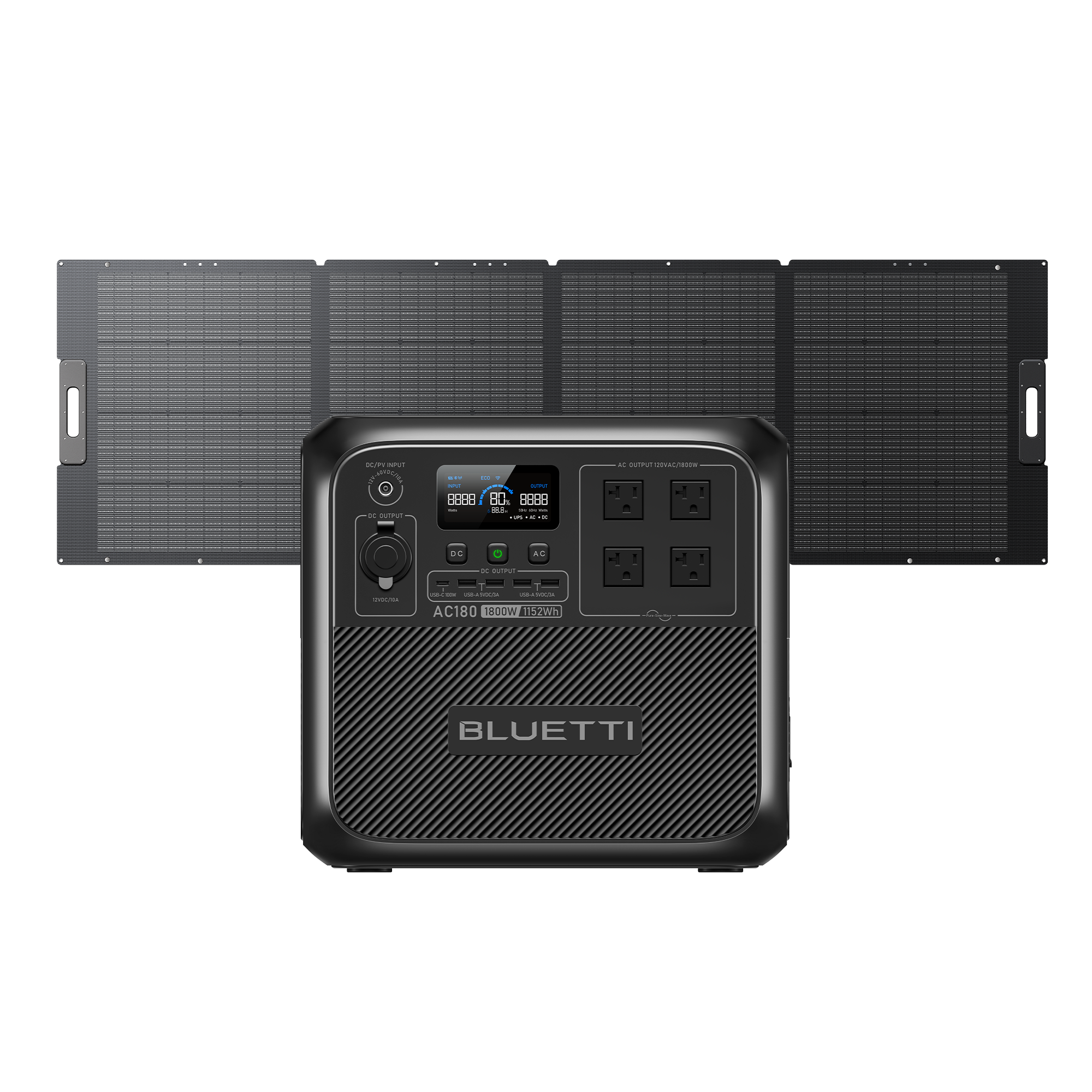
Explore this need in the finder →This BLUETTI AC180 selection is variant 44143025029339 / SKU AC180-2-180-SPFUS-00, sold under the manufacturer’s “AC180 + 350W Solar” name. Its exact selected-option image is associated with a foldable PV350D panel, and BLUETTI’s PV350D support material lists AC180 among compatible station models. That resolves the offer and panel family more precisely than the contradictory route slug seen on a separate Apex 300 bundle; this AC180 offer is the 350 W PV350D selection, not the unrelated Apex row.
More panel nameplate, but a current-limit caveat
The AC180 has a single solar input rated up to 500 W, 12–60 V DC and 10 A. The PV350D is a 350 W panel, and the U.S. panel material lists 33 V open-circuit voltage and 13.8 A short-circuit current. Its voltage is within the AC180’s published range, and the panel’s nameplate watts are below 500 W. But the panel’s published short-circuit current is higher than the station’s stated 10 A maximum input current. BLUETTI lists the models as compatible and markets this exact option, yet the saved documents do not explain how the station’s current limit interacts with the panel’s maximum output or whether full panel nameplate output is achievable through this pairing.
That is a real qualification, not a reason to invent a disconnect or claim a 350 W recharge. The package is an official selected configuration, so its exact identity and panel inclusion are known. The full-rating operating question remains open: do not assume that every panel rating can be delivered to the station, and follow BLUETTI’s current manual and support direction before connecting it. The 10 A figure is the AC180 limit; the 13.8 A figure is the panel’s short-circuit current, not a measured operating draw. This review does not claim that either number represents a test of the combined kit.
Same AC180 loads, a more substantial panel to carry
The panel does not increase the AC180’s battery capacity, inverter output or outlets. One station still has 1,152 Wh nameplate storage and 1,800 W total 120 V AC output; its four receptacles share that ceiling. A refrigerator, pump or power tool needs a startup-load check, and 2,700 W surge is not continuous output. The capacity figure is not a runtime promise. The station weighs about 36 lb before the panel, so this bundle suits a vehicle, campsite or stationary backup location better than a long carry. The foldable panel needs unshaded space, careful positioning and a safe place to rest while operating.
Compared with the 100 W SP100L bundle, the PV350D offers a higher panel nameplate rating and a larger physical setup. It may be attractive when a buyer wants the panel named and included rather than shopping separately. The smaller SP100L kit has a cleaner electrical-envelope match on its published panel ratings but collects less nominal panel power. The AC180 + 200 W selection is a middle ground in advertised watts, although its exact panel model is not settled by the source images. These are differences in specified equipment, not comparative field-harvest results.
Choose it only if the input boundary suits your plan
The bundle can suit an owner who values the identified 350 W panel and is prepared to verify the exact PV350D/AC180 connection against current support information. It is not the obvious choice for anyone whose must-have is a proven 350 W solar charging rate, because the station is rated at 10 A and the panel’s published current figure is higher. If that uncertainty is unacceptable, select a lower-current panel with a clear published match or use the AC180 standalone offer with a separately verified array. If the essential need is 240 V output or one integrated home circuit, the AC180 is the wrong platform regardless of panel size.
BLUETTI says not to exceed the AC180’s 60 V open-circuit limit and warns against connecting its AC output to the grid. Do not infer waterproofing, fixed mounting, solar yield or runtime from the product art. The AC180 manual’s UPS figure is manufacturer data, not an independently tested result, and the user should test critical loads. This assessment uses manufacturer pages and manuals only; it does not claim ownership, lab work or observed charging performance.
Review the exact AC180 + 350 W selection, the PV350D U.S. panel material, and the AC180 manual together. BLUETTI’s product page reported the 350 W panel out of stock at the current check; it remains a required current-reference configuration, not a deleted option.
Key details at a glance
| Nameplate battery capacity | 1152 Wh |
|---|---|
| Rated AC output | 1800 W |
| Manufacturer surge rating | 2700 W |
| Maximum solar input | 500 W |
| Included panels, combined nameplate | 350 W |
| Maximum USB-C output per port | 100 W |
More specifications and setup details
| Listed weight | 36.16 lb |
|---|---|
| 12 V DC output | 120 W |
| Maximum AC recharge input | 1440 W |
| Manufacturer UPS transfer figure | 20 ms |
| AC outlet output | Yes |
| USB-C ports | 1 |
| USB-A ports | 4 |
| Solar input ports | 1 |
| 12 V car-style output | 120 W |
| Battery chemistry | LiFePO4 |
| Separate station units in offer | 1 |
| Aggregate nameplate capacity across independent units | 1152 Wh |
| Solar panels in exact offer | 1 |
Use the exact model’s instructions for operating limits, supplied equipment and version differences.
Sources for this assessment

A useful match starts with the loads that matter.
Use the finder for hard electrical requirements, then check appliance starting behavior, actual run time and the exact package in the full assessment.