
On this page
Your needs, this model
Does it fit your priorities?
Do you want an included, identified SP100L panel rated at least 100 W?
This selected offer names one SP100L 100 W panel; its listed 24.62 V open-circuit voltage and 5.13 A short-circuit current fit the AC180’s stated 12–60 V and 10 A input limits.
Explore this need in the finder →Is a single 1,152 Wh, 1,800 W 120 V station sufficient?
The AC180’s four 120 V outlets share a rated 1,800 W total, with 1,152 Wh nameplate storage.
Explore this need in the finder →Must the one supplied panel fit the published station input envelope?
One SP100L stays below the AC180 voltage, current and power ceilings on the manufacturer’s published panel figures.
Explore this need in the finder →Do you need 240 V rather than U.S. 120 V outlets?
The selected AC180 is a single 120 V station, not a 240 V split-phase configuration.
Explore this need in the finder →Would you prefer the station without a supplied panel?
The exact selected variant includes one SP100L; choose the standalone AC180 if panel inclusion is not wanted.
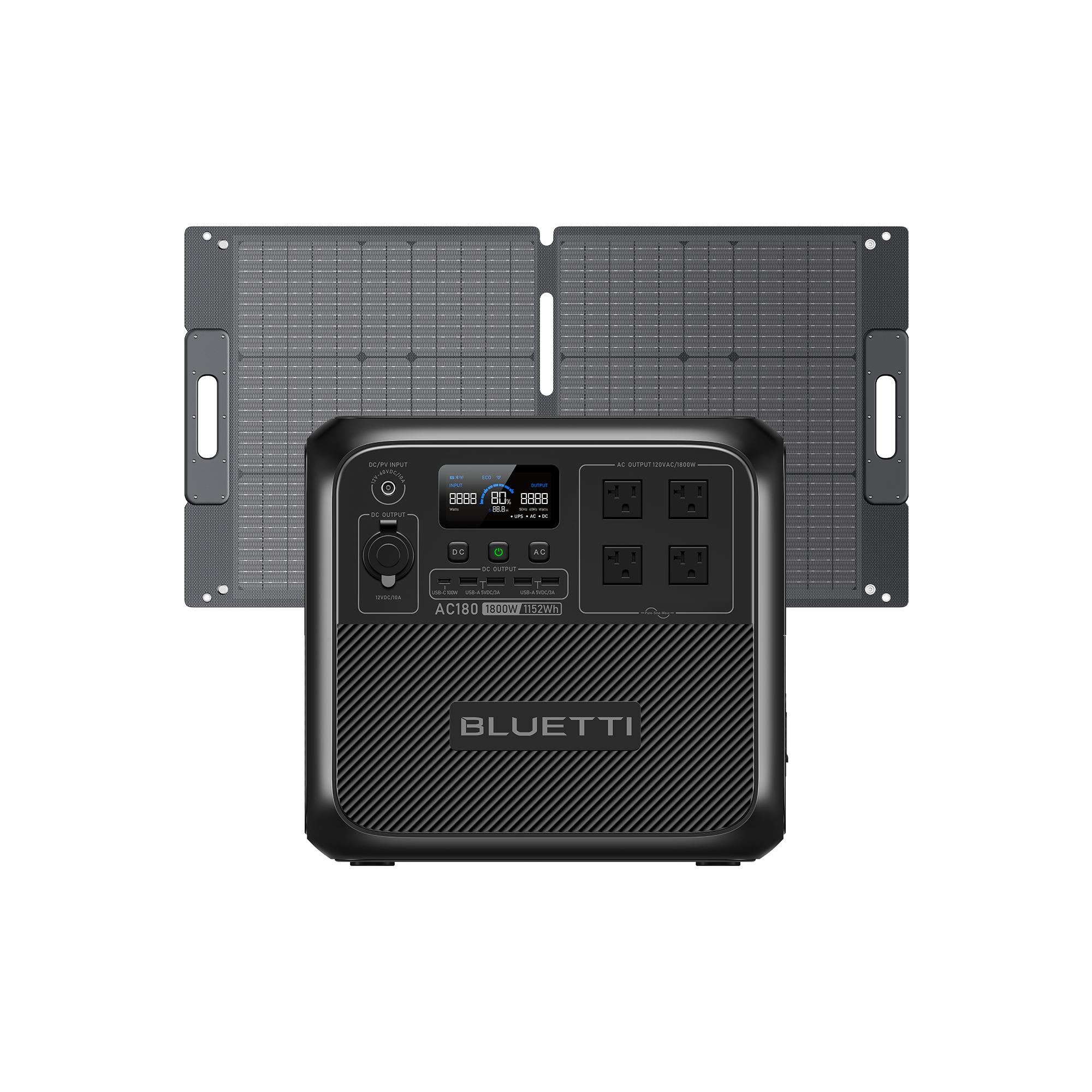
Explore this need in the finder →The BLUETTI AC180 + SP100L is the clearest of the AC180 solar bundles to assess from the saved U.S. product evidence: Shopify variant 44868697620699 / SKU AC180+100W-SPFUS-00 is explicitly named as a 100 W solar kit, and its selected-option image identifies the SP100L panel. It keeps the AC180’s 1,152 Wh battery and 1,800 W, 120 V inverter while supplying a modest, identified panel rather than leaving the panel choice to the buyer.
A small matched panel for a portable station
The SP100L is a single foldable 100 W panel. BLUETTI’s U.S. panel record lists 24.62 V open-circuit voltage and 5.13 A short-circuit current, while the AC180 manual specifies a 12–60 V DC, 10 A, 500 W maximum solar input. Those published panel voltage and current figures fall inside the station’s stated input window, and 100 W is below its 500 W ceiling. This is a supported one-panel plan on the manufacturer figures—not a prediction that sunlight will deliver 100 W to the battery all day. Shade, orientation, weather, temperature and the station’s charge state affect actual harvest. No charging-time estimate is a result from this review.
The panel makes this option a better fit than the base AC180 if you want a panel listed in the same purchase selection and do not already own compatible solar equipment. It remains a relatively low-wattage start: the AC180 can accept more than this one panel’s rating, but the bundle does not fill the station’s full 500 W solar input. A buyer seeking a larger, named panel should compare the PV350D kit carefully because its current and station input limits need more qualification. If you already own an array, the standalone AC180 may be the better way to avoid duplicating a panel.
What the panel does not change
At the outlet, the station still provides four 120 V receptacles sharing 1,800 W, plus a 12 V/10 A car-style outlet and USB connections. The surge figure is not a continuous rating; compressor starts and motor loads can be harder than their running labels imply. The 1,152 Wh battery is stored nameplate energy, not delivered AC energy or a guaranteed runtime. A 100 W panel may replenish energy during daylight but cannot be treated as an all-weather substitute for a larger battery or household backup system.
The AC180 itself weighs about 36 lb, and the SP100L is a separate foldable item to carry and position. The panel can be useful at a campsite, a sheltered outage location or a vehicle stop where you can face it toward open sky. It is not an integrated fixed rooftop installation, and the package image does not establish a mount, extension cable or exact in-box small parts. The AC180 manual lists its standard solar cable; keep the manufacturer’s connector and voltage instructions, and never exceed the station’s 60 V open-circuit limit. Do not use the artwork as a wiring diagram.
Fit and alternatives
This kit is a sensible shortlist candidate for a buyer who wants one 120 V AC station for selected loads and values an exact, modest solar panel included in the offer. It is less suitable if your essential need is high solar replenishment, 240 V service, a documented expandable battery, or a very light carry. For a single station without a panel, the AC180 standalone option avoids carrying solar hardware. If you need two separate 100 W panels, BLUETTI lists a different panel bundle, but that panel count is not included here. A larger single station with a higher solar ceiling may fit longer outages better, at the cost of more weight or a different configuration.
BLUETTI’s AC180 manual gives a UPS transfer figure and warns users to test their own equipment; this review has not tested UPS performance. The AC180’s AC output is for off-grid loads and must not be connected to the grid. Keep the station dry and follow its temperature guidance. There are no hands-on, runtime, noise or laboratory claims in this assessment.
For the exact selected package, consult BLUETTI’s AC180 + SP100L product option, the AC180 manual, and the SP100L U.S. panel listing. Those sources support the configuration and ratings; they do not promise a particular solar yield.
Key details at a glance
| Nameplate battery capacity | 1152 Wh |
|---|---|
| Rated AC output | 1800 W |
| Manufacturer surge rating | 2700 W |
| Maximum solar input | 500 W |
| Included panels, combined nameplate | 100 W |
| Maximum USB-C output per port | 100 W |
More specifications and setup details
| Listed weight | 36.16 lb |
|---|---|
| 12 V DC output | 120 W |
| Maximum AC recharge input | 1440 W |
| Manufacturer UPS transfer figure | 20 ms |
| AC outlet output | Yes |
| USB-C ports | 1 |
| USB-A ports | 4 |
| Solar input ports | 1 |
| 12 V car-style output | 120 W |
| Battery chemistry | LiFePO4 |
| Separate station units in offer | 1 |
| Aggregate nameplate capacity across independent units | 1152 Wh |
| Solar panels in exact offer | 1 |
Use the exact model’s instructions for operating limits, supplied equipment and version differences.
Sources for this assessment

A useful match starts with the loads that matter.
Use the finder for hard electrical requirements, then check appliance starting behavior, actual run time and the exact package in the full assessment.