
On this page
Your needs, this model
Does it fit your priorities?
Do you need a standalone 120 V station with at least 1,000 Wh of nameplate capacity and 1,800 W continuous AC output?
The exact U.S. standalone AC180 is listed at 1,152 Wh and 1,800 W at 120 V. Nameplate energy is not a runtime promise.
Explore this need in the finder →Must solar input be available, even if you will choose the panel separately?
The standalone AC180 accepts up to 500 W at 12–60 V DC and 10 A; the reviewed base offer does not include a panel.
Explore this need in the finder →Do you need both a 12 V car-style output and one USB-C port rated for a 100 W device?
The manual lists one 12 V/10 A cigarette-lighter output and one USB-C port at up to 100 W.
Explore this need in the finder →Is your load plan under the AC180’s shared 1,800 W continuous inverter limit?
The four AC outlets share the same 1,800 W total; the manual’s 2,700 W surge rating does not raise continuous output.
Explore this need in the finder →Must a compatible battery expansion system or a 240 V output be confirmed?
Neither a supported expansion battery nor a 240 V standalone operating plan is established by the reviewed U.S. sources; unknown expansion does not meet an essential requirement.
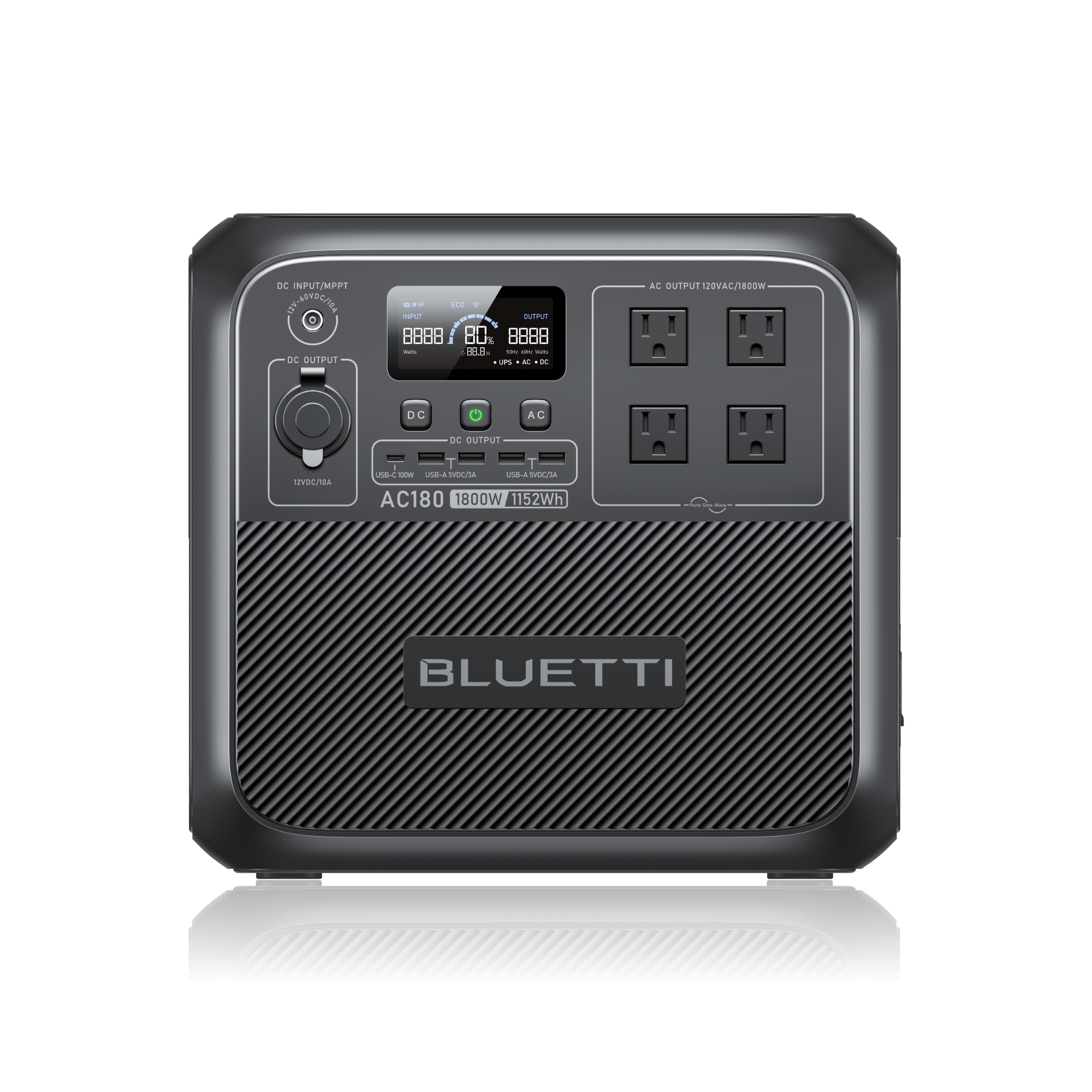
Explore this need in the finder →The BLUETTI AC180 is a mid-size, single-station setup: 1,152 Wh of LiFePO₄ storage behind a 1,800 W, 120 V pure-sine-wave inverter. The exact U.S. standalone listing is SKU AC180-US-GY-BL-SPFUS; separate panel and charger packages appear as other choices on the same product page. This assessment covers the station-only option, not those kits. The figures below come from BLUETTI’s product information and manual, not an independent load or runtime test.
A 1,152 Wh battery behind a 1,800 W ceiling
The AC180 can supply common household plug-in loads as long as the combined continuous demand stays within 1,800 W and any startup surge is compatible. The manual gives a 2,700 W surge figure, but that is not a second continuous rating. Compressors and motors can draw substantially more when starting than their running label suggests; a refrigerator, pump or power tool therefore needs a startup check rather than a decision based only on its running watts. Four AC receptacles share the same inverter, so plugging into another outlet does not create additional capacity.
The 1,152 Wh battery figure is stored nameplate energy, not a promise of that much AC energy at the wall. Conversion losses, the connected load, temperature and the station’s own consumption all affect runtime. BLUETTI’s manual provides an estimated runtime calculation and an example for a small refrigerator, but neither that example nor the capacity number is a result measured by this review. Treat the AC180 as a useful buffer for selected loads, not as an automatic whole-home replacement or a guarantee that a refrigerator will run for a particular number of hours.
Direct-device charging is a strong part of the layout
Alongside its four 120 V outlets, the AC180 has one 12 V/10 A car-style output, one USB-C port rated up to 100 W, four USB-A ports and a 15 W wireless charging pad. The manual lists the USB-A ports in two groups, each with 15 W total, so the four sockets should not be treated as four simultaneous 15 W sources. For laptops, phones and smaller electronics, the direct DC ports can avoid using the AC inverter. Low or intermittent loads still need attention: the manual describes ECO behavior that can shut off AC or DC output when demand stays below the selected threshold.
Solar input is useful, but it does not include a panel
The station accepts solar input up to 500 W at 12–60 V DC and 10 A. BLUETTI warns that panel open-circuit voltage must not exceed 60 V; its manual also specifies MC4 connections and cautions against mixing different panel types. Check the array’s voltage and current as well as its advertised watts before connecting it. The base AC180 package lists a solar charging lead but no solar panel, so the panel cost and compatibility are separate decisions.
Wall charging is rated up to 1,440 W, with that maximum specified for a 10–30°C charging range. The manual also supports vehicle charging from a 12 V cigarette-lighter outlet, but the reviewed specification does not establish a maximum vehicle-input wattage. Do not turn “car charging supported” into a specific recharge-time promise. These are different charging paths with different ceilings, and the standalone unit’s 500 W solar input is the relevant limit when planning a panel array.
Portable backup has real operating boundaries
At about 36.16 lb and 13.39 × 9.72 × 12.48 in, the AC180 is movable, but it is not a featherweight day-hike battery. It makes more sense where a person can lift it into a car, camper or sheltered outage location and then leave it in place. The manual lists a ≤20 ms UPS switchover and explicitly advises testing the function to avoid data loss; it is not a reason to assume every computer or sensitive device will ride through an interruption. BLUETTI also says the AC output is for off-grid use and must not be connected to the grid. The reviewed standalone plan is 120 V, not a 240 V or split-phase household circuit.
The manufacturer materials reviewed do not establish a compatible expansion-battery plan for this standalone option. If future capacity growth is essential, choose a model with a documented expansion system instead of assuming another BLUETTI battery will connect.
Where it fits among alternatives
The AC180 is a reasonable shortlist candidate for a campsite, vehicle-based trip, work area or limited outage plan when one 120 V inverter and roughly 1.15 kWh of nameplate storage suit the loads. It is less compelling if light carry weight is the priority: the Anker SOLIX C1000 is listed at 1,056 Wh and 1,800 W but weighs 28.44 lb, while the AC180 carries 96 Wh more nameplate storage at 36.16 lb. For a substantially larger reserve and higher continuous output, BLUETTI’s Elite 200 V2 is rated at 2,073.6 Wh and 2,600 W, with a higher listed weight of 53.35 lb. Those comparisons are manufacturer specifications, not matched runtime tests.
Choose the AC180 when a straightforward 120 V/1,800 W station, solar-input capability and several direct-device ports matter more than a lighter case, expansion certainty or 240 V service. Look elsewhere if your must-haves include an included solar panel, documented extra-battery expansion, a 240 V plan or proven UPS behavior for critical equipment. For the exact standalone option, consult the manufacturer’s AC180 listing and AC180 manual for the current package and connection limits.
Key details at a glance
| Nameplate battery capacity | 1152 Wh |
|---|---|
| Rated AC output | 1800 W |
| Manufacturer surge rating | 2700 W |
| Maximum solar input | 500 W |
| Included panels, combined nameplate | 0 W |
| Maximum USB-C output per port | 100 W |
More specifications and setup details
| Listed weight | 36.16 lb |
|---|---|
| 12 V DC output | 120 W |
| Maximum AC recharge input | 1440 W |
| Manufacturer UPS transfer figure | 20 ms |
| AC outlet output | Yes |
| USB-C ports | 1 |
| USB-A ports | 4 |
| Solar input ports | 1 |
| 12 V car-style output | 120 W |
| Battery chemistry | LiFePO4 |
| Solar panels in exact offer | 0 |
Use the exact model’s instructions for operating limits, supplied equipment and version differences.
Sources for this assessment

A useful match starts with the loads that matter.
Use the finder for hard electrical requirements, then check appliance starting behavior, actual run time and the exact package in the full assessment.