
Your needs, this model
Does it fit your priorities?
Must this package include a listed 200 W panel with the AC200P L?
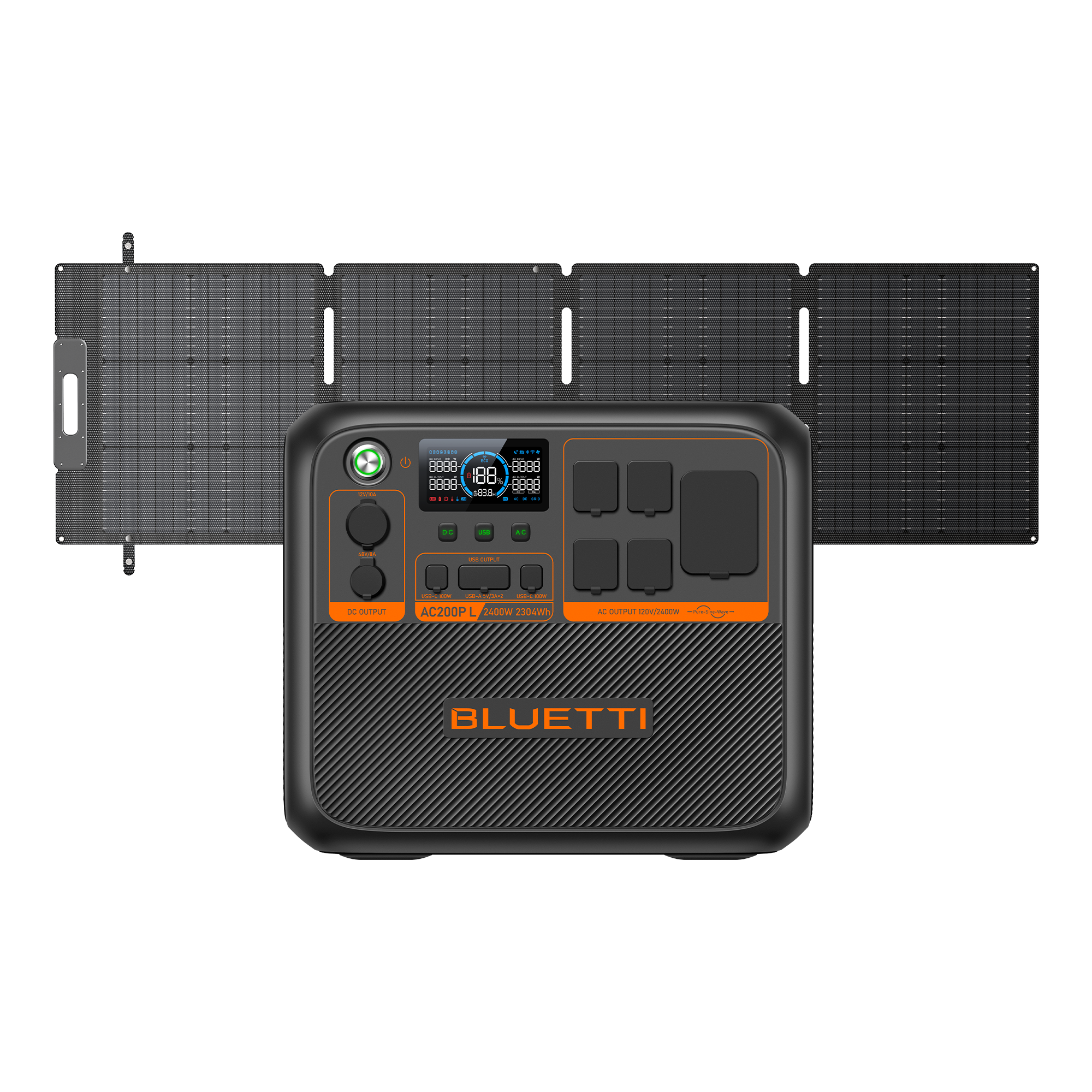
The exact selected offer is AC200P L+200W Solar, SKU AC200PL-2-21-SPFUS-00. It identifies one 200W panel but does not resolve its exact in-box panel code or electrical values; it does not raise the station input ceiling.
Explore this need in the finder →Do you require 48 V DC output in addition to the panel bundle?
The AC200P L retains its 48V/8A DC outlet, a separate output for compatible 48V equipment; the panel does not alter it.
Explore this need in the finder →Do you need both a TT-30 receptacle and later expansion support?
The AC200P L has a TT-30 receptacle and supports selected B210P, B230 and B300 expansion paths. TT-30 is still limited by the station’s 2,400W total AC rating; extra batteries are separate.
Explore this need in the finder →The exact U.S. BLUETTI offer “AC200P L+200W Solar” is a package variation of the AC200P L, not a higher-capacity station. Its retailer option ID is 45028724211931 and its package SKU is AC200PL-2-21-SPFUS-00. BLUETTI lists a 2,304 Wh battery, 2,400 W AC output and one 200 W solar panel in this offer. The panel is a useful starting component if a buyer wants the station and modest panel rating in one manufacturer package, but the station remains the same 2.4 kW/2.3 kWh platform. The exact offer’s image filename names SP200L; its current 200 W component page uses a different PV200-family SKU and does not print the bundle’s panel SKU in a carton list. I therefore keep the package panel’s exact replacement identity unresolved rather than converting an image filename into a guaranteed box label.
Solar included does not mean faster than the station allows
The station manual rates its solar input at up to 1,200 W, 15 A and 12–145 V. The bundle lists a single 200 W panel, only one-sixth of that wattage ceiling on nameplate figures. That tells you the source is smaller than the station’s maximum input capability; it does not promise a particular daily harvest, number of charging hours or recharge time. The sun angle, shade, cloud, temperature, panel placement and cable losses all matter. BLUETTI’s manual’s faster solar-charge estimate assumes a stated 1,200 W input, not the 200 W panel in this package. Do not reuse that high-input estimate for this offer.
The exact bundle image and variant title document a 200 W solar-kit option; they do not provide a separately printed panel model and component SKU. A separate BLUETTI 200 W panel page uses SP200L in its URL and compatibility copy, but its selected component record is labeled PV200-UJ-BK-MD-SPFUS-00, and the linked single-page guide’s cover identifies PV200. Because the bundle’s accessory label is not provided as an exact model line, this review treats only “one listed 200 W panel” as confirmed. Panel voltage, current, individual mass and the exact panel-to-station lead remain unconfirmed for this package. Match the actual delivered panel label and cable against the AC200P L manual before assembling any solar array.
The station itself remains a substantial RV-capable box
The AC200P L part of the offer still has four 120 V/20 A household receptacles and a 120 V/30 A NEMA TT-30 receptacle. BLUETTI’s manual says all AC output is 2,400 W total at 120 V/20 A; the TT-30 connector does not deliver a separate 30 A/3,600 W budget. Power Lifting up to 3,600 W is limited to appropriate pure-resistive loads and actual output remains 2,400 W, so it does not support an RV air conditioner or motor whose real requirement exceeds the rating. The battery panel does not alter those limits.
Other ports are two 100 W USB-C, two USB-A up to 18 W each, two wireless pads up to 15 W, a 12 V/10 A car-style outlet and a separate 48 V/8 A DC output. The 48 V port is a specialized option for compatible RV equipment; D40 is an additional accessory for the manufacturer’s illustrated RV-battery use. A 48 V label alone is not proof that an arbitrary battery can be charged safely.
Size, carrying, expansion and operating limits
The station mass is uncertain because the product page states 28.8 kg/63.5 lb while the manual gives 28.3 kg/62.4 lb. Full kit mass is also unknown, and the 200 W panel’s weight is not assigned to this package. If a strict carry ceiling matters, ask BLUETTI for the package’s exact component and carton values before choosing it. The station’s published dimensions are about 16.5 × 11 × 14.4 inches; the panel’s footprint and handling need their own setup space.
The station accepts B210P or B300 expansion batteries (up to two), or one B230, according to the manual. None is included in this solar bundle. Expansion can raise documented stored capacity as high as 8,448 Wh with two B300, but does not raise the 2,400 W AC rating. Charging is specified at 0–40°C and discharge at −20–40°C. The manual’s ≤20 ms UPS specification is accompanied by a warning against high-performance servers, workstations and medical equipment. Do not rely on it as a critical-device guarantee or connect the AC output back to a household grid.
When this package is a useful shortlist candidate
It suits a user who already wants the AC200P L’s TT-30, 48 V DC port or expansion path, needs no more than 2,400 W AC, and values an in-box 200 W panel rating more than a documented panel part number. It is less compelling if a 200 W panel alone is supposed to replenish a 2,304 Wh battery quickly, or if exact connector, panel mass, cold-temperature voltage or kit weight is an essential constraint. The exact variant carries a different package SKU from the standalone unit; verify that full SKU when comparing offers and confirm the panel code and correct lead before depending on it. If the panel model matters, the AC200P L standalone review documents the same station without treating the solar equipment as included. For a lighter panel bundle, compare smaller 1 kWh-class stations, but check their exact AC output and RV ports rather than assuming a solar kit makes them equivalent. No panel harvest, runtime or charge-time testing was done here.
Key details at a glance
| Nameplate battery capacity | 2304 Wh |
|---|---|
| Rated AC output | 2400 W |
| Manufacturer surge rating | 3600 W |
| Maximum solar input | 1200 W |
| Included panels, combined nameplate | 200 W |
| Maximum USB-C output per port | 100 W |
| Compatible extra-battery expansion | Yes |
| 12 V DC output | 120 W |
| Maximum AC recharge input | 2400 W |
| Manufacturer UPS transfer figure | 20 ms |
| AC outlet output | Yes |
| USB-C ports | 2 |
| USB-A ports | 2 |
| Solar input ports | 1 |
| 12 V car-style output | 120 W |
| Vehicle charge input | 96 W |
| Battery chemistry | LiFePO4 |
| TT-30 RV outlet | Yes |
| Manufacturer minimum charge temperature | 0 °C |
| Manufacturer minimum discharge temperature | -20 °C |
| Solar panels in exact offer | 1 |
Use the exact model’s instructions for operating limits, supplied equipment and version differences.
Sources for this assessment
- BLUETTI U.S. portable power station overview/navigation
- BLUETTI U.S. exact selected AC200P L offer
- BLUETTI U.S. AC200P L product support and manual route
- BLUETTI AC200P L User Manual V2.0, U.S. English/French PDF
- BLUETTI AC200P L exact product page primary rendering
- BLUETTI AC200P L exact U.S. product-page image
- BLUETTI AC200P L + 200W Solar exact U.S. product-page image
- BLUETTI U.S. 200W solar panel product page for identity adjudication


A useful match starts with the loads that matter.
Use the finder for hard electrical requirements, then check appliance starting behavior, actual run time and the exact package in the full assessment.