
Your needs, this model
Does it fit your priorities?
Must this package include a documented 350 W PV350D panel?
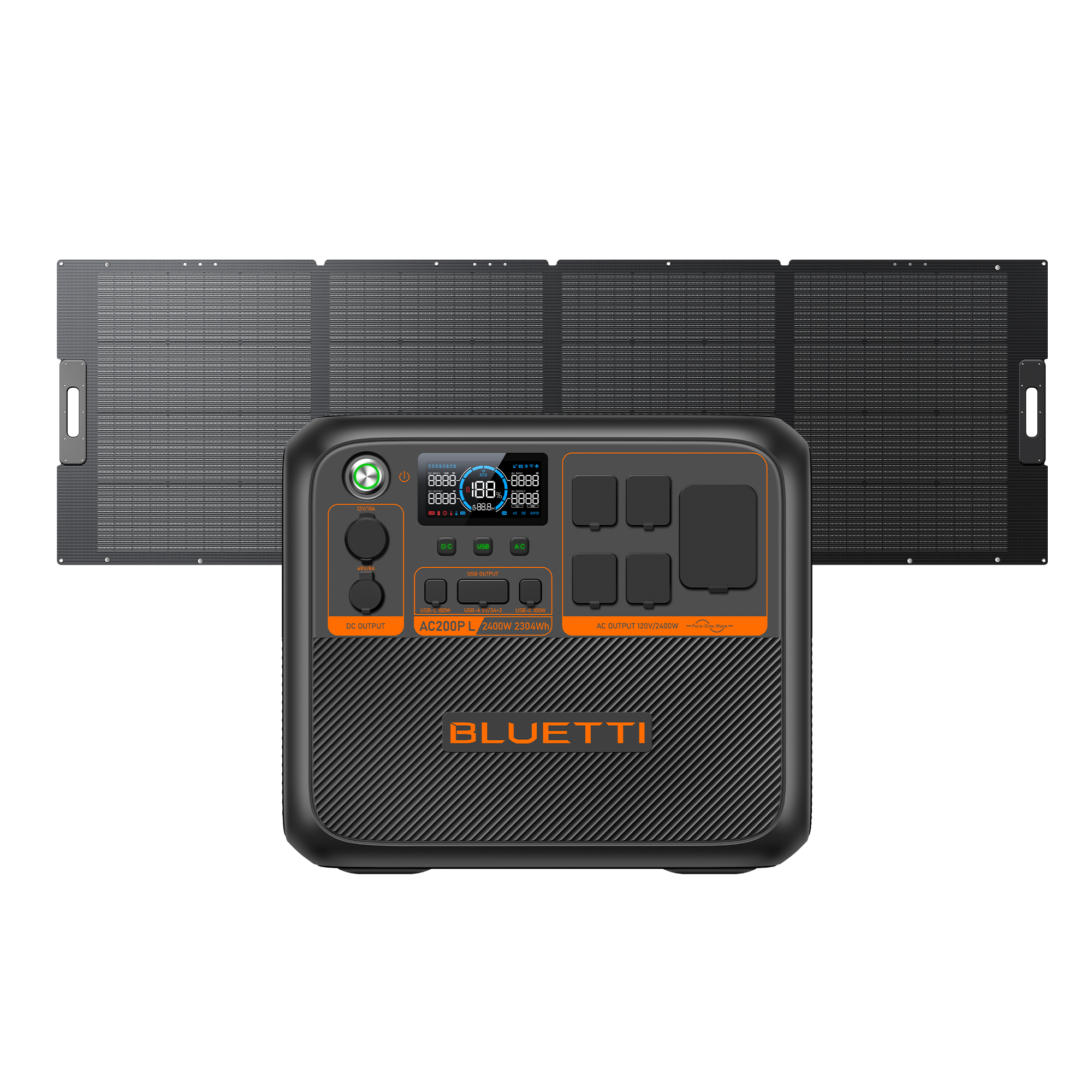
This exact option is listed as AC200P L+350W Solar and its option artwork plus BLUETTI’s U.S. PV350D guide support a single PV350D. The panel fits the station input limits nominally; sunlight does not guarantee 350W harvest.
Explore this need in the finder →Is the separate 48 V DC output essential for your compatible RV equipment?
The AC200P L offers 48V/8A DC in addition to the 350W solar package. D40 is a separate accessory, not included in this selected offer.
Explore this need in the finder →Do you need the AC200P L expansion path and TT-30 socket?
The station supports specified BLUETTI expansion batteries and has a TT-30 receptacle. The package does not include those separate batteries, and AC output remains 2,400W in total.
Explore this need in the finder →The U.S. BLUETTI AC200P L+350W Solar option pairs the AC200P L station with one listed 350 W panel. The selected variant is 45028724113627, package SKU AC200PL-2-65-SPFUS-00. Unlike the 200 W offer, the option artwork filename calls the panel PV350D, and BLUETTI’s U.S. PV350D support page links a guide whose cover names PV350D. That makes this a source-grounded component identity, although the offer title itself says “350W Solar” rather than printing a separate panel SKU. The additional panel does not change the station’s 2,304 Wh capacity or 2,400 W output. Its value is a larger single-panel solar starting point, not an upgraded inverter or battery.
A documented panel, within the nominal input window
The scanned BLUETTI PV350D guide lists 350 W maximum power, 27.6 V at maximum power, 12.7 A at maximum power, 33 V open-circuit voltage and 13.8 A short-circuit current. The AC200P L manual lists a 1,200 W solar-input maximum, 15 A maximum current and 12–145 V input. One PV350D’s listed values are therefore below the station’s published wattage, voltage and current limits in nominal conditions. This is a one-panel compatibility assessment, not a field performance result. It does not approve additional panels, a series/parallel wiring plan, or cold-weather open-circuit calculations; obtain manufacturer guidance for any multi-panel array or temperature-sensitive installation.
The PV350D guide is foldable and marks the panel IP65, with a warning not to leave it in rain or water for long periods. BLUETTI’s current generic 350 W sales page instead says IP67. Those manufacturer sources do not agree, so do not treat either as a guarantee that the entire solar kit is weatherproof; the station itself has no confirmed weather-protection rating here. The guide depicts the panel, MC4 cable and documentation in its box. The AC200P L manual separately lists a station solar charging cable among standard accessories. Do not confuse the panel’s MC4 lead with the station’s input cable, and inspect the delivered carton and connectors before assuming the kit is ready to connect. The manual and product page differ on station mass, and the PV350D guide prints a mass conversion pair that does not reconcile exactly; no full-package or carry weight is stated here.
The familiar AC200P L limits still govern
The station supplies 120 V AC through four household receptacles and one NEMA TT-30 receptacle, but its manual sets 2,400 W and 20 A as the total AC output. A TT-30 plug is not a separate full-30-amp circuit. BLUETTI’s “Power Lifting” figure of 3,600 W is limited to pure-resistive loads and does not increase the actual 2,400 W rating. Check both continuous load and start-up demand; more solar panel nameplate watts cannot help an appliance exceed the inverter ceiling.
Its 2,304 Wh LFP battery may suit a longer low-to-moderate-load plan than a compact station, but stored capacity is not guaranteed delivered AC energy. There are two 100 W USB-C ports, two 18 W USB-A ports, two 15 W wireless pads, one 12 V/10 A car outlet and a distinct 48 V/8 A DC output. BLUETTI describes that output for compatible 48 V loads and, with a separate D40, RV lithium battery charging. The D40 is not part of this solar package. For an RV, confirm the battery maker’s approved charging interface and do not mistake the station’s TT-30 receptacle for evidence of 30 A output.
Expansion, handling and continuity cautions
AC200P L can use up to two B210P or two B300 expansion batteries, or a single B230, under the manual’s documented topology. Those batteries are not included in the 350 W solar option. Two B300 can produce a published combined system capacity of 8,448 Wh, but do not increase this station’s AC rating. The base station dimensions are about 16.5 × 11 × 14.4 inches. A hard weight filter should remain unknown: the manual says 62.4 lb while the live product page says 63.5 lb, and neither tells you the complete station-plus-panel kit mass.
BLUETTI specifies charging at 0–40°C and discharging at −20–40°C. The manual’s UPS switching time is ≤20 ms, but it warns against use with high-performance servers, workstations and medical equipment. This is not a medical-device promise, and the AC output must not be tied to a building grid. A manufacturer-listed 50 dB maximum is not a quiet-mode measurement or an independent sound test. No runtime, inverter surge, panel harvest or switching test was conducted for this review.
Choose the panel package only if it solves a real setup need
This variant makes sense when the same AC200P L platform fits your 120 V/2,400 W and TT-30 plan and a 350 W panel is useful immediately. It is not an answer to a strict weight ceiling, a 240 V requirement, loads over 2,400 W, or a need for a full 30 A RV supply. If matching battery capacity and a similar inverter matter more than the 48 V output or battery expansion, the Elite 200 V2 is listed at 2,073.6 Wh and 2,600 W but has different ports and is not expandable. The Elite 300 keeps a 2,400 W output with 3,014.4 Wh and a TT-30 receptacle, but uses a distinct 12 V architecture. Check exact configuration names and panel/cable contents before choosing either alternative. This review judges published facts; it is not a test of a physical unit.
Key details at a glance
| Nameplate battery capacity | 2304 Wh |
|---|---|
| Rated AC output | 2400 W |
| Manufacturer surge rating | 3600 W |
| Maximum solar input | 1200 W |
| Included panels, combined nameplate | 350 W |
| Maximum USB-C output per port | 100 W |
| Compatible extra-battery expansion | Yes |
| 12 V DC output | 120 W |
| Maximum AC recharge input | 2400 W |
| Manufacturer UPS transfer figure | 20 ms |
| AC outlet output | Yes |
| USB-C ports | 2 |
| USB-A ports | 2 |
| Solar input ports | 1 |
| 12 V car-style output | 120 W |
| Vehicle charge input | 96 W |
| Battery chemistry | LiFePO4 |
| TT-30 RV outlet | Yes |
| Manufacturer minimum charge temperature | 0 °C |
| Manufacturer minimum discharge temperature | -20 °C |
| Solar panels in exact offer | 1 |
Use the exact model’s instructions for operating limits, supplied equipment and version differences.
Sources for this assessment
- BLUETTI U.S. portable power station overview/navigation
- BLUETTI U.S. exact selected AC200P L offer
- BLUETTI U.S. AC200P L product support and manual route
- BLUETTI AC200P L User Manual V2.0, U.S. English/French PDF
- BLUETTI AC200P L exact product page primary rendering
- BLUETTI AC200P L exact U.S. product-page image
- BLUETTI AC200P L + 200W Solar exact U.S. product-page image
- BLUETTI U.S. 200W solar panel product page for identity adjudication
- BLUETTI AC200P L + 350W Solar exact U.S. product-page image
- BLUETTI U.S. 350W solar panel product page
- BLUETTI U.S. PV350D support route and linked one-page bilingual user guide


A useful match starts with the loads that matter.
Use the finder for hard electrical requirements, then check appliance starting behavior, actual run time and the exact package in the full assessment.