
Your needs, this model
Does it fit your priorities?
Do you need 120 V AC at up to 2,400 W and about 2.3 kWh nameplate storage?
The AC200P L is rated 2,400 W total at 120 V with 2,304 Wh nameplate capacity. Stored energy is not measured AC-delivered energy, and Power Lifting does not raise the continuous rating.
Explore this need in the finder →Is a TT-30 RV receptacle essential, with the station’s shared 2,400 W ceiling understood?
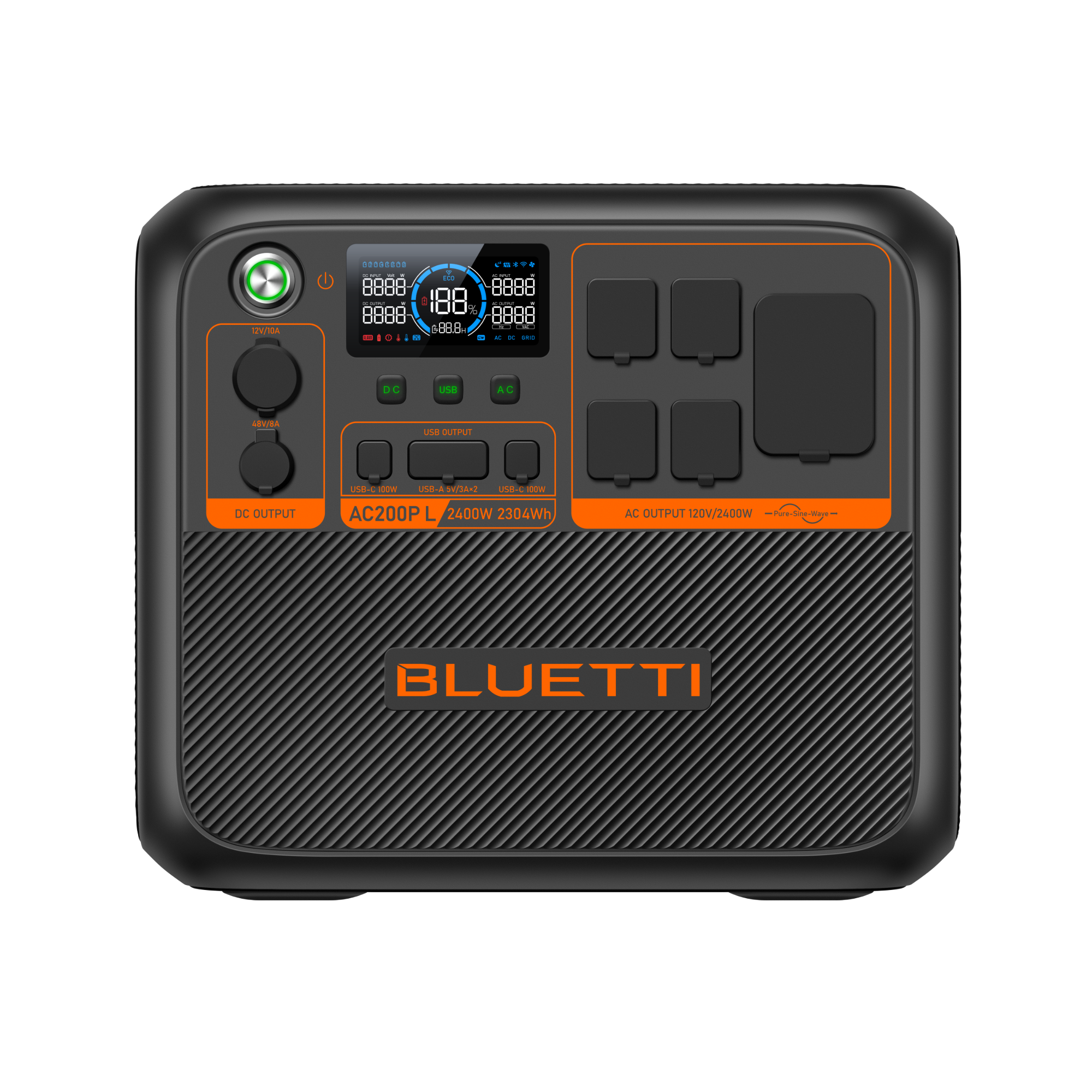
The manual lists four household outlets and one TT-30, but all AC outlets share a 2,400 W/20 A total. The TT-30 connector is not a separate full-30 A supply.
Explore this need in the finder →Do you need a documented 48 V DC / 8 A output for compatible equipment?
The AC200P L has a separate 48 V/8 A DC port. BLUETTI describes RV battery charging with the optional D40; check the load’s exact charging interface rather than treating the connector as universally compatible.
Explore this need in the finder →The BLUETTI AC200P L is a 2,304 Wh station with 2,400 W of rated 120 V AC output. Its useful distinction is not a larger inverter than every similarly sized unit; it is the combination of a high-voltage solar-input window, a NEMA TT-30 receptacle, a separate 48 V DC output and optional B210P, B230 or B300 expansion. That makes it worth comparing for a parked RV or fixed backup corner where those connectors or the battery-growth path matter. It is still a 62-pound-class box, and the unusual ports do not make its 2,400 W ceiling disappear. This assessment uses BLUETTI’s [U.S. product page](https://www.bluettipower.com/products/ac200p-l) and [AC200P L manual](https://s4.bluettipower.com/bluetti_lgf/support/2025/05/4d149741-16a3-4fb3-810c-70970a91cd9f.pdf); it is not a bench test.
One power budget behind five AC receptacles
The manual lists four 120 V/20 A receptacles and one 120 V/30 A NEMA TT-30 receptacle, but states 2,400 W in total at 120 V and 20 A. The connector count is a convenience, not five independent budgets, and the TT-30 marking is not evidence of a full 30 A supply. If an RV’s intended load plan needs more than 2,400 W at once, this is not a workaround. Check appliance starting demand as well as running labels, especially for pumps, compressors and kitchen equipment. The 3,600 W Power Lifting claim is for suitable pure-resistive loads rated from 2,400–3,600 W; BLUETTI says the actual output remains 2,400 W. It is not a higher continuous rating for a motor or mixed household loads.
The battery’s 2,304 Wh is nameplate stored energy, not guaranteed AC energy at the sockets. Conversion losses, temperatures, standby draw, inverter behavior and the particular load change runtime. The manual’s 2,400 W AC charging figure and its stated 0–80% time at 25°C are manufacturer conditions, not a charge-rate measurement here. A 50 dB maximum noise specification is likewise not an independent or all-load sound reading.
Ports that matter only when the load matches
There are two USB-C ports, each listed up to 100 W; two USB-A ports up to 18 W each; two 15 W wireless charging pads; one 12 V/10 A cigarette-lighter output; and a separate 48 V/8 A DC port. The latter is described for 48 V equipment and, with the D40 accessory, RV lithium batteries. It is not an ordinary household outlet and the D40 is not part of the standalone offer. Buyers using a proprietary RV battery should confirm the battery’s own charging requirements and the correct cable/accessory instead of treating “48 V” as universal compatibility.
Charging options include wall AC, solar, a 12 V vehicle socket, generator and lead-acid-battery charging with the appropriate optional cable. Solar input accepts 12–145 V, up to 15 A and 1,200 W; that unusually broad voltage ceiling is useful for a compatible one-panel or array plan but does not approve arbitrary series wiring. The manual says to respect voltage and current limits. In the car, the manual lists a maximum 96 W route, so vehicle charging is a slow top-up rather than a substitute for a high-current alternator charger.
Expandable, but not light
BLUETTI identifies support for B210P, B230 and B300 expansion batteries. The manual allows up to two B210P or two B300 units, but only one B230; two B300 can bring the documented system to 8,448 Wh. Those batteries and their cables are separate equipment, not hidden in this standalone SKU. Expansion adds stored capacity, not a higher rated 2,400 W inverter. Confirm exact battery model, firmware and cable instructions before building a plan around it.
Weight is unresolved: the manual gives 28.3 kg/62.4 lb, while the product page lists 28.8 kg/63.5 lb. The station’s exact carry mass therefore stays unknown in this assessment; do not make a hard maximum-weight choice from either conflicting label. Dimensions are about 16.5 × 11 × 14.4 inches. The manual lists charging from 0–40°C and discharging from −20–40°C. Neither a TT-30 socket nor the UPS feature makes this a permanent, code-compliant home transfer system: the manual warns against grid backfeed and says its ≤20 ms UPS mode is not for high-performance servers, workstations or medical equipment. Do not use it as a medical-device or critical-computing assurance.
Who should compare it—and who should move on
Consider the AC200P L if a 48 V DC output, TT-30 receptacle, 1,200 W/12–145 V solar input or documented expansion options solve a real requirement, and 2,400 W total AC is enough. An essential 240 V load, a load above the rated AC ceiling, an exact station mass limit, a medical backup need or a requirement for a full 30 A TT-30 supply should rule it out until independently verified. If a smaller carry package matters more than RV-style connections, the reviewed BLUETTI Elite 200 V2 has 2,073.6 Wh and 2,600 W rated output in a 53.35 lb listed body, but it lacks this model’s TT-30 and expansion route. The Elite 300 offers 2,400 W and TT-30 with 3,014.4 Wh, but it uses a different battery plan and is also not a 240 V supply. Compare exact port and wiring requirements rather than the family name. No runtime, surge-start, noise, UPS-transfer or panel-harvest testing was performed for this guide.
Key details at a glance
| Nameplate battery capacity | 2304 Wh |
|---|---|
| Rated AC output | 2400 W |
| Manufacturer surge rating | 3600 W |
| Maximum solar input | 1200 W |
| Included panels, combined nameplate | 0 W |
| Maximum USB-C output per port | 100 W |
| Compatible extra-battery expansion | Yes |
| 12 V DC output | 120 W |
| Maximum AC recharge input | 2400 W |
| Manufacturer UPS transfer figure | 20 ms |
| AC outlet output | Yes |
| USB-C ports | 2 |
| USB-A ports | 2 |
| Solar input ports | 1 |
| 12 V car-style output | 120 W |
| Vehicle charge input | 96 W |
| Battery chemistry | LiFePO4 |
| TT-30 RV outlet | Yes |
| Manufacturer minimum charge temperature | 0 °C |
| Manufacturer minimum discharge temperature | -20 °C |
| Solar panels in exact offer | 0 |
Use the exact model’s instructions for operating limits, supplied equipment and version differences.
Sources for this assessment
- BLUETTI U.S. portable power station overview/navigation
- BLUETTI U.S. exact selected AC200P L offer
- BLUETTI U.S. AC200P L product support and manual route
- BLUETTI AC200P L User Manual V2.0, U.S. English/French PDF
- BLUETTI AC200P L exact product page primary rendering
- BLUETTI AC200P L exact U.S. product-page image

A useful match starts with the loads that matter.
Use the finder for hard electrical requirements, then check appliance starting behavior, actual run time and the exact package in the full assessment.