
Your needs, this model
Does it fit your priorities?
Would two B300K modules and about 8.29 kWh nameplate capacity fit your fixed backup plan?
The exact box list names two B300K modules; the one Apex inverter remains rated at 3,840 W.
Explore this need in the finder →Can you accommodate roughly 214 lb of station and expansion modules?
The three listed components sum to about 213.9 lb before leads or cartons.
Explore this need in the finder →Do you require solar panels to be supplied?
The exact two-B300K box list contains no panel; solar hardware is not included in this package assessment.
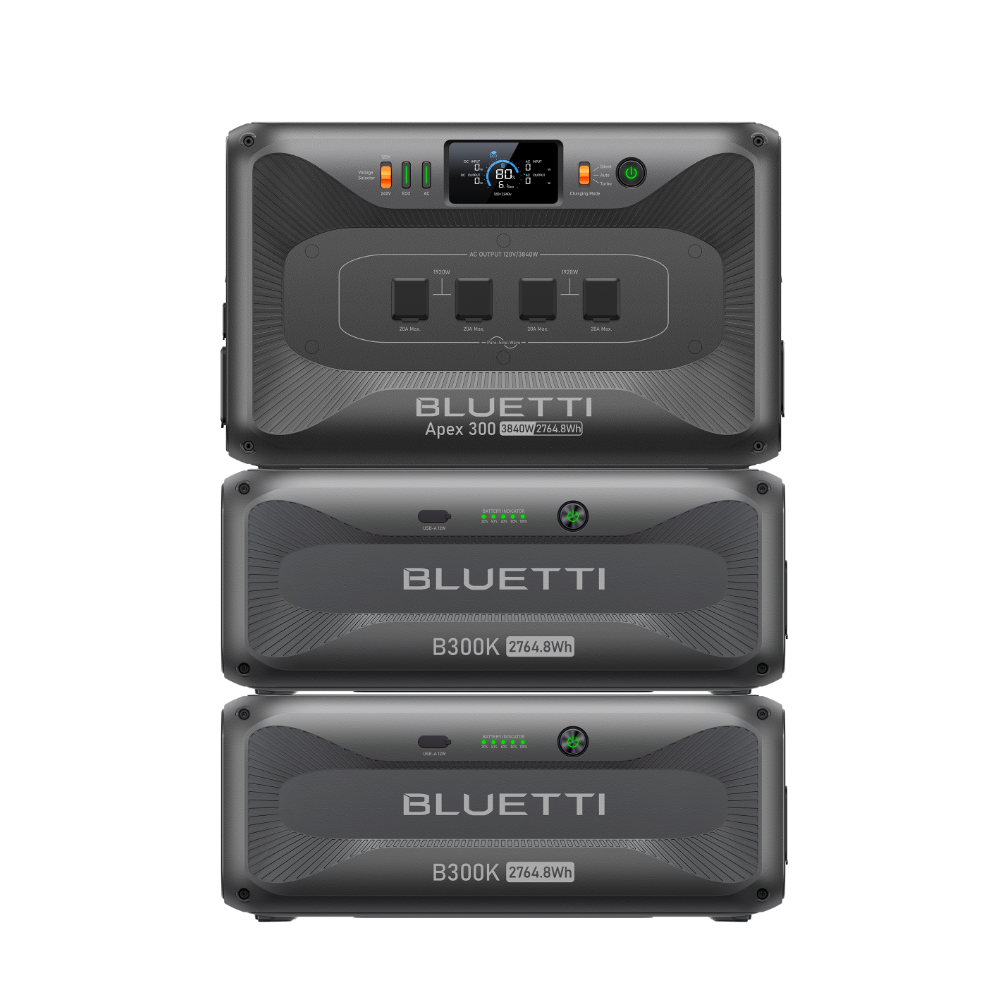
Explore this need in the finder →This exact BLUETTI package contains one Apex 300 and two B300K expansion batteries. The two modules add 5,529.6 Wh to the station’s 2,764.8 Wh battery, giving 8,294.4 Wh of combined nameplate storage. The Apex remains a single 3,840 W inverter. If your goal is more reserve for moderate loads over a longer interval, this arrangement offers a clear step beyond the one-B300K kit. If your goal is a higher-power appliance, a second battery will not raise the one station’s AC output rating.
Storage, weight and physical layout
Each B300K is listed at about 65 lb and the Apex at about 83.8 lb, so the three major components together approach 213.9 lb before cables, packing or support surfaces. This is not a kit to move as one object. Check doorways, shelving or floor load, how batteries will sit relative to the Apex, and whether a cart or two-person handling is available. The included cables allow the components to be connected; they do not make every placement or stacking arrangement sensible.
The station’s published 2,764.8 Wh and the two battery ratings add arithmetically to 8,294.4 Wh. That total is useful for comparing storage plans but is not guaranteed AC delivery. Inverter losses and conditions reduce usable output, while actual runtime depends on the load profile. If you are deciding whether this will keep a refrigerator or pump going, add the actual appliance draw and starting behavior rather than relying on a generic hours claim. The station’s 3,840 W continuous limit remains the key output constraint for a single Apex.
Ports and limitations remain those of one Apex
The Apex 300 offers selectable 120 V or 240 V output. The manual lists four NEMA 5-20R outlets, a TT-30R, a 14-50R and a P050A connector. The port panel’s overall output is not the same as each receptacle’s current capacity: at 240 V, the household ports are listed at 16 A max and 1,920 W per pair. The manual’s 7,680 W Power Lifting value is for pure-resistive loads only, not a substitute for the 3,840 W rated output on motors or compressors.
The Apex does not have direct USB or 12 V output ports in the reviewed manual; optional Hub D1 is the documented DC-output path. A product questionnaire requiring native USB-C, a conventional car outlet, or an already integrated household transfer arrangement should not consider this kit an automatic pass. It is an AC-oriented expandable system. Solar input is up to 2,400 W across two XT60 inputs with limits on voltage and current, but no solar panel is included in this package. Add only panels and wiring that satisfy the Apex manual’s input limits and local cold-corrected open-circuit voltage.
Package details and alternatives
The selected page’s in-box list identifies one Apex 300, two B300K modules, one AC charging cable, one car cable, one grounding screw, two CA90 connection cables and a manual/warranty set. This selected option is Shopify variant 47353679315163; do not confuse it with the separate single-B300K or dual-station Hub A1 offers. The package contains expansion batteries, not a second Apex inverter, Hub A1, or solar panels.
For less handling, the one-B500K configuration adds 5,120 Wh in a single but heavier module; the two-B500K option increases the total system capacity much further. The one-B300K version weighs less but tops out at 5,529.6 Wh as packaged. These alternatives all retain one Apex output stage and the same output/voltage tradeoffs. If 240 V is essential, choose that mode and verify how the specific load maps to the outlet limits; two 120 V sockets do not create split phase.
How the questionnaire should treat it
Use a 8,294 Wh nameplate-capacity floor only if it reflects a real storage need and the size of a station-plus-two-battery placement is acceptable. An 8,295 Wh floor is above this package’s documented arithmetic total and should exclude it. A total-equipment-weight ceiling below about 213.9 lb should also exclude the principal station and modules; the figure omits leads and cartons. A panel-in-box requirement should exclude it, as should a 240 V need if you intend to operate only in the 120 V mode. A required TT-30 receptacle can be met only in the supported 120 V configuration. The questionnaire should not mark solar wiring or USB output as included.
Keep the IP20 station dry and follow the current battery connection and temperature instructions. Do not route AC power into house wiring using a cord or self-made transfer method. We have not tested runtime, real solar yield, usable AC energy or appliance startup. The review is based on the exact selected Apex 300 + 2 B300K offer, the official Apex manual and the B300K manual.
Key details at a glance
| Nameplate battery capacity | 8294.4 Wh |
|---|---|
| Rated AC output | 3840 W |
| Maximum solar input | 2400 W |
| Included panels, combined nameplate | 0 W |
| Maximum USB-C output per port | 0 W |
| Listed weight | 83.78 lb |
| Compatible extra-battery expansion | Yes |
| Maximum AC recharge input | 1800 W |
| AC outlet output | Yes |
| USB-C ports | 0 |
| USB-A ports | 0 |
| Solar input ports | 2 |
| Battery chemistry | LiFePO4 |
| Ingress rating | IP20 |
| TT-30 RV outlet | Yes |
| Solar panels in exact offer | 0 |
Use the exact model’s instructions for operating limits, supplied equipment and version differences.
Sources for this assessment

A useful match starts with the loads that matter.
Use the finder for hard electrical requirements, then check appliance starting behavior, actual run time and the exact package in the full assessment.