
On this page
Your needs, this model
Does it fit your priorities?
Do you need the second 2,764.8 Wh B300K, or would the Apex 300 alone be enough?
The exact package totals 5,529.6 Wh nameplate, but remains a single 3,840 W Apex 300 inverter; battery capacity is not additional AC output.
Explore this need in the finder →Is a solar panel in the exact box essential?
The current Trolley 2 offer is a distinct package from BLUETTI’s separately named panel bundles; do not count its 2,400 W station input as an included panel.
Explore this need in the finder →Must the complete battery-and-trolley setup stay below a whole-system weight ceiling?
The Apex 300 and B300K alone total 148.82 lb; the Trolley 2 and complete bundle mass are unreported, so an essential total-plan weight limit is not confirmed.
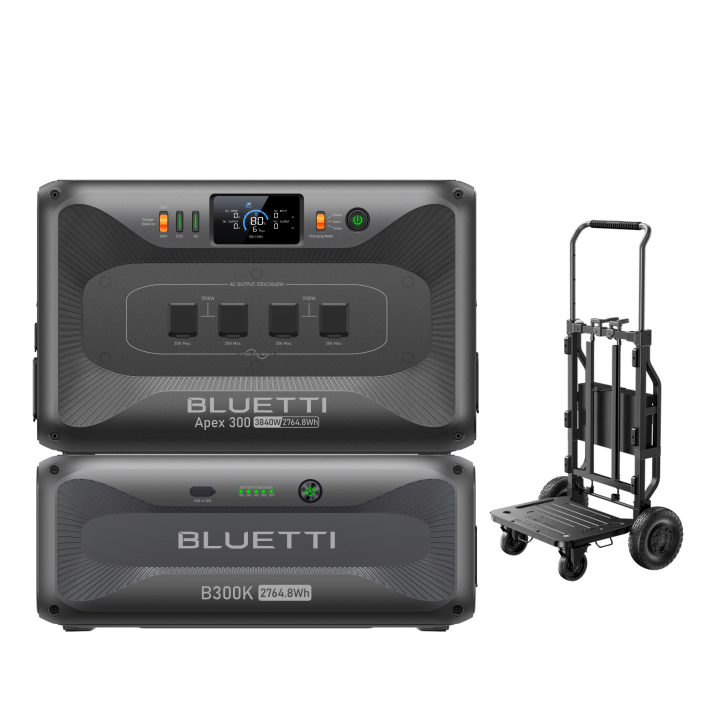
Explore this need in the finder →This is the current U.S. BLUETTI offer named “Apex 300 + B300K + Foldable Trolley 2,” not a different inverter or a higher-output version of the Apex 300. The selected manufacturer page describes 5,529.6 Wh, 3,840 W and 120 V/240 V; its package image shows the Apex 300, one B300K battery and the folding trolley. The maker’s selected offer page and the Apex 300 U.S. manual are the basis for this assessment. The image is a transparent manufacturer rendering, not a photograph of a sample we own or tested.
Who this package fits
Consider it for a home, workshop or recurring work site where you want more nameplate storage than the station alone and a wheeled accessory may help move the equipment across a clear floor. The extra battery is the main electrical change. The trolley is a handling aid, not extra energy, an inverter or a lighter battery. This is still a large, heavy system rather than a carry-in-a-hand portable station.
BLUETTI rates the Apex 300 station itself at 2,764.8 Wh, 3,840 W AC and 83.78 lb. The B300K manual lists another 2,764.8 Wh and about 65.04 lb. Together that is 5,529.6 Wh of nameplate battery capacity and 148.82 lb for those two components before the trolley, cables or packaging. The trolley’s weight and the complete package’s total mass were not published in the saved selected-offer materials, so a strict whole-kit weight ceiling cannot be verified. Those figures are specifications, not measured usable energy or a runtime promise. See the Apex manual’s specifications and the B300K U.S. manual.
More reserve, not more AC watts
One Apex 300 inverter remains rated for 3,840 W continuous AC whether it is used alone or with this one B300K. The battery adds reserve for a longer outage or longer work session; it does not raise the single station’s rated output to 5,000 W or 7,680 W. Check motor and compressor starting demand as well as the appliance’s running label, and keep the total within the station’s outlet-specific ratings. The manual describes a selectable 120 V/240 V output mode and gives different limits by outlet and mode; choose the supported plan your load actually needs instead of treating every receptacle as simultaneously available at its headline maximum.
The B300K manual identifies the CA90 expansion cable as the connection for Apex 300. The exact trolley offer page’s rendered “In the Box” panel is a station-level list, not a complete three-piece bundle packing manifest, so confirm the included battery lead and the trolley’s mounting/retention details before setup. The page also says units are delivered separately. Do not interpret the included cart as permission to move connected equipment while operating.
Solar and DC needs change the answer
The Apex 300 manual supports two solar inputs, up to 1,200 W per input, with 12–60 V and 20 A maximum per input; the combined ceiling is 2,400 W. That is a station input limit, not panel output or expected harvest. The Trolley 2 offer is distinct from the product page’s separately named panel bundles, and its selected image shows no panel. If a panel in the exact box is essential, this package should not satisfy that requirement. If you already own compatible panels, verify their open-circuit voltage and current against both input limits before connecting them.
This option does not list a Charger 2, Hub D1 or a higher-capacity parallel kit. If your use requires a particular 12 V/DC or USB arrangement, check the exact output hardware and cable in the manual or a separately reviewed hub bundle rather than borrowing features from a different Apex configuration. The station-only ratings here do not establish that an accessory is included.
Which nearby configuration is the better buy?
Choose the Apex 300 by itself if 2,764.8 Wh is enough and the extra B300K and trolley would add cost and bulk without solving a real need. Choose the Apex 300 + B300K base package if the added storage matters but the trolley does not. If your requirement is above 3,840 W, a second battery is not the fix: compare a separately reviewed two-Apex/Hub A1 configuration with its own supported 240 V operating plan and installation requirements. For solar charging, select a confirmed panel-in-box bundle only if that package’s exact panel model and host compatibility are verified.
In the questionnaire, this package can fit a 5.5 kWh nameplate request in a supported 120 V or 240 V plan, while a 4,000 W continuous-output requirement rules it out. Requiring an included solar panel also rules it out. If total system weight is essential, leave the ceiling active: the known station-and-battery mass alone is 148.82 lb and the trolley mass is unknown, so the complete kit cannot be certified below a strict threshold. The best case for this offer is specific—more storage than the base station, plus a trolley option—not a claim that it is light, panel-equipped or more powerful.
Key details at a glance
| Nameplate battery capacity | 5529.6 Wh |
|---|---|
| Rated AC output | 3840 W |
| Maximum solar input | 2400 W |
| Included panels, combined nameplate | 0 W |
| Maximum USB-C output per port | 0 W |
| Listed weight | 83.78 lb |
More specifications and setup details
| Compatible extra-battery expansion | Yes |
|---|---|
| Maximum AC recharge input | 1800 W |
| AC outlet output | Yes |
| USB-C ports | 0 |
| USB-A ports | 0 |
| Solar input ports | 2 |
| Battery chemistry | LiFePO4 |
| Ingress rating | IP20 |
| TT-30 RV outlet | Yes |
| Expansion battery in this package | Yes |
| Solar panels in exact offer | 0 |
| Included expansion batteries | 1 units |
Use the exact model’s instructions for operating limits, supplied equipment and version differences.
Sources for this assessment

A useful match starts with the loads that matter.
Use the finder for hard electrical requirements, then check appliance starting behavior, actual run time and the exact package in the full assessment.