
Your needs, this model
Does it fit your priorities?
Would one included B300K and roughly 5.53 kWh nameplate storage fit your plan?
The exact package adds one 2,764.8 Wh B300K to the 2,764.8 Wh Apex; nameplate total is not delivered AC energy.
Explore this need in the finder →Is a supplied solar panel essential?
This exact B300K offer lists no solar panel; compatible solar equipment is separate.
Explore this need in the finder →Can your location handle roughly 149 lb of station and battery equipment?
The listed Apex and B300K weights sum to about 148.8 lb before cables and cartons.
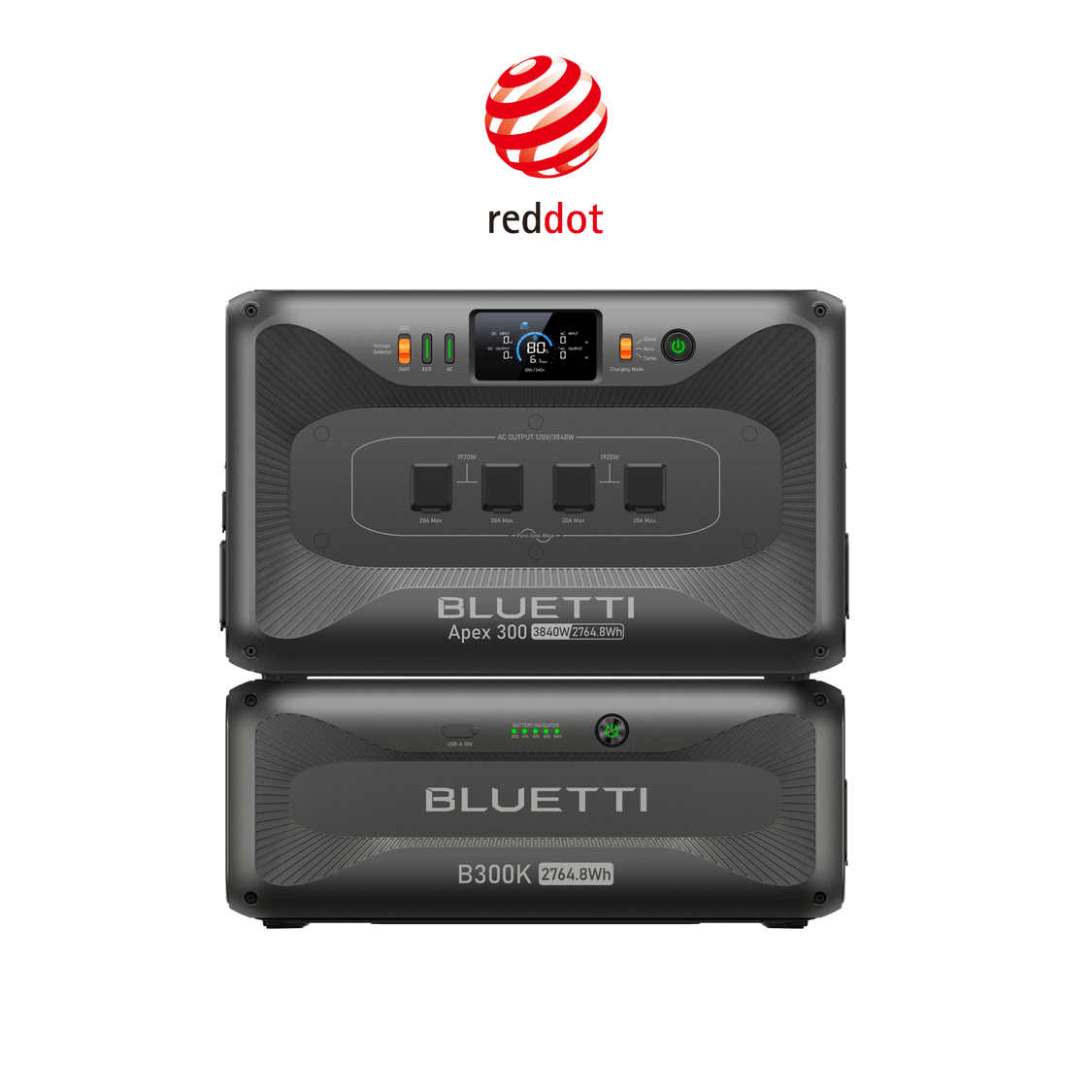
Explore this need in the finder →This exact BLUETTI Apex 300 + B300K U.S. package pairs one Apex 300 inverter with one B300K expansion battery and its CA90 battery cable. It starts with the same 3,840 W rated AC output and selectable 120/240 V modes as the standalone Apex, but doubles nameplate storage from 2,764.8 Wh to 5,529.6 Wh. That distinction is the reason to choose this package: it buys more reserve for the same one-station output, not more watts for a larger appliance.
Who benefits from the included B300K
The B300K is a 2,764.8 Wh LiFePO4 expansion module. Its manual gives a listed mass around 65 lb; the Apex itself is about 83.8 lb. Together the two major components weigh roughly 148.8 lb before connection cables, charging leads or cartons. The expansion unit is therefore not a small accessory. This configuration is better for a fixed backup corner, workshop, vehicle base or a site where the equipment can be moved by cart than for frequent hand-carried use.
More capacity can lengthen an outage plan for loads that already fit the Apex’s outlet and watt limits. It cannot guarantee a particular number of hours: nameplate watt-hours are not delivered AC watt-hours, and the result depends on load and conversion losses. Nor does the B300K make one Apex a 7,680 W source. If your appliance exceeds the station’s 3,840 W rating—or needs an unverified startup surge—this is not a solution. If you need longer runtime rather than extra output, however, an included compatible battery is a more concrete starting point than buying the bare station and deciding later.
Connections and operating plan
The exact offer page’s box contents list one Apex 300, one B300K, one AC cable, one car cable, one grounding screw, a CA90 battery connection cable and one manual/warranty set. It is not a solar-generator bundle: no panel is listed. The B300K connects as a DC expansion battery, not as an independent AC power station. BLUETTI documents up to six B300K batteries with an Apex 300; the one-in-box package is only the first supported increment. Its source material recommends matching the cable length to battery placement and proper stacking, rather than letting a heavy battery perch insecurely.
For 120 V use, the Apex manual shows four NEMA 5-20R outlets and a TT-30R among its ports. It also has a 14-50R and a P050A connection. At 240 V, per-outlet current and paired-port power limits still apply; the outlet panel and voltage selector should be checked against the manual. The “Power Lifting” figure is only for pure-resistive loads and should not be substituted for the rated continuous output when choosing a motor or compressor.
How the questionnaire should interpret it
A capacity choice around 5.5 kWh should distinguish this package from the 2.76 kWh standalone unit, while a 3,840 W AC minimum should remain tied to the Apex inverter’s real rating. A request for a supplied panel should disqualify it because the exact offer does not list one. If the required connection is native USB-C or a 12 V car outlet, do not count an expansion battery as satisfying it; the Apex 300 has no native USB/DC output panel documented in the reviewed manual. Select 240 V only for equipment that needs that voltage, and require TT-30 only for a compatible 120 V operating plan.
When total lifting weight matters, use the combined station-and-expansion figure rather than the station-only value. This package’s core components add to about 148.8 lb. A strict 140 lb total-system ceiling therefore rules it out even though the Apex body alone is under 84 lb. Conversely, a 150 lb ceiling may admit the listed components while leaving cables and packing outside that estimate; do not turn the estimate into a shipping weight.
Alternatives and boundaries
The Apex 300 + B500K package gives a larger capacity step from one expansion module—7,884.8 Wh combined—at a much higher added module mass. The two-B300K package reaches 8,294.4 Wh using two smaller modules and is a different footprint/carry plan. If you need to start small, compare the standalone Apex and add batteries only after confirming that the station and cable route suit the site. None of these single-Apex battery packages changes the station’s AC output rating.
The equipment is IP20, so keep it dry and use the manufacturer’s ventilation and temperature guidance. Do not connect its AC output to house wiring through an improvised cord. No runtime test, independent power measurement or physical sample assessment is represented. Source basis: BLUETTI’s exact U.S. Apex 300 + B300K offer, the Apex manual and B300K manual.
Key details at a glance
| Nameplate battery capacity | 5529.6 Wh |
|---|---|
| Rated AC output | 3840 W |
| Maximum solar input | 2400 W |
| Included panels, combined nameplate | 0 W |
| Maximum USB-C output per port | 0 W |
| Listed weight | 83.78 lb |
| Compatible extra-battery expansion | Yes |
| Maximum AC recharge input | 1800 W |
| AC outlet output | Yes |
| USB-C ports | 0 |
| USB-A ports | 0 |
| Solar input ports | 2 |
| Battery chemistry | LiFePO4 |
| Ingress rating | IP20 |
| TT-30 RV outlet | Yes |
| Solar panels in exact offer | 0 |
Use the exact model’s instructions for operating limits, supplied equipment and version differences.
Sources for this assessment

A useful match starts with the loads that matter.
Use the finder for hard electrical requirements, then check appliance starting behavior, actual run time and the exact package in the full assessment.