
On this page
Your needs, this model
Does it fit your priorities?
Do your essential loads need the Apex 300’s selectable 120 V or 240 V output together with about 7.9 kWh nameplate storage?
One Apex 300 supplies the inverter; one B500K adds 5,120Wh to its 2,764.8Wh base, while the station remains rated 3,840W AC.
Explore this need in the finder →Must the exact package include both expansion storage and a 500W solar-panel component?
The current option is titled Apex 300 + B500K + 500W Solar; panel model and electrical label remain unspecified.
Explore this need in the finder →Can you accept a station-plus-battery equipment plan around 183lb before the panel and cartons?
Apex 300 and B500K listed masses total about 183lb; panel/full-package mass is unknown, so a lower capacity ceiling is not demonstrated.
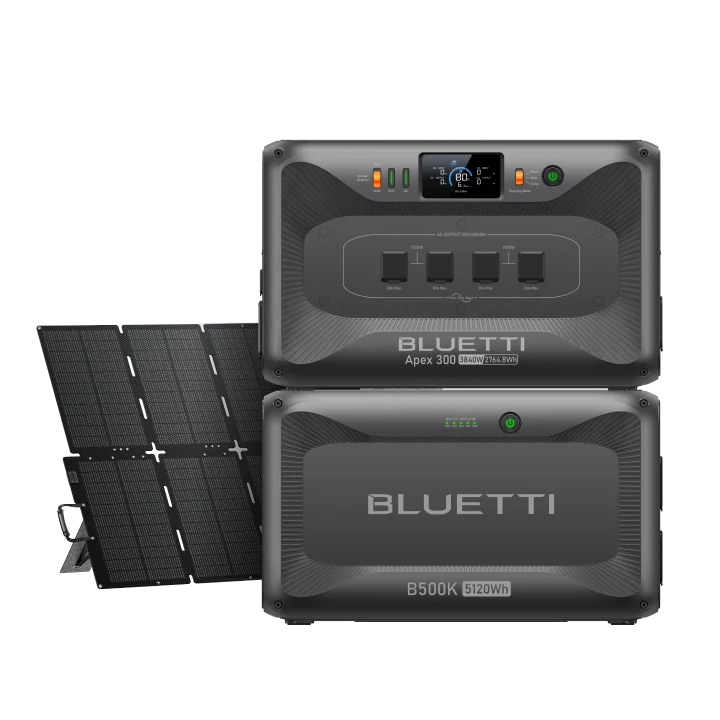
Explore this need in the finder →This exact U.S. offer joins an Apex 300 with one B500K expansion battery and a 500W solar-panel package. That is a more complete starting point for a backup plan than the Apex 300 + B500K alone: the advertised nameplate storage is 7,884.8 Wh, and the product option also names a 500W panel. The inverter remains one Apex 300, rated at 3,840 W AC. It does not become a second inverter when the battery is added, and a panel rating is not a promise of daily solar energy. The manufacturer’s current page title and option selector say “Apex 300 + B500K + 500W,” although the old route slug still says 350W. Before ordering, verify that the selected option displayed on the page is the 500W package.
The extra battery changes stored energy, not output power
The Apex 300 contributes 2,764.8 Wh and the B500K contributes 5,120 Wh, for 7,884.8 Wh of combined nameplate capacity. The single station’s published AC rating stays 3,840 W. Those numbers describe different limits: capacity is stored energy, while the inverter rating is a power ceiling. They do not establish how long any particular fridge, sump pump or other essential will run. Build a load list from the appliance labels or measured consumption, include motor-starting demand, and allow for conversion losses rather than treating all 7.88 kWh as usable AC energy.
The B500K is an expansion battery, not a second AC power station. It connects to the Apex system using the supported battery path; it does not add a separate set of wall outlets. This makes the bundle relevant to an outage plan that values more reserve behind one inverter, but not to someone whose essential loads exceed that inverter’s rating. The Apex manual documents selectable 120 V and 240 V operation. At either setting, consult the manual’s outlet-by-outlet limits and your appliance requirements; selecting 240 V does not mean every receptacle can deliver the full system rating.
The 500W panel is useful, but not fully characterized
The manufacturer’s option name and associated product material identify a 500W solar-panel component with the B500K package. That distinguishes it from the Apex 300 + B500K offer, whose box list has no panel, and from the Apex 300 + 500W Solar package, which has the panel but no included B500K. The current page material does not establish a separate bundle SKU or a complete carton-by-carton packing list. The panel’s exact model, electrical label, dimensions, weight and weather rating are not stated in the bundle information I could verify. I therefore would not use the package image or a panel filename to infer those specifications.
The Apex 300 manual gives a station-side solar limit of up to 2,400 W across two inputs, each rated up to 1,200 W within a 12–60 V DC and 20 A window. That is the station’s maximum input capability, not what this one 500W panel necessarily delivers. Because the included panel’s exact voltage and current are not disclosed here, do not calculate charge time or assume the panel can be freely combined with other panels. Check the panel label, connection plan and manual limits before adding anything. The 500W designation is a helpful package distinction, not a field-harvest guarantee.
Who should choose this configuration?
It suits a stationary home, cabin or workshop backup arrangement where the buyer wants a larger battery and a panel in the same offer, and has a safe place for the components. The station is about 83.8 lb and the B500K about 99.2 lb: those two known pieces alone total roughly 183 lb. The panel and full package weight are not established, so this is not a compact carry kit. Plan delivery, lifting and placement before purchasing. Keep the power station and expansion battery dry; the Apex 300 is IP20, not a weatherproof outdoor enclosure. Treat the panel as a separate setup item and secure it appropriately for its actual location and manual guidance.
Questionnaire choices that change the match
Choose 240 V if an essential appliance or system actually needs it; a 120 V-only plan can use the Apex’s 120 V mode instead. A requirement for AC output is met, and the exact offer includes one B500K expansion battery plus a 500W solar-panel component. If you need solar charging but already own compatible panels, the less expensive or lighter Apex + B500K package may fit better, subject to separately checking those panels. If the included panel is essential, the Apex + B500K listing without solar should fall off your shortlist. If your required panel model or electrical operating point must be known in advance, this offer’s published bundle details do not answer that question; unknown values should not count as a pass.
A 12 V DC output requirement is a different issue: the Apex 300 itself has no documented native USB/DC output ports, so this configuration should not be chosen for direct 12 V loads on the strength of its AC outlets or solar input. The included battery also does not cure a need for more than 3,840 W AC. For shoppers who want the panel but not the heavy B500K, compare the Apex 300 + 500W Solar offer. For shoppers who want storage but already own a compatible array, compare the Apex 300 + B500K review. A lighter B300K-based package trades away some nameplate capacity for less battery mass.
Setup boundaries and alternatives
Use the manufacturer’s supported connection method and current manual for the Apex and B500K; do not improvise battery cabling or treat a storage bundle as an installed transfer system. A portable station should not be connected by backfeeding a household wall outlet. The package can be a candidate for keeping selected loads powered, but home-circuit backup needs compatible equipment and safe installation. The official sources establish component ratings, not our own runtime, recharge-time or outage-duration test. For the exact offer and current selection, see BLUETTI’s Apex 300 + B500K + 500W option page, the Apex 300 U.S. support/manual page and the B500K support/manual page.
Key details at a glance
| Nameplate battery capacity | 7884.8 Wh |
|---|---|
| Rated AC output | 3840 W |
| Maximum solar input | 2400 W |
| Included panels, combined nameplate | 500 W |
| Maximum USB-C output per port | 0 W |
| Listed weight | 83.78 lb |
More specifications and setup details
| Compatible extra-battery expansion | Yes |
|---|---|
| Maximum AC recharge input | 1800 W |
| AC outlet output | Yes |
| USB-C ports | 0 |
| USB-A ports | 0 |
| Solar input ports | 2 |
| Battery chemistry | LiFePO4 |
| Ingress rating | IP20 |
| TT-30 RV outlet | Yes |
| Expansion battery in this package | Yes |
| Separate station units in offer | 1 |
| Solar panels in exact offer | 1 |
| Included expansion batteries | 1 units |
Use the exact model’s instructions for operating limits, supplied equipment and version differences.
Sources for this assessment

A useful match starts with the loads that matter.
Use the finder for hard electrical requirements, then check appliance starting behavior, actual run time and the exact package in the full assessment.