
On this page
Your needs, this model
Does it fit your priorities?
Do you want Charger 2 in the exact kit for combined vehicle and solar charging?
This bundle includes Charger 2 and supports vehicle plus solar inputs together, with a documented 1,200 W maximum package charging ceiling; vehicle wiring and suitable sun are required.
Explore this need in the finder →Does a 12/24 V DC Hub path need to be part of your one station plan?
This package includes the Charger 2 DC Hub. Its offer page states up to 600 W, while its manual diagram lists 700 W max; matching conservatively uses 600 W and exact output-current limits need checking.
Explore this need in the finder →Do you need 240 V AC from the Apex 300 as well as the bundled Charger 2 system?
The Apex 300 remains a selectable 120/240 V, 3,840 W station with 2,764.8 Wh nameplate storage; the charger does not add inverter watts or an expansion battery.
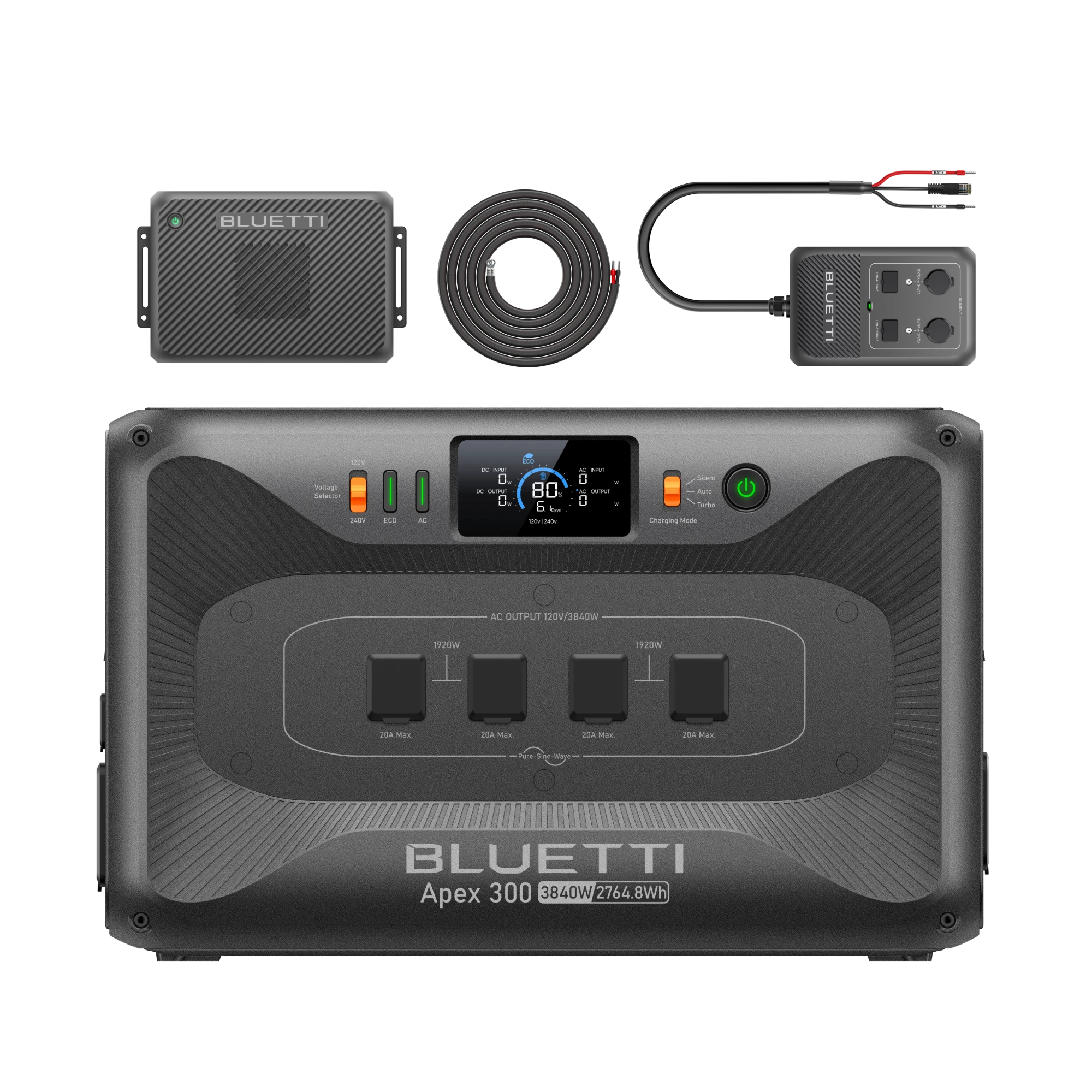
Explore this need in the finder →The BLUETTI Apex 300 + Charger 2 + DC Hub is a specific U.S. package for a buyer who wants more than a stand-alone battery: the offer combines one Apex 300 power station with a vehicle-oriented charger and a separate 12/24 V DC hub. The selected variant is 48103718486235, package SKU APEX300-3-87-SPFUS-00. The current manufacturer box list names the Apex 300, Charger 2, DC Hub for Charger 2, cables, a 75 A fuse, mounting screws, and manuals. It does not list a solar panel or an expansion battery. Those exact contents are the important difference from the similarly named standalone, solar-panel, and B300K bundles.
One inverter and a charging system
The Apex 300 remains the core station: 2,764.8 Wh of nameplate capacity, 3,840 W rated AC, and selectable 120 V or 240 V output in BLUETTI’s U.S. manual. Adding Charger 2 does not create a second inverter or increase the station’s AC rating. Four AC receptacles and the limits on each outlet still determine which loads can run together. The capacity figure is not delivered AC energy, and a larger appliance can have startup demand that a headline wattage does not settle. For a home or RV plan, compare the actual appliance ratings and outlet arrangement before assuming one station will power everything.
The practical addition is Charger 2. BLUETTI describes simultaneous alternator and solar charging with a maximum 1,200 W package charging ceiling. Its manual’s system overview lists up to 800 W from a vehicle starter battery and a 600 W, 50 V / 20 A solar input; those individual maxima should not be added into a 1,400 W promise because the documented combined ceiling is 1,200 W. The selected bundle includes the car battery cable, MC4 input and output cables, bidirectional power cable, fuse, and fasteners. It is a vehicle installation, not simply a cigarette-lighter plug: the Charger 2 is mounted and wired into the vehicle system. Follow the current manual, fuse and polarity instructions, and use a qualified automotive installer if you are not comfortable working at the vehicle battery and fuse box.
DC output is a separate hub path
The Apex 300 station itself does not provide the ordinary built-in USB or 12 V outlets some smaller stations have. This exact bundle changes that by including the DC Hub for Charger 2, through which BLUETTI says it can supply 12 V or 24 V DC devices. The offer page advertises up to 600 W of DC output. The archived Charger 2 manual’s overview diagram instead labels the DC Hub “700 W Max.” Because those manufacturer references differ, I use 600 W as the conservative matching ceiling and would not choose a load on the assumption that 700 W is continuously available. The per-output current limits and the reason for the rating difference need confirmation from the exact current manual before connecting a demanding DC load.
This path is not equivalent to a native 12 V socket on the Apex. It adds wiring, a separate hub, and an installation decision. The product page also notes the need for an Anderson adapter cable for a DC-panel connection and says the DC panel itself is not included. Confirm the connector and device voltage before purchase. If your essential plan is only household AC, the less elaborate Apex 300 alone may be a better match. If you need direct DC power without an in-vehicle install, compare a station that has the required built-in outputs rather than assuming this bundle behaves like one.
Solar and expansion are options, not box contents
There is no panel in the selected box list. That does not mean the station cannot charge from solar: Apex 300 has its own two documented solar inputs, each rated up to 1,200 W within 12–60 V DC and 20 A per input. Charger 2 provides a separate vehicle-plus-solar route with its own 600 W solar ceiling. The two figures describe different input paths and should not be added into one unverified simultaneous station charging total. Choose a compatible panel and the intended route using the manual’s connector and electrical limits.
The station supports compatible expansion batteries, but none is bundled here. A B300K would increase storage rather than the 3,840 W rating of the Apex inverter, and its weight would make the installed system less convenient to move. BLUETTI lists the station at about 83.8 lb; the package’s complete weight including Charger 2, DC Hub, cables, and mounting hardware is not stated. Plan for a fixed location in a vehicle or backup area and allow for a professional installation, rather than treating the whole system as a grab-and-go power box.
Who should shortlist it
In the questionnaire, this bundle is the relevant choice when one plan needs Apex 300’s AC output, Charger 2 included, the documented vehicle-and-solar charging route, and a DC Hub path. It should fail an essential “solar panel included” condition: the charger accepts a solar input, but no panel is supplied. It should also fail an included-expansion-battery condition. This keeps charging capability separate from included hardware and avoids matching a buyer to an absent panel or battery.
Consider the Apex 300 + 500W Solar if a panel in the carton matters more than vehicle charging or the DC hub. Consider the Apex 300 + B300K if the priority is more stored energy and you do not need this Charger 2/DC Hub package. For an AC-only backup plan, the standalone Apex 300 removes extra installation complexity. In every case, compare the exact selected option: several Apex 300 configurations share a product family page and similar station images. Here the package SKU, Charger 2, and DC Hub are the defining details; a separate panel, B300K, or DC-panel adapter should not be assumed.
Key details at a glance
| Nameplate battery capacity | 2764.8 Wh |
|---|---|
| Rated AC output | 3840 W |
| Maximum solar input | 2400 W |
| Included panels, combined nameplate | 0 W |
| Maximum USB-C output per port | 0 W |
| Listed weight | 83.78 lb |
More specifications and setup details
| Compatible extra-battery expansion | Yes |
|---|---|
| 12 V DC output | 600 W |
| Maximum AC recharge input | 1800 W |
| Total rated DC output | 600 W |
| AC outlet output | Yes |
| USB-C ports | 0 |
| USB-A ports | 0 |
| Solar input ports | 2 |
| Vehicle charge input | 800 W |
| Battery chemistry | LiFePO4 |
| Ingress rating | IP20 |
| TT-30 RV outlet | Yes |
| Published vehicle-charger package ceiling | 1200 W |
| Charger 2 solar input ceiling | 600 W |
| Expansion battery in this package | No |
| Separate station units in offer | 1 |
| Solar panels in exact offer | 0 |
| Included expansion batteries | 0 units |
Use the exact model’s instructions for operating limits, supplied equipment and version differences.
Sources for this assessment
A useful match starts with the loads that matter.
Use the finder for hard electrical requirements, then check appliance starting behavior, actual run time and the exact package in the full assessment.