
Your needs, this model
Does it fit your priorities?
Does the Apex 300’s selectable 240 V mode suit an essential appliance?
The manual documents selectable 120/240 V output and 3,840 W rated AC, with lower per-outlet limits that need checking.
Explore this need in the finder →Do you need compatible battery expansion later?
The Apex 300 supports up to six B300K batteries, though none is in this standalone box and added batteries do not increase this inverter’s rated watts.
Explore this need in the finder →Does your appliance require native USB-C or 12 V DC output?
No direct USB/DC outputs are documented on the Apex 300; a separate accessory route should not be counted as built in.
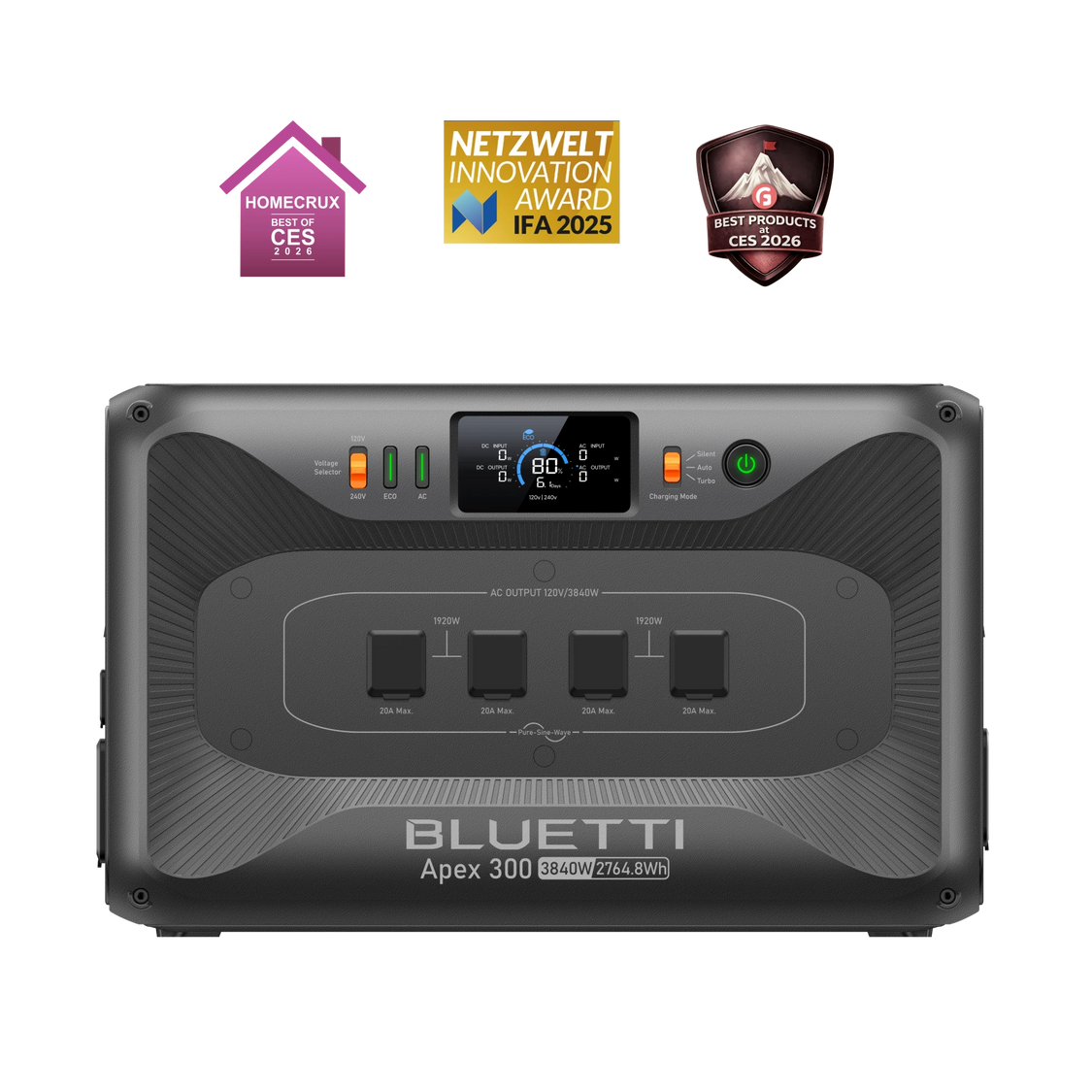
Explore this need in the finder →The BLUETTI Apex 300 is a large, expandable power station with an unusually flexible outlet panel: its manual documents selectable 120 V or 240 V output, a 3,840 W rated AC ceiling and a 2,764.8 Wh LiFePO4 battery. It is best treated as a heavy backup/worksite unit rather than a casually portable battery. At about 83.8 lb before cables, it is a two-person lift for many owners, and its 20.67 × 12.87 × 12.6 in body needs a stable, dry place.
What the output selector means in practice
At 120 V, the Apex has four NEMA 5-20R outlets, a TT-30R, a 14-50R and a P050A output connection. The manual’s outlet diagrams show that total wattage and per-outlet limits still matter: four household receptacles do not each deliver the full station rating simultaneously. At 240 V the listed household ports are limited to 16 A each, with each pair sharing up to 1,920 W. Use the exact port table for the load and selected voltage, not just the large 3,840 W headline. The optional “Power Lifting” figure is 7,680 W for pure-resistive loads only; it is not a 7,680 W continuous rating for compressors, motors or unknown startup loads.
The central limitation is easy to miss in photos: the Apex 300 itself does not provide ordinary USB or 12 V DC output ports. BLUETTI documents the Hub D1 as the add-on route for DC loads. If your everyday kit is phones, USB-C laptops, a car-fridge plug or other low-voltage accessories, a smaller station with native DC ports may be simpler. If you need 240 V, a TT-30 receptacle or a substantial AC load, this model has a more relevant output layout, subject to the manual’s individual circuit limits.
Capacity and expansion are separate decisions
The 2,764.8 Wh rating is nameplate battery capacity, not a promise of that much AC energy reaching an appliance. Inverter conversion, load, temperature and operating conditions reduce delivered energy. BLUETTI allows the Apex to use compatible B300K, B300 or B300S expansion batteries, but advises against mixing battery types. With up to six B300K units, its published combined nameplate capacity reaches 19,353.6 Wh. The expansion modules add substantial weight and cost; they do not raise the single Apex inverter’s rated output. A larger battery is useful only if you have a real longer-duration plan, not as a way to run a load above the station’s output limits.
Solar is another potentially large system, not a casual panel connection. The manual describes two XT60 solar inputs, each rated up to 1,200 W, with 12–60 V DC and a 20 A maximum per input; the model’s combined ceiling is 2,400 W. These are limits for compatible panel wiring, not an expected daily yield. Check open-circuit voltage for local cold conditions, current, connector type and each input’s rules in the current manual before combining panels. Do not assume the panels in another BLUETTI kit are included with this standalone option.
How to choose this configuration
This standalone offer suits someone who wants one expandable 120/240 V inverter and will choose batteries or solar equipment separately after matching them to a specific use. It is the cleanest starting point if you do not yet know how much storage you need. The exact package box list states one Apex 300 plus its AC charging cable, car charging cable, grounding screw and manual/warranty card; it does not include an expansion battery or solar panel. Listed station weight is not total system weight.
Questionnaire choices should change the shortlist materially. Select 240 V or TT-30 only when the exact appliance or RV connection needs it. A required USB-C output, 12 V car socket, or native DC port should rule the Apex out unless you are separately planning a documented Hub D1 configuration. A capacity minimum above 2,764.8 Wh should qualify only when you select a supported battery plan, while a weight cap should be read as the station body alone unless the question explicitly asks for the complete equipment plan. The Apex’s manufacturer battery expansion support can meet a future-expansion preference, but no extra battery is assumed in this reviewed standalone package.
For a ready-made capacity step, compare the exact Apex 300 + B300K offer. A B500K package gives more added capacity per module but is heavier still. If you need USB, vehicle/DC sockets or easier one-person handling, look at the smaller BLUETTI Elite models or a station with native ports rather than solving a different need with a large inverter.
Limits and safe setup
The manual rates the enclosure IP20, so this is not a rain-exposed camping station. Keep it dry, ventilated and within the documented temperature range; do not improvise an inlet or connect its AC output to household wiring by backfeeding. Hub A1 parallel or home-backup installations involve dedicated connections and require proper installation—not extension-cord improvisation. No independent runtime, transfer-time measurement, usable AC energy test or appliance-start test is claimed here. Manufacturer specifications describe the product, not a tested result.
Checked against BLUETTI’s selected U.S. Apex 300 offer, its U.S. manual and official support page.
Key details at a glance
| Nameplate battery capacity | 2764.8 Wh |
|---|---|
| Rated AC output | 3840 W |
| Maximum solar input | 2400 W |
| Included panels, combined nameplate | 0 W |
| Maximum USB-C output per port | 0 W |
| Listed weight | 83.78 lb |
| Compatible extra-battery expansion | Yes |
| Maximum AC recharge input | 1800 W |
| AC outlet output | Yes |
| USB-C ports | 0 |
| USB-A ports | 0 |
| Solar input ports | 2 |
| Battery chemistry | LiFePO4 |
| Ingress rating | IP20 |
| TT-30 RV outlet | Yes |
| Solar panels in exact offer | 0 |
Use the exact model’s instructions for operating limits, supplied equipment and version differences.
Sources for this assessment

A useful match starts with the loads that matter.
Use the finder for hard electrical requirements, then check appliance starting behavior, actual run time and the exact package in the full assessment.