
Your needs, this model
Does it fit your priorities?
Must the U.S. offer include one 350 W panel and its station-side 10 A solar cable?
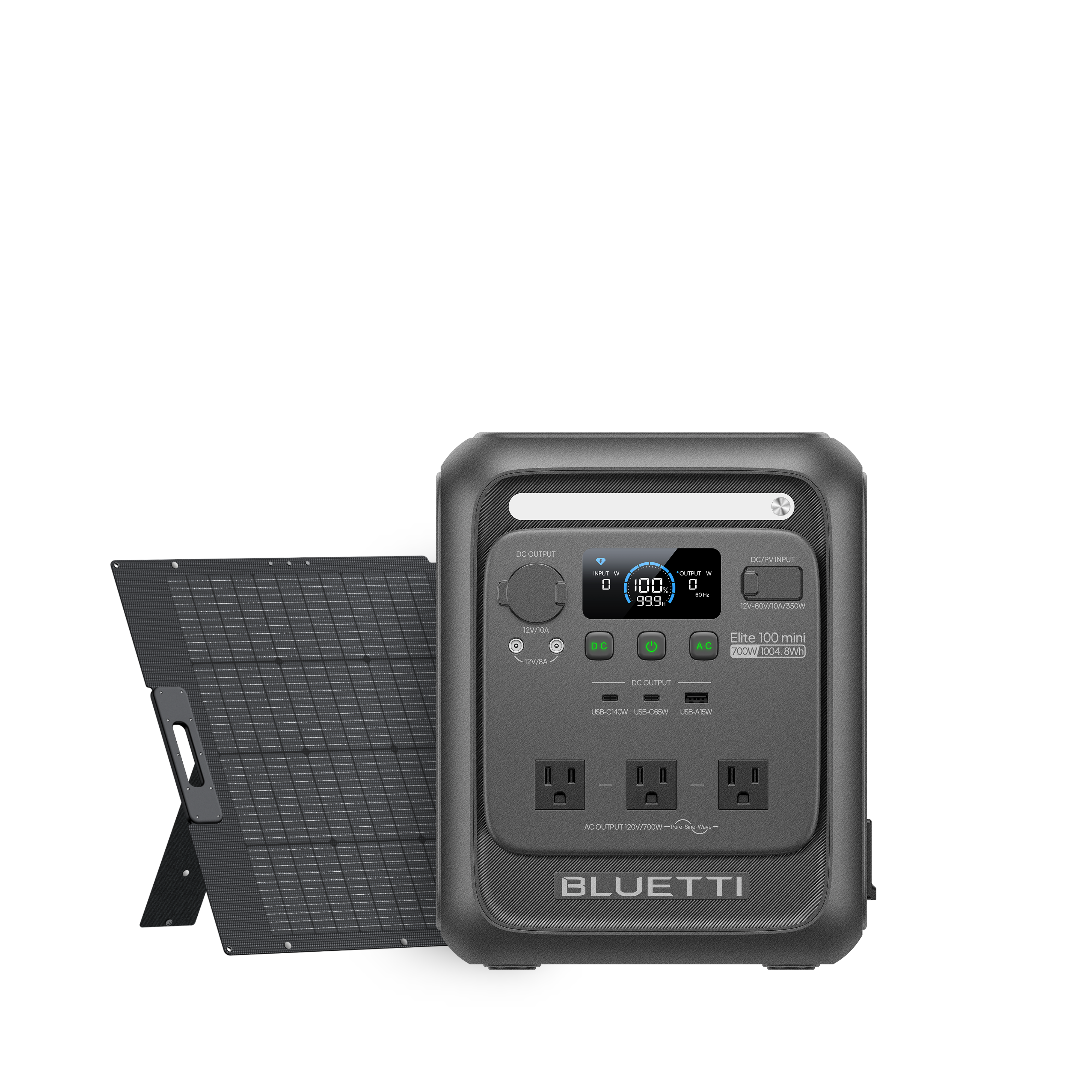
The selected Elite 100 mini +350W option lists one 350 W Solar panel and one 10 A MC4-to-XT60 lead. Its panel is identified as PV350D from the official in-box asset and support/manual bridge; the lead rating is not a solar charge-rate promise.
Explore this need in the finder →Does the station still suit a 1 kWh, 700 W 120 V load plan when a 350 W panel is in the box?
The package keeps the EL100M’s 1,004.8 Wh and 700 W/120 V station ratings. Its separate panel rating cannot raise the AC ceiling, and its 350 W solar input is a maximum at 10 A, not guaranteed harvest.
Explore this need in the finder →Is this a light station body with a 350 W supplied-panel option, not a 350 W measured charge guarantee?
The EL100M station body is 23.59 lb; whole-kit mass is not established because the panel guide prints conflicting weight units. The 350 W panel label and 350 W station input maximum are different measurements, with the panel’s listed Imp above the station’s 10 A limit.
Explore this need in the finder →The BLUETTI Elite 100 mini +350W Solar is an exact U.S. EL100M package, not a higher-output station. The selected listing gives SKU EL100M-2-05-SPFUS-00 and lists one Elite 100 mini, one 350W Solar panel, one 10A MC4-to-XT60 solar lead, AC and car cables, and a manual. BLUETTI's PV350D guide and package image identify the supplied panel family. The panel and lead add no storage or inverter capacity.
The station remains a 1 kWh, 700 W unit
The EL100M is listed at 1,004.8 Wh, 700 W of 120 V AC and 23.59 lb for the station body. Its three AC receptacles share that 700 W continuous rating. The 1,400 W Power Lifting mode is not a general inverter rating: the manufacturer describes it for pure resistive loads, and it does not make a compressor, motor or sensitive electronic load a safe 1,400 W match. A device with an unknown startup demand needs more investigation than a nameplate wattage comparison.
The station's useful mix of AC, USB-C, USB-A and 12 V outputs is unchanged by this package. The EL100M manual limits combined AC and DC output to 700 W and total DC output to 200 W. The 1,004.8 Wh figure is battery nameplate capacity, not energy independently measured at the AC outlets or a promised runtime. The panel does not solve either a continuous-load problem or an overnight energy shortfall on its own.
A 350 W panel does not mean a measured 350 W charge
The PV350D manual lists 350 W nameplate output, 27.6 V at maximum power, 12.7 A at maximum power, 33 V open circuit and 13.8 A short-circuit current. The EL100M manual gives the station's solar input as 12–60 V, at most 10 A and at most 350 W. The panel's listed voltage points sit inside the station's voltage window, but its 12.7 A maximum-power current is above the station's 10 A limit. The selected bundle page itself puts this panel with the EL100M and includes a 10 A MC4-to-XT60 cable, so this review describes the exact manufacturer-offered package rather than advising a generic panel match. Still, neither source explains the current difference or states what solar power the station will actually accept from this panel.
That distinction matters. The panel's 350 W is a nameplate rating, and the station's 350 W is an input ceiling, not a delivered-charge guarantee. Sun angle, shade, temperature and the station's input behavior all affect real power. Do not count on a 350 W charge rate, assume the station can use the panel's full 12.7 A operating point, or add a second panel in series or parallel from the package listing alone. The cautious plan is one supplied PV350D and the listed cable, following current BLUETTI instructions; if a guaranteed full-panel current or charge-rate match is essential, ask BLUETTI for clarification before purchase. This bundle should not be treated as proof that all 350 W of panel output is usable by the EL100M.
Portability is a package question
The station body is 23.59 lb, but that number is not the weight of the whole kit. The PV350D guide prints two panel-mass units that do not agree when converted, so I do not use either as a precise panel or package-weight figure. The panel is a separate folding component, and cables add more to the carry. If your limit applies to everything carried from car to campsite, the station-only weight will understate the real load. A station weight threshold in a shortlist is not a total-kit guarantee.
Panel setup needs open space and sunlight, so it is not equivalent to an outlet at a shaded campsite or in bad weather. The package simplifies buying the EL100M, panel and lead together, but the panel still must be unfolded and positioned. If your stops are short or shaded, plan another recharge route. No field harvest or recharge-time test is claimed here.
Where the package improves on the alternatives
Compared with the standalone EL100M, this option puts a 350 W panel and its station-side lead in the same offer. The +100W package supplies a smaller panel, but the Mini still has the same 350 W, 10 A input ceiling; the larger nameplate rating does not establish a proportional charge-time improvement. A smaller panel may be easier to handle for occasional top-ups, while the standalone station avoids duplicate equipment if you already own compatible gear.
If the main need is a larger appliance rather than a larger panel, compare the Elite 100 V2: it retains roughly 1 kWh of nameplate capacity while listing 1,800 W AC and a 1,000 W solar input, rather than the Mini's 700 W AC and 350 W solar ceiling. The V2 is a different station, not a mode available by attaching this panel. Conversely, the Mini's lower station-body weight may be useful when keeping the power station itself small matters more than inverter headroom.
How to set your requirements
Choose this profile if you want the 350 W panel nameplate and station-side cable in the same offer and the EL100M's 1,004.8 Wh / 700 W station otherwise fits. A 350 W included-panel setting means nameplate wattage; a 350 W solar-input setting means the station's published maximum. Neither promises real-world charging. Needs above 350 W solar input, above 700 W continuous AC, confirmed expansion or a known whole-kit weight do not fit the evidence. If 350 W delivered to the station is essential, treat that as unresolved rather than translating the panel label into a match.
No physical sample, charge-rate test, runtime measurement or panel-harvest test was performed. The exact EL100M +350W U.S. package listing, PV350D guide and Elite 100 mini support and manual page are the relevant first-party references. Confirm the panel-current question and any strict carry-weight need with BLUETTI before relying on this combination.
Key details at a glance
| Nameplate battery capacity | 1004.8 Wh |
|---|---|
| Rated AC output | 700 W |
| Maximum solar input | 350 W |
| Included panels, combined nameplate | 350 W |
| Maximum USB-C output per port | 140 W |
| Listed weight | 23.59 lb |
| 12 V DC output | 120 W |
| Maximum AC recharge input | 700 W |
| Manufacturer UPS transfer figure | 10 ms |
| Total rated DC output | 200 W |
| AC outlet output | Yes |
| USB-C ports | 2 |
| USB-A ports | 1 |
| Solar input ports | 1 |
| 12 V car-style output | 120 W |
| Vehicle charge input | 192 W |
| Battery chemistry | LiFePO4 |
| Manufacturer minimum charge temperature | 0 °C |
| Manufacturer minimum discharge temperature | -20 °C |
| Solar panels in exact offer | 1 |
Use the exact model’s instructions for operating limits, supplied equipment and version differences.
Sources for this assessment
A useful match starts with the loads that matter.
Use the finder for hard electrical requirements, then check appliance starting behavior, actual run time and the exact package in the full assessment.