
Your needs, this model
Does it fit your priorities?
Is the included Charger 1 vehicle route, bounded to 350 W by the EL100M, enough for your recharge plan?
The selected package contains BLUETTI Charger 1. Its 560 W hardware maximum is above the station limit; a manual-derived 35 V / 10 A setting is 350 W within both published ranges. Actual charging was not measured.
Explore this need in the finder →Must Charger 1 and the station-side solar lead be included, with no panel requirement?
The selected option lists Charger 1 and an MC4-to-XT60 station lead, but no panel. The EL100M retains its own 350 W solar input; the full package mass is not stated.
Explore this need in the finder →Does your essential plan require direct solar and Charger 1 to charge the station at the same time?
The station has a 350 W solar/DC input and the package includes Charger 1, but the station and Charger 1 manuals do not establish simultaneous use of the two sources on this exact setup. Treat that combination as unconfirmed.
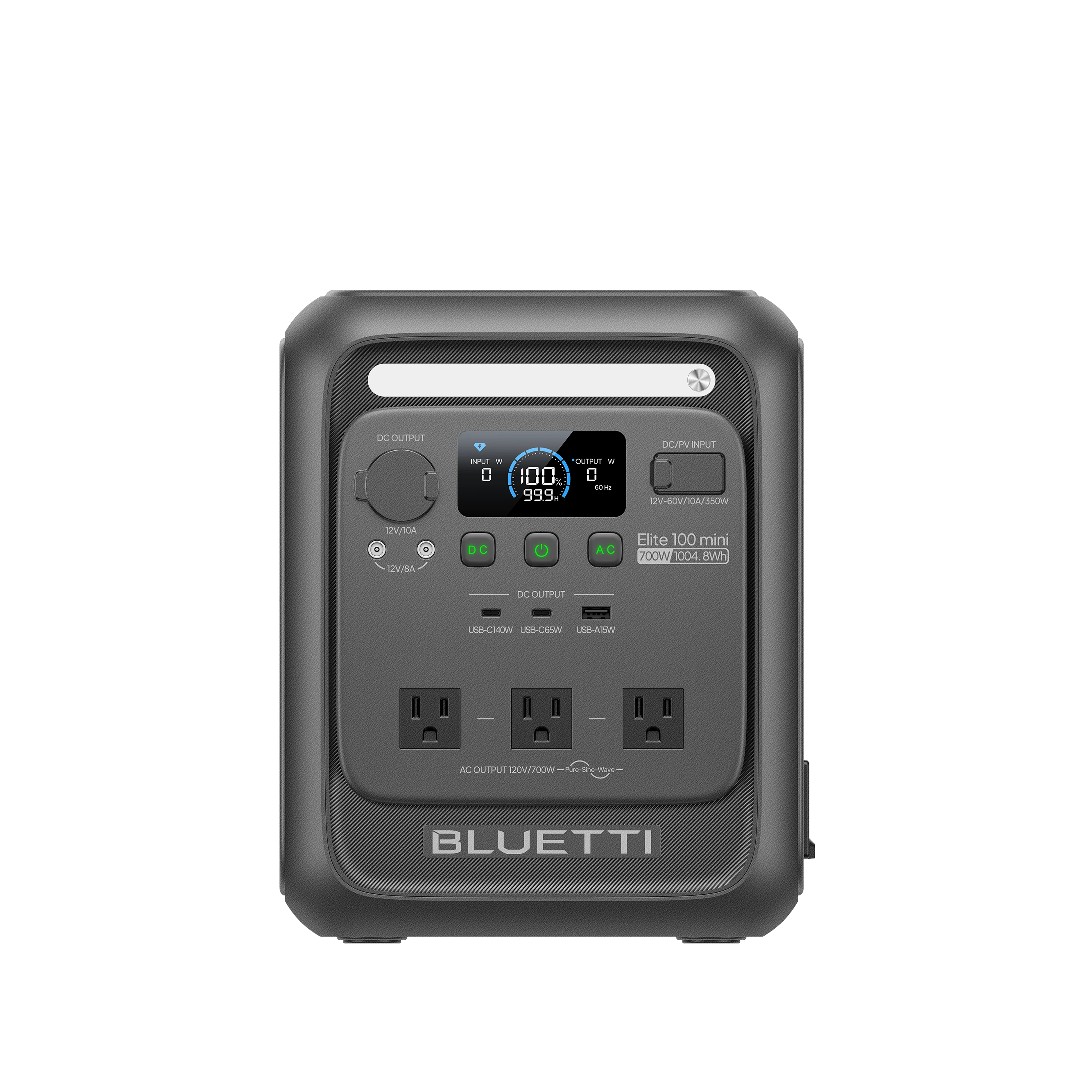
Explore this need in the finder →The exact U.S. “Elite 100 mini + Charger 1” option pairs BLUETTI’s EL100M station with its vehicle-battery DC-to-DC charger. This is a materially different recharge plan from plugging the station into a car’s accessory socket: Charger 1 is wired to a 12 V or 24 V vehicle battery, then feeds the station through its solar/DC input. The selected package page identifies variant 49212172009691 and SKU EL100M-2-10-SPFUS-00. The package does not change the station’s battery or AC output.
Keep the station limit separate from the Charger 1 headline
The EL100M remains a 1,004.8 Wh LiFePO4 station rated for 700 W of 120 V AC. Its manual lists a 350 W solar/DC input limit at 12–60 V and 10 A. Charger 1 has a higher 560 W hardware maximum, but that does not turn this bundle into a 560 W charging configuration: the station is the limiting component. The Charger 1 manual gives a default 27 V output, a 10 A current limit and app-adjustable voltage ranges of 15–56 V from a 12 V battery or 27–56 V from a 24 V battery. At its 27 V default and 10 A ceiling, the arithmetic output is 270 W; a 35 V / 10 A setting is within both published ranges and meets the EL100M’s 350 W / 10 A input ceiling. These are compatible settings derived from the two manuals, not measured charge rates. Vehicle capability, wiring, temperature, battery state and conversion losses can all reduce real input.
That distinction matters when comparing Charger 1 with the station’s ordinary car-charging cable. The EL100M manual lists up to 96 W from a 12 V vehicle input or 192 W at 24 V. Charger 1 can provide a higher configured DC input when installed and adjusted within the station’s limits, but a buyer should not assume the accessory’s 560 W maximum will reach this station. Nor does it add energy storage, raise the 700 W inverter rating, create a 240 V output, or establish an expansion-battery route.
This is a wired vehicle installation, not a plug-in adapter
The selected U.S. station package page lists one Elite 100 mini, one Charger 1, an AC charging cable, the ordinary car charging cable, a user manual and an MC4-to-XT60 solar charging cable. No solar panel is listed. The Charger 1 manual’s own packing list names its 5 m / 6 AWG battery-input cables with a 60 A breaker, an MC4 output cable, terminals, mounting hardware and product documentation. Its wiring directions connect to the vehicle battery; this is not an accessory-socket charger. Follow the charger manual’s battery, breaker, clearance and output-voltage requirements, and plan the physical installation before treating it as a travel convenience. The station’s standard car cable is a separate, simpler route with its lower 12 V / 24 V limits.
The package also lists an MC4-to-XT60 solar lead but no panel. That makes the lead available for a separately selected compatible panel; it does not prove that a particular solar panel is in the box. Charger 1’s manual describes connecting its MC4 output cable to the station’s solar-charging cable, while the EL100M manual supplies the 12–60 V / 10 A / 350 W station-input limits. The manuals do not establish that Charger 1 and direct solar charging may be used simultaneously on this package, so do not make a both-sources-at-once plan essential unless BLUETTI confirms it for the exact setup.
Who should choose this configuration?
This version suits a van, RV or road-trip owner who wants the EL100M’s modest household AC output and DC ports, but expects to replenish it from a properly wired vehicle battery while driving. It is less suitable for someone who wants to recharge from a 12 V socket without installation, or who needs a high-output appliance above 700 W continuous. If a 192 W 24 V vehicle charge route is enough, the standalone EL100M already lists that input and may avoid buying and mounting the extra charger. If solar is the priority, the exact +100W package is a different in-box choice: it lists one panel and its station-side lead, while this Charger 1 offer lists the lead but no panel.
For questionnaire choices, selecting “Charger 1 included” is appropriate only for this exact package; the normal EL100M listing should not pass that condition. A 350 W minimum vehicle-charger package threshold is supported by the station-capped 35 V / 10 A operating plan, but a threshold above 350 W is not. The package’s total carry mass is not published. The station alone is listed at 23.59 lb and Charger 1 at about 2.645 lb, before cables and other contents, so use a whole-kit weight limit only if the complete configuration is confirmed. The selected-plan total weight therefore remains unknown.
No physical sample, vehicle installation, runtime measurement, charge-rate test or delivered-AC-energy test was performed for this assessment. The exact EL100M + Charger 1 U.S. option, Elite 100 mini manual and support page, and Charger 1 support and manual page are the relevant manufacturer references. Check the exact package and installation requirements before purchase.
Key details at a glance
| Nameplate battery capacity | 1004.8 Wh |
|---|---|
| Rated AC output | 700 W |
| Maximum solar input | 350 W |
| Included panels, combined nameplate | 0 W |
| Maximum USB-C output per port | 140 W |
| Listed weight | 23.59 lb |
| 12 V DC output | 120 W |
| Maximum AC recharge input | 700 W |
| Manufacturer UPS transfer figure | 10 ms |
| Total rated DC output | 200 W |
| AC outlet output | Yes |
| USB-C ports | 2 |
| USB-A ports | 1 |
| Solar input ports | 1 |
| 12 V car-style output | 120 W |
| Vehicle charge input | 192 W |
| Battery chemistry | LiFePO4 |
| Published vehicle-charger package ceiling | 350 W |
| Manufacturer minimum charge temperature | 0 °C |
| Manufacturer minimum discharge temperature | -20 °C |
| Solar panels in exact offer | 0 |
Use the exact model’s instructions for operating limits, supplied equipment and version differences.
Sources for this assessment
- BLUETTI US Elite 100 mini product page, selected standalone option
- BLUETTI US Elite 100 mini product record
- BLUETTI Elite 100 mini support and downloads page
- Elite 100 mini User Manual, English US low-voltage edition A0 26.06.04
- BLUETTI US Elite 100 mini + Charger 1 selected package option
- BLUETTI Charger 1 official support page
- BLUETTI Charger 1 User Manual V1.0
A useful match starts with the loads that matter.
Use the finder for hard electrical requirements, then check appliance starting behavior, actual run time and the exact package in the full assessment.