
Your needs, this model
Does it fit your priorities?
Will a 700 W rated 120 V AC ceiling and about 1,000 Wh nameplate capacity cover the loads you need to run?
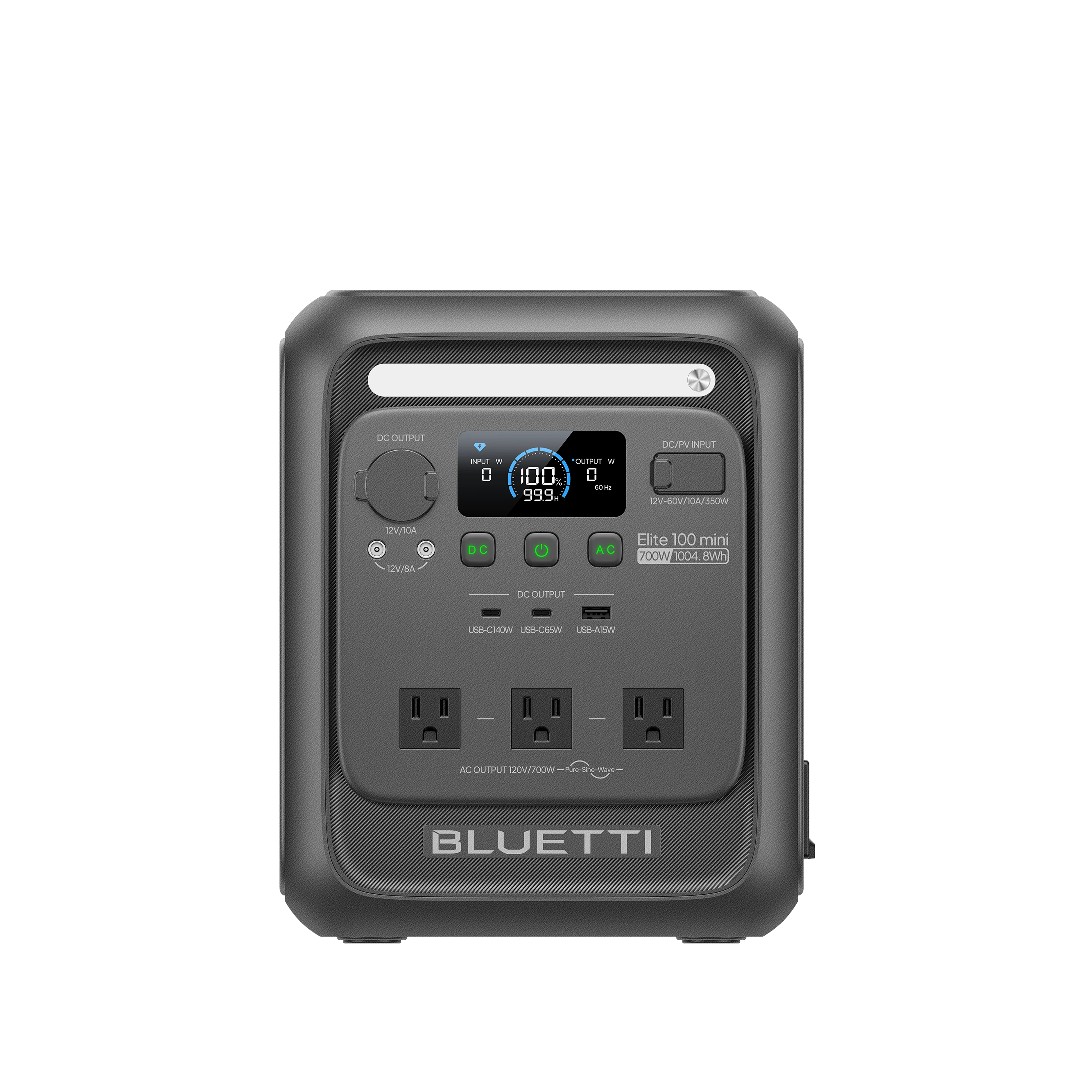
The standalone EL100M lists 700 W of 120 V AC and 1,004.8 Wh of LiFePO4 storage. Nameplate capacity is not delivered AC energy, and Power Lifting up to 1,400 W is only for pure resistive loads; it does not raise the rated AC ceiling.
Explore this need in the finder →Do you need one 140 W USB-C port and up to 350 W of solar-input acceptance in a station under 24 lb?
The manual lists 140 W and 65 W USB-C ports and a 350 W maximum solar input within a 12–60 V, 10 A window. The 23.59 lb figure is station weight; the base offer does not include a panel or optional solar cable.
Explore this need in the finder →Does your plan need a 12 V output and a carryable 1 kWh station, without requiring expansion?
The base station has one 12 V/10 A car-style output and two DC5521 ports, with parallel current limits. A compatible add-on battery path was not established in the manual reviewed, so treat expansion as unknown rather than a confirmed capability.
Explore this need in the finder →The BLUETTI Elite 100 mini EL100M is an unusual trade: a 1,004.8 Wh battery in a body listed at 10.7 kg (23.59 lb), but only 700 W of rated AC output. It is for someone who values the smaller footprint and nearly 1 kWh nameplate capacity more than running a high-wattage appliance. The 120 V outlets are useful for ordinary electronics and smaller loads, provided the combined running load and starting behavior fit the 700 W ceiling.
Capacity is not the same thing as appliance power
Its 1,004.8 Wh LiFePO4 battery is close in nominal capacity to BLUETTI's Elite 100 V2, but the two products make different compromises. The Elite 100 mini is rated for 700 W of 120 V AC; the V2 is rated at 1,800 W. The Mini is listed at 23.59 lb and the V2 at 25.3 lb, so the weight difference is small relative to the substantial inverter-output gap. If an essential appliance needs more than 700 W continuously, or has a compressor or motor whose startup demand is high, a similar capacity figure does not make the Mini an equivalent substitute.
BLUETTI's 1,400 W Power Lifting mode is described for pure resistive loads only. It does not change the rated 700 W AC output and should not be used to justify a match for a motor, compressor, sensitive electronic load or an appliance whose actual demand is unknown. The three AC receptacles share the same inverter limit. Battery capacity is a nameplate figure, not a promise of 1,004.8 Wh delivered through AC; no model-specific AC-delivered-energy test is claimed here.
Useful connections, with shared limits
The front layout includes three 120 V receptacles, a 12 V/10 A car-style socket, two DC5521 ports, one 140 W USB-C, one 65 W USB-C and one USB-A port rated up to 15 W. These ratings make the Mini more flexible than a USB-only pack, but they are not all independent power supplies. The manual caps total DC output at 200 W and combined AC plus DC output at 700 W. The DC5521 ports are each labelled 12 V/8 A, but their pair shares an 8 A maximum; the 12 V outlets are connected in parallel under a 10 A combined limit. A fridge using the car socket and a second DC load therefore needs a combined-current check, not a sum of the individual labels.
For a laptop-and-router setup, the higher-power USB-C port may avoid running the inverter for a load that accepts USB-C Power Delivery. For a device that requires household AC, use its input wattage and startup behavior instead. The station also lists a UPS transfer figure of 10 ms, but that is a manufacturer claim rather than a measured switchover result. The manual cautions against relying on it as a high-performance UPS for servers or workstations, and it is not a medical-device continuity guarantee.
Solar and vehicle charging are modest, not bundle assumptions
Maximum solar input is 350 W at 12–60 V and 10 A. That is a useful recharge route when a compatible array is available, but it is much lower than the Elite 100 V2's 1,000 W solar-input ceiling. Stay within both the station's voltage and current window; panel wattage alone does not establish that a particular series or parallel arrangement is safe. The manual lists an MC4-to-XT60-F cable as optional. The standalone EL100M profile therefore does not include a solar panel or that charging lead. A separate exact U.S. product-page option is titled “Elite 100 mini +200W Solar” (option 6a967d55bbf52407126482fd, variant 49212173091035, SKU EL100M-2-02-SPFUS-00); its page record lists an item called “200W Solar.” That is a distinct offer variant of the same EL100M station, not a second battery model. The option’s hero asset path names SP200L while its box-image resource names PV200D, and the box list does not identify a station-side MC4-to-XT60-F lead. I have not assigned either panel model to the package or treated the solar-class label as proof of a verified charging connection. If the panel model, panel electrical limits or included lead are essential to your plan, confirm those exact items before buying; the standalone station profile remains a no-panel configuration.
Vehicle charging is listed up to 96 W from a 12 V system or 192 W from 24 V, with the vehicle engine running as directed. AC charging modes are listed at 550 W Standard, 700 W Turbo and 300 W Silent. A stated 80% charge time is a manufacturer estimate under its stated conditions, not a charge test. Charging choices affect how quickly the battery refills, not what a connected appliance can draw from the AC outlets.
What to choose for a real trip or outage
Choose the Elite 100 mini when your important AC appliances remain below 700 W, you want around 1 kWh of nameplate storage in a roughly 24 lb case, and 350 W maximum solar input is enough. Its 12 V outputs and two USB-C ratings are helpful for mixed DC loads. Do not choose it to get 1,400 W of general inverter power, a strong solar array, a built-in panel, or a confirmed future battery-expansion route; the reviewed manual does not establish expansion compatibility.
If you need more AC headroom but similar battery capacity, the Elite 100 V2 is the more logical BLUETTI comparison: it raises rated AC output to 1,800 W and solar input to 1,000 W, while remaining close in weight. If the appliance list is low-power and mostly USB, a smaller direct-DC station can save weight and avoid an inverter you do not use. If you need long runtime for large loads, compare higher-capacity systems and their documented expansion paths rather than relying on this Mini's 1 kWh label. Before choosing, list each essential device's running watts, starting demand, desired hours, and recharge route; then see whether one actual output plan meets all of them at once.
Key details at a glance
| Nameplate battery capacity | 1004.8 Wh |
|---|---|
| Rated AC output | 700 W |
| Maximum solar input | 350 W |
| Included panels, combined nameplate | 0 W |
| Maximum USB-C output per port | 140 W |
| Listed weight | 23.59 lb |
| 12 V DC output | 120 W |
| Maximum AC recharge input | 700 W |
| Manufacturer UPS transfer figure | 10 ms |
| Total rated DC output | 200 W |
| AC outlet output | Yes |
| USB-C ports | 2 |
| USB-A ports | 1 |
| Solar input ports | 1 |
| 12 V car-style output | 120 W |
| Vehicle charge input | 192 W |
| Battery chemistry | LiFePO4 |
| Manufacturer minimum charge temperature | 0 °C |
| Manufacturer minimum discharge temperature | -20 °C |
Use the exact model’s instructions for operating limits, supplied equipment and version differences.
Sources for this assessment
A useful match starts with the loads that matter.
Use the finder for hard electrical requirements, then check appliance starting behavior, actual run time and the exact package in the full assessment.