
Your needs, this model
Does it fit your priorities?
Is a 200 W panel in the box more important than knowing its model number now?
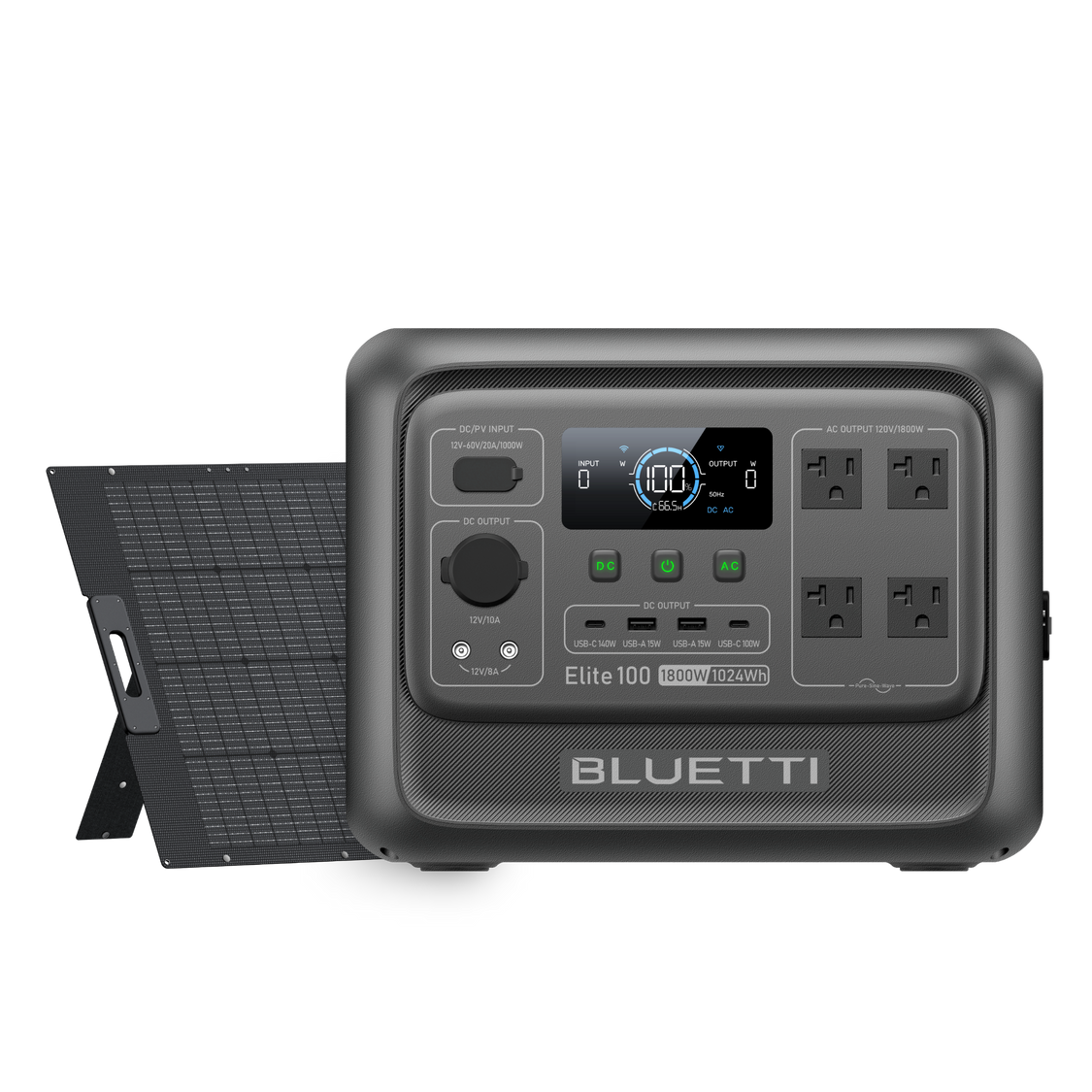
The exact U.S. option lists one 200 W panel and a solar charging cable, but its artwork and box thumbnail conflict on panel identity. The station’s 1,000 W solar input is known; panel-specific wiring remains a pre-use confirmation.
Explore this need in the finder →Does the 25.3 lb station body fit before you add the panel and cable?
The EL100V2 body is listed at 25.3 lb; this offer’s exact 200 W panel model and complete package weight are not confirmed, so a combined carry limit cannot be promised.
Explore this need in the finder →Would one listed 200 W panel be enough for a starter solar route?
The offer lists one 200 W panel and a solar lead, whereas the station accepts up to 1,000 W at 12–60 V/20 A. The 200 W rating is package-level evidence, not a verified panel manual or daily recharge guarantee.
Explore this need in the finder →This is the exact U.S. Elite 100 V2 + 350W Solar option, retailer package SKU EL100V2-2-201-SPFUS-00 (option 685df920258285bb41303e68; variant 47048303444187). The option's box list says one EL100V2, one 350W Solar Panel, one Solar Charging Cable, an AC charging cable, documentation and a grounding screw. Although the written box line uses a generic panel name, the selected-option image asset is named for PV350D and BLUETTI's U.S. PV350D support/manual page supplies the matching 350W panel identity. I treat PV350D as the supported component model, but the bundle page does not print a separate panel SKU.
Same compact station, more panel rating
The station is still EL100V2: a 1,024Wh LiFePO4 battery, four 120V household outlets and 1,800W rated AC output in a 25.3lb body. The 350W bundle does not change those limits. Nor does its panel increase the station's 1,000W solar-input ceiling, which BLUETTI specifies at 12–60V DC and up to 20A. The meaningful difference from the Elite 100 V2 + 100W and +200W offers is the panel nameplate rating in the box, not a different battery or inverter.
The stronger panel may be useful for a car-camping setup, a temporary outage station near a window or patio, or a work site where one folding panel can be placed in good sun while the station remains sheltered. It is a less attractive choice for someone whose top priority is the lightest kit: the station alone weighs 25.3lb, the panel is a separate carried object, and BLUETTI does not publish a reconciled complete-package weight here. The one-page panel guide's printed pound and kilogram figures do not convert consistently, so I do not repeat either as a dependable panel weight.
What a single PV350D can and cannot promise
BLUETTI's PV350D guide lists 350W nameplate power, 27.6V at maximum power, 12.7A at maximum power, 33V open-circuit voltage and 13.8A short-circuit current. Those nominal values fit within the station's stated 12–60V/20A solar input when considering one panel: the bundle is not a 1,000W solar array. The page lists one Solar Charging Cable; its in-box image identifies an MC4-to-XT60 lead, and the panel guide shows the MC4 connection path. This supports the supplied one-panel arrangement, not a do-it-yourself multi-panel extension.
Panel ratings are measured under defined conditions and do not say what this package will harvest through clouds, shade, low sun, dirt or poor orientation. The station's 1,000W figure is a separate input limit, not a charge-time forecast for this 350W offer. BLUETTI has not provided a cold-weather voltage coefficient in the reviewed panel guide, so I do not claim a universal cold-corrected margin or recommend adding panels in series or parallel. Use the exact manuals and cable for the shipped revision, keep the panel in suitable outdoor conditions, and ask the seller before relying on a different array.
Who should choose this bundle?
Consider it when the EL100V2's 120V, 1,800W output and 1,024Wh nameplate capacity fit your load list, and you specifically want a higher-rated panel included in the same order. It offers a better starting point for daytime replenishment than the lower-wattage Elite 100 solar bundles, while staying within a one-station, one-panel arrangement. It is not a whole-home system and its capacity does not prove a particular refrigerator, pump, microwave or medical device will run for a given number of hours. Estimate energy separately, account for inverter losses and motor startup, and confirm a load's continuous draw stays within the station rating. No measured runtime or solar yield is claimed here.
Answers should rule it out when you require 240V, continuous AC output above 1,800W, or more than 1,024Wh before recharge. The advertised 2,700W Power Lifting mode is not a substitute for the continuous rating or a universal way to start an appliance. A larger Elite 200 V2 has a different capacity/output class; the 100 V2's solar bundle does not make it equivalent. For very light carry, the +100W option is a lower-panel alternative, while the +200W offer carries unresolved exact-panel naming in its published bundle material. A standalone EL100V2 with a separately chosen, verified panel may be preferable if you want to select every component yourself.
How the shortlist questions change the result
Requiring 120V AC and at least 1,800W rated output admits this station but does not distinguish its solar package from the bare EL100V2. Requiring an included panel admits the package; a 350W minimum is met, while a 351W minimum is not. A 1,000W minimum solar-input question describes the station's maximum input capability, not the wattage of the panel supplied. The listed 25.3lb weight is for the station body; the questionnaire's station-weight limit does not include the panel or cable. If a strict all-in carry limit is essential, this package cannot be confirmed against it from the published weight data.
Bottom line
The main reason to choose the EL100V2 + 350W package is a documented 350W one-panel solar starting point with a capable 1kWh-class 120V station. Its important limits are equally concrete: 1,800W continuous AC, 1,024Wh nameplate storage, one included panel rather than a full array, no reconciled kit weight and no independently measured recharge result. Match the station to the essential loads first; treat panel wattage as an input opportunity, not guaranteed energy. If a panel model, temperature margin, bundled weight or wiring arrangement is critical, confirm that exact detail with BLUETTI before purchase instead of assuming a similar-looking panel is interchangeable.
Key details at a glance
| Nameplate battery capacity | 1024 Wh |
|---|---|
| Rated AC output | 1800 W |
| Maximum solar input | 1000 W |
| Included panels, combined nameplate | 350 W |
| Maximum USB-C output per port | 140 W |
| Listed weight | 25.3 lb |
| 12 V DC output | 120 W |
| Maximum AC recharge input | 1200 W |
| Manufacturer UPS transfer figure | 10 ms |
| AC outlet output | Yes |
| USB-C ports | 2 |
| USB-A ports | 2 |
| Solar input ports | 1 |
| 12 V car-style output | 120 W |
| Battery chemistry | LiFePO4 |
| Solar panels in exact offer | 1 |
Use the exact model’s instructions for operating limits, supplied equipment and version differences.
Sources for this assessment
A useful match starts with the loads that matter.
Use the finder for hard electrical requirements, then check appliance starting behavior, actual run time and the exact package in the full assessment.