
Your needs, this model
Does it fit your priorities?
Is 1,800 W of 120 V AC output and 1,024 Wh nameplate capacity the right size?
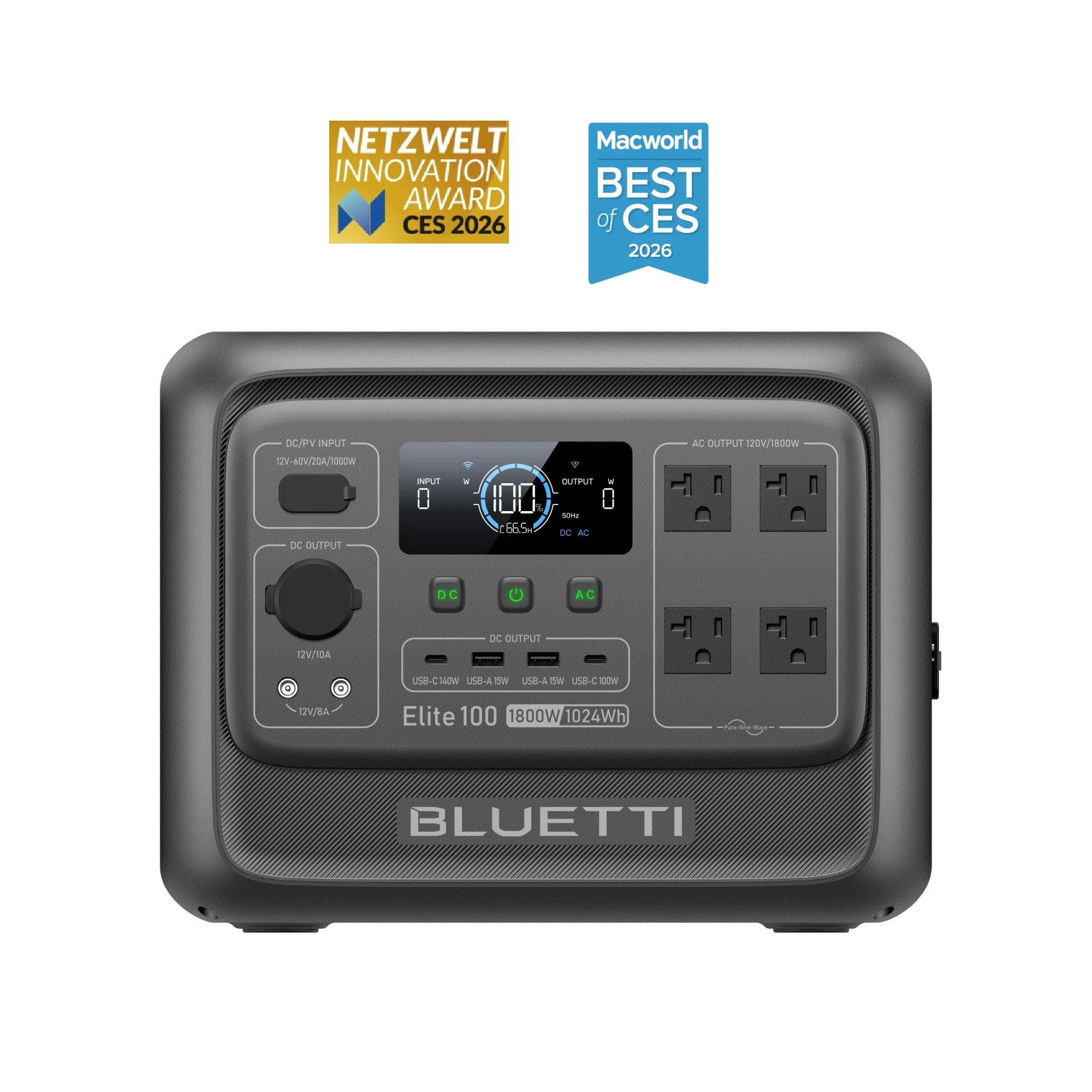
The EL100V2 standalone station lists 1,800 W of total 120 V AC and 1,024 Wh of LiFePO4 storage. The 2,700 W Power Lifting claim only applies to pure resistive loads and does not change the rated 1,800 W output.
Explore this need in the finder →Do you need a 1,000 W maximum solar input, one 140 W USB-C and one 100 W USB-C port?
The manual lists one DC/PV input up to 1,000 W at 12–60 V/20 A and two USB-C ports rated 140 W and 100 W. Maximum solar acceptance depends on valid input voltage, current, array conditions and cable setup; it is not a panel output promise.
Explore this need in the finder →Will a 25.3 lb body and an unconfirmed battery-expansion path work for this plan?
The standalone station is listed at 25.3 lb. Its documentation reviewed here does not establish a compatible expansion battery, so expansion cannot satisfy an essential requirement without further model-specific evidence.
Explore this need in the finder →The BLUETTI Elite 100 V2 (EL100V2, US standalone SKU EL100V2-US-GY-ID-SPFUS-01) is a 1,024 Wh LiFePO4 station with 1,800 W of rated 120 V AC and a maximum 1,000 W solar input. At 25.3 lb, it is still a substantial lift, but notably easier to place or move than a 2 kWh unit weighing more than 50 lb. It fits users who need a broad mix of AC and USB-C outputs in one portable case and can keep their essential appliances below the actual 1,800 W ceiling.
Useful ports, but the numbers describe one shared system
The manual lists four AC outlets sharing 1,800 W, a single 12 V/10 A car socket, two DC5521 ports, two USB-A outputs up to 15 W each, and USB-C ports rated at 140 W and 100 W. The DC5521 pair can deliver 5 A per port, 8 A total across that pair; BLUETTI's manual also says the car outlet and DC5521 ports are wired in parallel with a 10 A maximum across them. Treat each connector as a way to plug in a compatible load, not as three separate 12 V supplies whose individual ratings can all be added together. Likewise, the two USB-C figures are port ratings, not proof of simultaneous maximum output on every port.
Power Lifting is described for pure resistive loads from 1,800 to 2,700 W. It does not raise actual station output above 1,800 W and does not make the unit suitable for a device with a 2,400 W startup or continuous demand. Count the loads likely to run at the same time, including surge behavior, before choosing a rating. The 1,024 Wh battery figure is nameplate energy; AC conversion, reserves and load behavior reduce what reaches an appliance, and no load-specific AC-delivered energy result is published in the sources reviewed.
One generous solar input; AC charging has several modes
The one solar input accepts up to 1,000 W at 12–60 V and 20 A. That broad voltage range can support a serious array for a station this size, but the actual input must respect both voltage and current limits. Do not connect panels in a way that exceeds the manual's input window, and do not assume a nominal 1,000 W panel will produce 1,000 W in changing weather. The separate standalone SKU does not automatically include the 100 W, 200 W or 350 W panels shown in BLUETTI's product selections.
AC charging is rated up to 1,200 W in Turbo mode; the manual lists 600 W Standard and 1,200 W Turbo/Silent charging. It separately lists 1,800 W for charging plus bypass and 1,200 W for combined AC and solar input. A wall-input figure that includes bypass is not the same thing as the battery's charging rate. The manual's stated 80%-in-45-minutes figure is an estimate under its stated conditions, not an observed charge test. It also shows a vehicle-input path, but the exact maximum car-input wattage was not established by the manual used here.
UPS and low-load behavior need a real equipment check
BLUETTI lists UPS switchover within 10 ms. That is a manufacturer claim rather than an independently timed transfer result. The manual says ECO modes are disabled by default, but if enabled the AC/DC outputs can shut off after low or no load; the app exposes thresholds and auto-off settings. A low-watt light, router or refrigerator control board therefore needs a deliberate setup check. For medical equipment or anything whose interruption could endanger someone, use the equipment maker's backup requirements and a safe alternate power plan rather than assuming a portable-station label is sufficient.
There is also a noise-spec nuance. BLUETTI's current product page promotes operation below 30 dB at loads up to 600 W, while the English manual's specifications table lists up to 50 dB. Those statements refer to different contexts; don't generalize a low-load claim to turbo charging or heavier output. The cover on the archived English manual is marked V5.1, while the illustration of the package contents labels the model version V2.0. The model identity is clear, but that internal version-label mismatch remains unresolved. The manufacturer advertises 4,000-plus cycles; no cycle testing or sample testing was performed for this assessment.
Where it fits against the smaller and heavier V2 stations
Choose the Elite 100 V2 when your outlet requirement is 120 V, your continuous AC list fits within 1,800 W, and a 25.3 lb case is acceptable. A 1,024 Wh minimum, 1,000 W solar minimum and one USB-C port at 140 W all fit the published standalone plan. It becomes the wrong size if the essential load demands more than 1,800 W, the carry limit is below 25.3 lb, or an expansion battery is non-negotiable. No compatible battery-expansion plan was established from the official product page and manual inspected here; unknown compatibility is not a positive expansion recommendation.
Compared with the Elite 30 V2, the 100 moves from 288 Wh/600 W to 1,024 Wh/1,800 W and its single solar input rises from 200 W to 1,000 W, but the station weight rises from 9.48 lb to 25.3 lb. The Elite 200 V2 doubles nameplate capacity again and raises AC output to 2,600 W, yet weighs 53.35 lb and has a slower 15 ms UPS figure. If you only need phone or laptop USB-C and no AC, a DC-only option can be lighter and avoids inverter overhead; if you need more battery capacity at an outage base, compare expansion-capable alternatives instead of assuming this standalone station can grow. Review the exact package, input limits, and load list before purchase.
Key details at a glance
| Nameplate battery capacity | 1024 Wh |
|---|---|
| Rated AC output | 1800 W |
| Maximum solar input | 1000 W |
| Maximum USB-C output per port | 140 W |
| Listed weight | 25.3 lb |
| 12 V DC output | 120 W |
| Maximum AC recharge input | 1200 W |
| Manufacturer UPS transfer figure | 10 ms |
| AC outlet output | Yes |
| USB-C ports | 2 |
| USB-A ports | 2 |
| Solar input ports | 1 |
| 12 V car-style output | 120 W |
| Battery chemistry | LiFePO4 |
Use the exact model’s instructions for operating limits, supplied equipment and version differences.
Sources for this assessment
A useful match starts with the loads that matter.
Use the finder for hard electrical requirements, then check appliance starting behavior, actual run time and the exact package in the full assessment.