
Your needs, this model
Does it fit your priorities?
Does your load need the Elite 200 V2 station’s published 120V / 2,600W / 2,073.6Wh figures?
This package has one EL200V2 station. Its panel count does not change the station capacity or AC rating.
Explore this need in the finder →Would the two supplied 350W panels still suit you if only one can be connected to this station at a time?
The selected package lists two 350W panels (700W combined nameplate), but a single-panel 350W plan is the only one within the station’s published input limits. This may fit someone with a separate use or spare role for panel two; it is not a 700W simultaneous charging kit.
Explore this need in the finder →Must all solar panels supplied in the package work together on this station at their published ratings?
No. For two PV350D panels, series wiring would total 66V open circuit against the station’s 60V limit; parallel wiring would total 25.4A at maximum power against its 20A limit. One panel at a time is the supported plan.
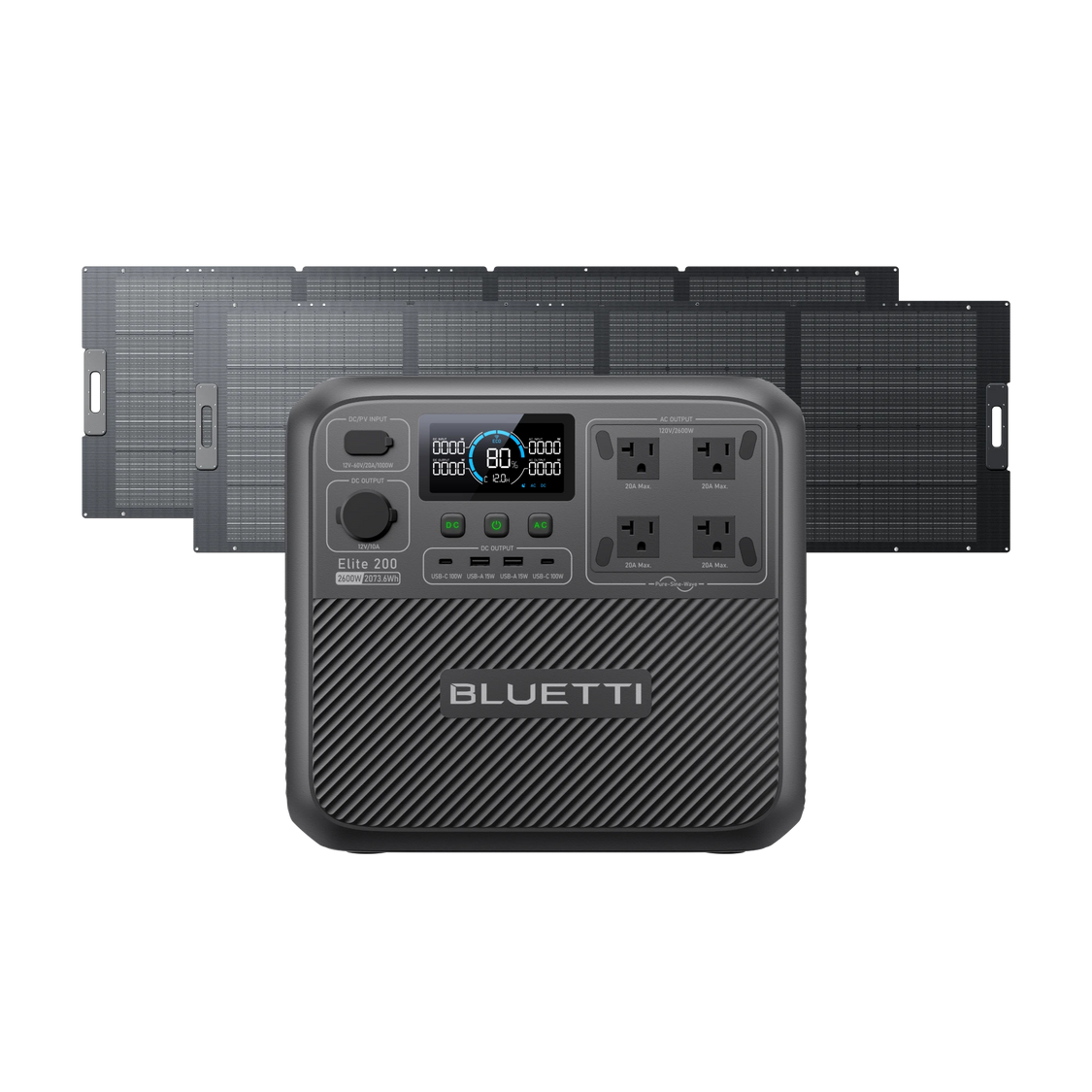
Explore this need in the finder →The exact U.S. option is titled Elite 200 V2 + 2×350W Solar. It includes the same EL200V2 station reviewed elsewhere in this library, plus two listed 350 W panels; it is not a second or higher-capacity station. More importantly, the two supplied panels do not form a documented 700 W array on this station. Their published electrical ratings exceed one of the station’s input limits whether the pair is wired in series or parallel. The usable plan established here is one panel at a time, with the other panel left disconnected or used with a separate compatible unit.
What this selected package contains
BLUETTI’s selected-option page records option ID 672d8b674bd75caefb7af662 and Shopify variant 46252055068891. The page’s “In the Box” list names one Elite 200 V2, one AC charging cable, documentation, one grounding screw, one solar charging cable and two 350 W solar panels. The offer does not display a separate package SKU in the selected option record, so I do not supply one. This is a package variant of the EL200V2, not another station identity.
The written panel line is generic, but the selected option’s hero resource is named “Elite_200_V2_2PV350D” and its in-box panel image resource is named “PV350D.” BLUETTI’s U.S. support page and its PV350D guide independently identify that exact panel family. I inspected the original selected-option image: it is a transparent promotional composite showing the EL200V2 with two folded-panel renderings. It is useful for recognizing what the offer depicts, but it is not a carton photograph or a record of a physical sample.
Why the 700 W headline is not a safe two-panel plan
The EL200V2 manual lists a single solar input rated for 12–60 V DC, up to 20 A and up to 1,000 W. The official PV350D guide lists 350 W per panel, with 27.6 V and 12.7 A at maximum power, 33 V open circuit and 13.8 A short circuit. One panel is within the station’s published voltage, current and watt limits at those nominal ratings. The package also lists a solar charging cable; the station manual identifies its solar cable as MC4-to-XT60. That supports a one-panel connection path, not a guarantee of a particular charging rate or output under real sun and temperature conditions.
With both identical panels in series, their nominal open-circuit voltage totals 66 V (33 V + 33 V), above the station’s 60 V input ceiling. With both in parallel, the maximum-power current totals 25.4 A (12.7 A + 12.7 A), above the 20 A ceiling. A combined 700 W nameplate is below the station’s 1,000 W wattage ceiling, but that alone does not make the array compatible: voltage and current limits apply at the same time. The manufacturer material reviewed here does not establish another wiring arrangement for these exact panels that stays within all limits. Do not connect this pair as a 700 W array to one EL200V2 on the strength of the bundle title. If cold-weather operation matters, the panel guide supplies no temperature coefficient for calculating a cold-corrected voltage margin even for one panel.
The station’s useful strengths stay the same
The station remains a 2,073.6 Wh LiFePO4 unit with 2,600 W total rated 120 V AC output. Its manual’s 3,900 W Power Lifting figure applies to suitable pure-resistive loads; it does not raise the rated AC output above 2,600 W. The battery is not expandable. BLUETTI lists the station body at 53.35 lb, so this is better suited to a fixed outage corner, garage or vehicle-side camp than to a plan that repeatedly carries the full setup. The two panels add separate handling and storage, while the manufacturer’s PV350D guide has conflicting mass units; a reliable panel or full-kit weight cannot be calculated from it.
Battery capacity is nameplate energy, not a guaranteed quantity delivered through the AC outlets. Refrigerator compressors, pumps and other motor loads can also draw a startup surge beyond their everyday wattage. The EL200V2 manual describes UPS switching within 15 ms, while BLUETTI warns that this is not a high-performance UPS for data servers or workstations. Neither the listing nor the manual is a medical-device continuity guarantee, and no independent runtime, charge-time or solar-harvest measurement was made for this review.
Who should consider this bundle
This configuration is only a sensible fit if you already have a separate use for the second panel, or deliberately want it as a spare, and a single 350 W panel at a time is enough for the station. It is a poor choice if you are buying specifically for 700 W of simultaneous solar input from the supplied pair. In that case, do not treat the station’s larger 1,000 W input ceiling as approval for these two panels; choose a separately verified array and wiring plan instead. If one panel is all you need, compare the standalone EL200V2 and the separately listed one-panel 350 W option so you are not paying for a panel the station cannot use alongside its twin.
In the finder, the package’s two 350 W panels count as 700 W of combined supplied nameplate panel capacity, but a 700 W threshold is not a claim that the station can accept that pair together. The additional advanced requirement for all supplied panels to work together must reject this configuration. The supported operating plan uses one 350 W panel at a time; capacity, AC output and the station’s body weight are unchanged. Confirm the exact box and setup before relying on the kit, and do not substitute a different panel or connector based only on a similar wattage label.
Key details at a glance
| Nameplate battery capacity | 2073.6 Wh |
|---|---|
| Rated AC output | 2600 W |
| Maximum solar input | 1000 W |
| Included panels, combined nameplate | 700 W |
| Maximum USB-C output per port | 100 W |
| Listed weight | 53.35 lb |
| Compatible extra-battery expansion | No |
| 12 V DC output | 120 W |
| Maximum AC recharge input | 1800 W |
| Manufacturer UPS transfer figure | 15 ms |
| AC outlet output | Yes |
| USB-C ports | 2 |
| USB-A ports | 2 |
| Solar input ports | 1 |
| 12 V car-style output | 120 W |
| Vehicle charge input | 192 W |
| Battery chemistry | LiFePO4 |
| Solar panels in exact offer | 2 |
Use the exact model’s instructions for operating limits, supplied equipment and version differences.
Sources for this assessment

A useful match starts with the loads that matter.
Use the finder for hard electrical requirements, then check appliance starting behavior, actual run time and the exact package in the full assessment.