
Your needs, this model
Does it fit your priorities?
Do you need at least 2,600W of continuous 120V AC with 2,073.6Wh nameplate storage?
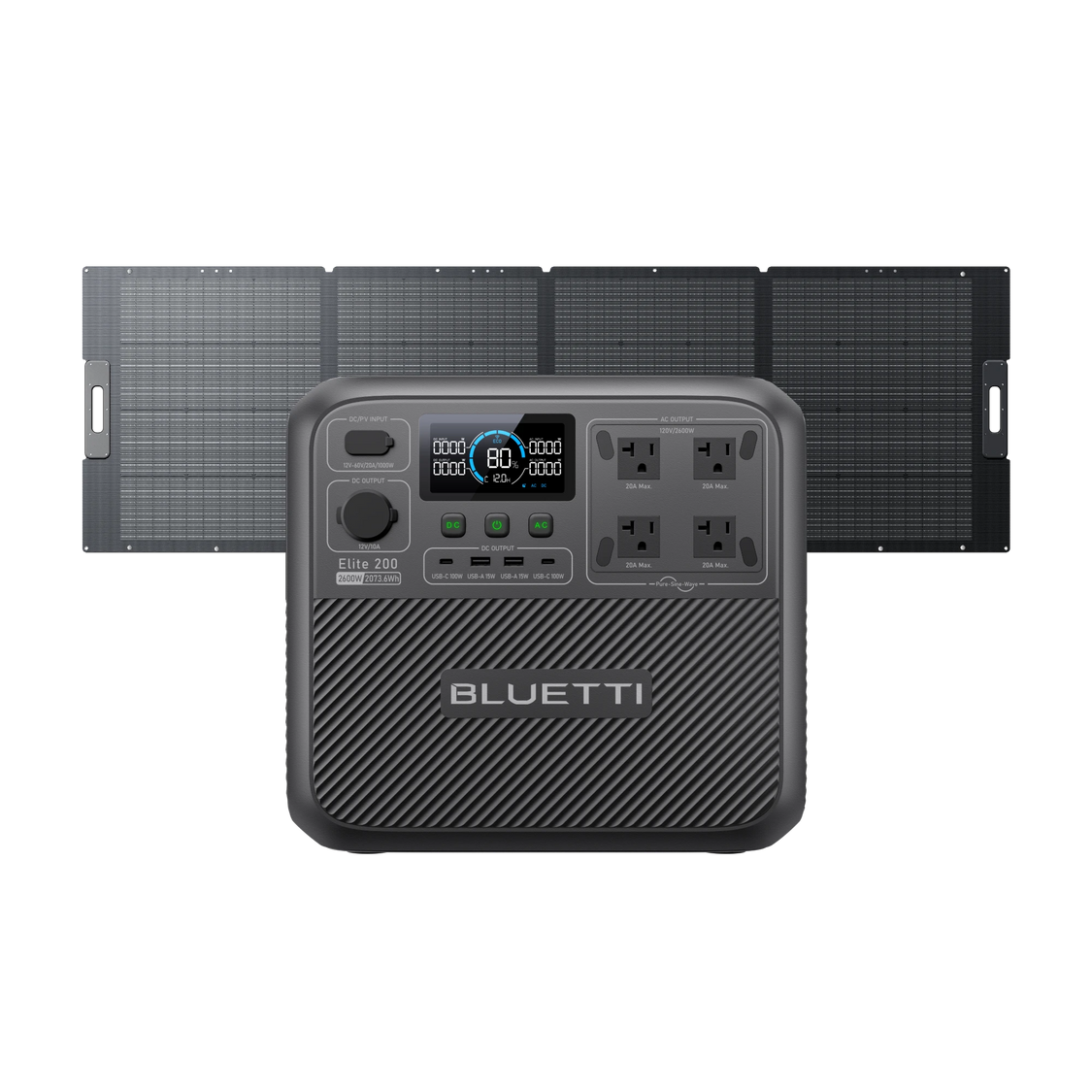
This option uses the same EL200V2 station as the standalone version: 2,600W total at 120V and 2,073.6Wh nameplate storage. The separate 3,900W Power Lifting feature applies only to suitable pure-resistive loads and does not raise rated output.
Explore this need in the finder →Is one identified 350W PV350D panel enough for your included-panel requirement?
The selected offer lists one 350W Solar Panel and its exact-option image paths identify PV350D; the U.S. support route and panel guide provide the model-specific nominal ratings. One panel fits the station input limits on published nominal values, but panel watts are not an actual harvest guarantee.
Explore this need in the finder →Must the package itself include the station-side solar lead?
The box list says the station’s PV cable is not included and the panel’s PV cable is included, without naming whether the supplied panel cable is the MC4-to-XT60 station lead. The Elite 200 V2 manual lists the 59.06-inch/1.5m MC4-to-XT60 cable as an optional accessory. This option therefore does not pass an essential in-box station-lead requirement without confirmation.
Explore this need in the finder →Must all package-supplied solar panels work together on the station at their published ratings?
This exact package has a documented array configuration within the station limits at published nominal values; see the package-specific panel wiring and cold-voltage caveats.
Explore this need in the finder →This is the solar-panel package of BLUETTI’s Elite 200 V2, not a larger or more powerful station. The exact U.S. offer is identified on the selected product page as option 672d8b564bd75caefb7af65c, variant 46252054544603, package SKU EL200V2-2-132-SPFUS-00. Its panel listing and image resources identify one 350 W PV350D. The underlying station is still the EL200V2: 2,073.6 Wh of nameplate capacity and 2,600 W of 120 V AC output.
What this package adds—and what it does not
The station remains a substantial, fixed-capacity unit. BLUETTI lists it at 53.35 lb and does not support adding an expansion battery. The 350 W offer adds one folding panel to that same station; it does not increase storage, inverter output, port count or the station’s 1,000 W maximum solar input. The question is whether a single panel in the same order is useful to your charging plan, not whether this bundle turns the EL200V2 into a different system.
The selected U.S. page’s box list names one Elite 200 V2, an AC charging cable, documentation, a grounding screw and one “350W Solar Panel (PV Cable Included).” The station entry itself says “PV Cable Not Included,” while the panel entry says it is included. Those lines do not identify the cable type or establish that the exact box includes the station-side MC4-to-XT60 solar charging lead. The Elite 200 V2 manual lists that 59.06-inch / 1.5 m lead among optional accessories, not in the station’s standard box. Treat the panel’s own PV cable and the station charging lead as separate facts: verify the exact bundle contents or plan to obtain a manufacturer-compatible lead before expecting to charge from this panel. The product page does not list a separate panel SKU, a second cable, or an array combiner for the option.
The one-panel electrical fit is specific, not a harvest promise
The package artwork and in-box panel image use PV350D names, and the BLUETTI U.S. support route and one-page guide identify the panel as PV350D. That guide gives a 350 W maximum-power rating, 27.6 V at maximum power, 12.7 A at maximum power, 33 V open-circuit voltage and 13.8 A short-circuit current. The Elite 200 V2 manual allows 12–60 V solar input, 20 A maximum and 1,000 W maximum. On the published nominal ratings, one PV350D is within those station limits. The station’s documented one-panel plan uses the MC4-to-XT60 solar charging lead specified in its manual; do not count that station-side lead as an in-box item unless BLUETTI confirms it for this exact bundle. The manual explains series and parallel arrays, but this assessment covers only the one panel listed in this package; it does not use the station’s 1,000 W ceiling to claim that added panels or a particular wiring layout are safe.
Neither the panel’s 350 W nameplate nor the station’s maximum input is a measured charging rate. Sun angle, shade, temperature, cloud cover, panel condition and conversion losses all affect what reaches the battery. BLUETTI’s PV350D guide gives a temperature range but no cold-voltage coefficient, so it does not support a cold-corrected voltage-margin calculation. If you will use panels in unusually cold conditions or later enlarge the array, check the exact equipment and manufacturer guidance instead of treating this single-panel plan as approval for a different topology.
Carryability and backup limits matter more than the bundle headline
The station body alone is over 53 lb. The panel is a separate item to unfold, position and store; the selected offer does not publish full-kit carry or shipping weight. The PV350D guide’s table prints 29.11 lb and 13.52 kg, which do not convert to one another, so I do not use either as a reliable panel mass or add it to the station figure. This package suits a fixed outage corner, garage, or vehicle-side camp better than a plan that repeatedly carries the entire setup by one person.
The EL200V2 supplies 2,600 W total at 120 V; its advertised 3,900 W Power Lifting mode is for suitable pure-resistive loads, and the manual says actual output remains capped at 2,600 W. Nameplate capacity is not usable AC energy, and a refrigerator, pump or compressor can draw a startup surge not represented by its everyday running wattage. The manual’s UPS claim is within 15 ms, while BLUETTI cautions against treating it as a high-performance UPS for servers or workstations. It is not a medical-device continuity promise.
When to choose the 350 W option
Choose this configuration if your load plan genuinely benefits from the EL200V2’s fixed 2 kWh-class battery and 2,600 W AC rating, you can manage the station’s body weight, and you want one identified 350 W panel rather than buying a smaller solar option separately. If you only need the station, compare the standalone EL200V2; the panel package changes the in-box equipment, not the station’s capabilities. The Elite 200 V2 + 200 W option is a lower-nameplate-panel alternative, while the lighter Elite 100 V2 trades down in battery capacity and AC output. If your essential requirement is a ready-to-plug panel kit with every station-side cable in the same box, the current listing leaves that detail unresolved: get written confirmation before treating the bundle as a complete out-of-box charging setup.
In the finder, requiring a panel in the box and setting a 350 W minimum distinguishes this package from the standalone station and the 200 W option. A 351 W minimum should rule it out. Capacity, 120 V output and the 53.35 lb listed station weight remain separate choices: setting a complete-kit carry maximum is not something the current product data can satisfy, because panel mass and total package mass are unresolved. The article therefore assesses one electrically suitable panel in a one-panel plan, but does not imply a guaranteed solar harvest, exact full-kit weight, ready-to-plug cable contents or an approved multi-panel array.
Key details at a glance
| Nameplate battery capacity | 2073.6 Wh |
|---|---|
| Rated AC output | 2600 W |
| Maximum solar input | 1000 W |
| Included panels, combined nameplate | 350 W |
| Maximum USB-C output per port | 100 W |
| Listed weight | 53.35 lb |
| Compatible extra-battery expansion | No |
| 12 V DC output | 120 W |
| Maximum AC recharge input | 1800 W |
| Manufacturer UPS transfer figure | 15 ms |
| AC outlet output | Yes |
| USB-C ports | 2 |
| USB-A ports | 2 |
| Solar input ports | 1 |
| 12 V car-style output | 120 W |
| Vehicle charge input | 192 W |
| Battery chemistry | LiFePO4 |
| Solar panels in exact offer | 1 |
Use the exact model’s instructions for operating limits, supplied equipment and version differences.
Sources for this assessment
A useful match starts with the loads that matter.
Use the finder for hard electrical requirements, then check appliance starting behavior, actual run time and the exact package in the full assessment.