
Your needs, this model
Does it fit your priorities?
Do you need 2,600 W of continuous 120 V AC and at least 2,073.6 Wh nameplate storage?
The single Elite 200 V2 station supplies 2,600 W total AC and stores 2,073.6 Wh. The separate 3,900 W Power Lifting feature applies only to pure resistive loads and leaves actual output capped at 2,600 W.
Explore this need in the finder →Would 1,000 W solar, two 100 W USB-C ports and one 12 V load outlet cover your setup?
The exact station has one 12–60 V/20 A, 1,000 W maximum solar input, two 100 W USB-C outputs and a 12 V/10 A car-style load outlet. It does not have 140 W USB-C or a bank of DC5521 sockets; solar panels and output split limits must be planned separately.
Explore this need in the finder →Can you handle a 53.35 lb fixed-capacity station without a compatible expansion battery?
The station itself weighs 53.35 lb and BLUETTI says the Elite 200 V2 is not expandable. It may suit a fixed base location better than repeated solo carrying; an essential expansion requirement rules it out.
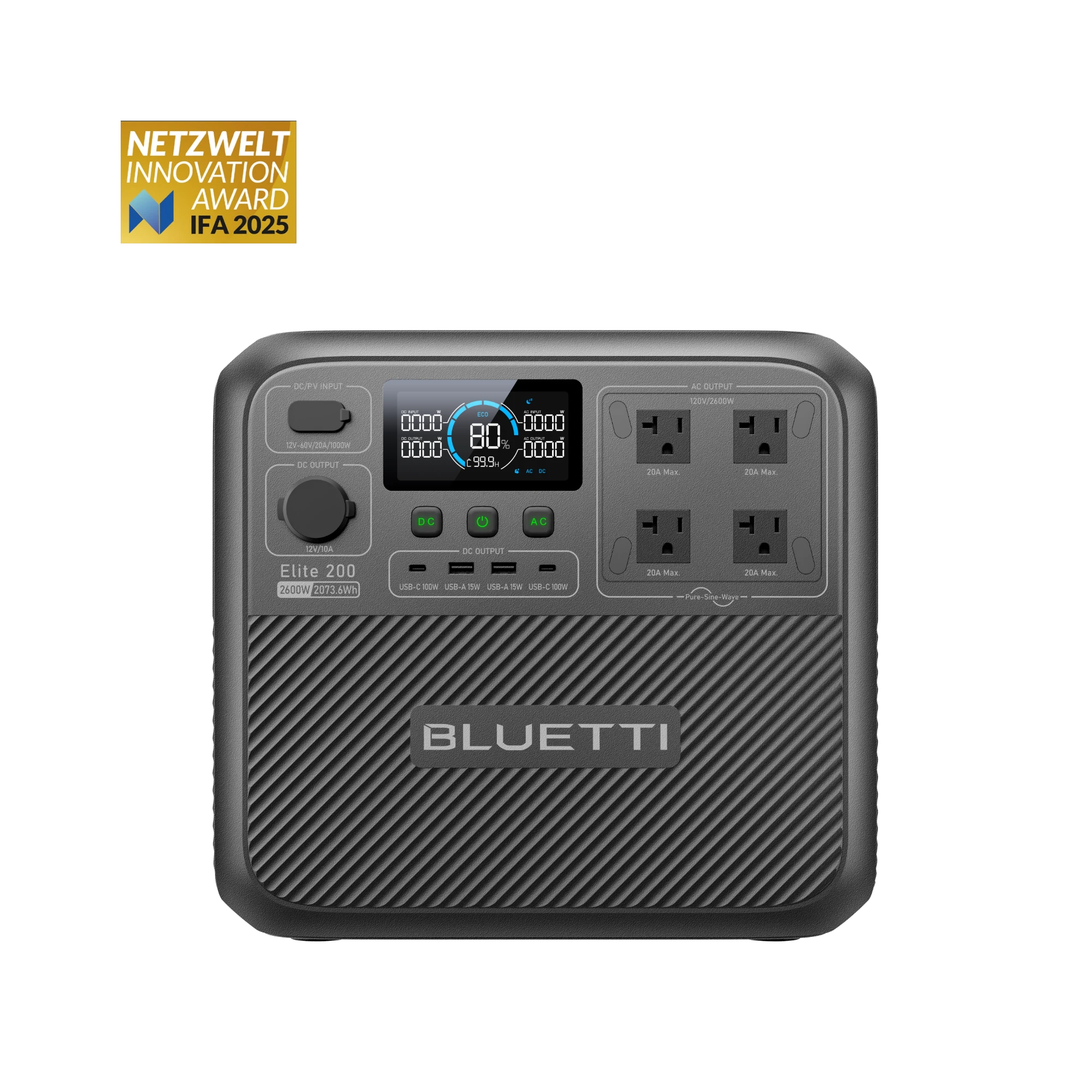
Explore this need in the finder →The BLUETTI Elite 200 V2 is the largest of the three Elite V2 stations in this reviewed group: a single 2,073.6 Wh LiFePO4 pack, 2,600 W of 120 V AC and a 53.35 lb case. It is a useful fit for an outage base or vehicle camp where a two-kilowatt-hour nameplate battery and a 2,600 W inverter are helpful, but it is not a grab-and-go station for repeated long carries. BLUETTI says the Elite 200 V2 itself is not expandable, so choose it only if the fixed capacity is adequate for a carefully planned load list.
High AC output in one heavy case
The manual lists 2,600 W total at 120 V, with four AC receptacles sharing that output. It also has a 12 V/10 A car-style output, two USB-C ports rated up to 100 W each and two 15 W USB-A ports. The total AC limit still applies when several appliances are plugged in, and an appliance's startup demand can differ from its normal running wattage. Battery capacity is nameplate energy, not an AC runtime promise: inverter conversion, reserve, temperatures and load shape affect usable energy, and the reviewed sources do not publish an appliance-specific delivered-energy test.
As with the smaller stations, Power Lifting can create a misleading headline. BLUETTI says the mode can serve pure resistive loads rated from 2,600 to 3,900 W, but actual output remains 2,600 W. That does not turn the station into a 3,900 W general inverter. Do not use that mode to pass a requirement for a higher continuous electrical rating or to assume a motor, compressor or precision load will work. If a load exceeds the actual rating, select a different unit or a properly engineered power system.
Solar, vehicle charging and AC charging are separate limits
The DC/PV input is one path rated up to 1,000 W at 12–60 V and 20 A. BLUETTI's manual allows two solar branches only under conditions that preserve those input limits and use matching input specifications. The manufacturer also offers a 200 W solar option, but it is a separate package choice, not an included panel in the standalone SKU reviewed here.
AC charging can reach 1,800 W in Turbo mode; the manual gives 1,440 W for Standard mode and says the AC input with bypass can reach 1,800 W. Combined AC and DC charging input is listed at 2,400 W. Those modes are easy to conflate: 2,400 W is a combined input ceiling, not a charge rate from the wall alone. The manual says Turbo may require BLUETTI support to enable. Vehicle charging is supported at up to 96 W from 12 V or 192 W from 24 V. That is useful as a slow secondary route, not equivalent to the high-voltage solar input.
A 15 ms UPS claim is not server-grade continuity
The manual gives a UPS switchover figure of no more than 15 ms, longer than the 10 ms listed for the Elite 30 V2 and Elite 100 V2. BLUETTI's support page says this is not suitable as a high-performance UPS for data servers or workstations. Transfer time alone does not establish that a particular computer, medical device or network system will ride through a power change; use equipment-maker requirements, test the actual load safely and retain a separate backup where interruption has serious consequences.
ECO modes are enabled by default and can shut off outputs after periods of low or no load. BLUETTI warns about loads below 60 W and critical appliances. Review the settings if a small control board or light must stay energized. The manual lists a noise range from 16 to 50 dB under its test conditions, so an especially quiet low-load statement should not be generalized to a high-power charge or discharge. Its approximately 10 W self-consumption note is likewise a manual condition, not a fixed runtime deduction for every state. BLUETTI's 6,000-plus cycle claim is a manufacturer claim, not a test conducted here.
Weight is part of the power plan
The 53.35 lb unit is roughly twice the Elite 100 V2's 25.3 lb and more than five times the Elite 30 V2's 9.48 lb. No wheels are listed for this chassis. It suits a fixed base or a cart/second-person move; repeated solo lifting is less practical. Solar equipment and separately selected charger packages add their own weight.
The model is not expandable. If more stored energy is essential, a fixed 2,073.6 Wh ceiling rules it out even if its inverter is large enough. An expansion-capable alternative may preserve a lighter base unit and add a battery later, but the battery, connector, communications and supported configuration must be verified for that exact brand and model.
Who should choose this station?
Choose the Elite 200 V2 for 120 V loads up to 2,600 W, at least 2,073.6 Wh nameplate storage, 1,000 W solar and two 100 W USB-C ports—if 53.35 lb is acceptable. More AC, more supported energy or a high-performance computer UPS rules it out. The 100 V2 has about half the capacity, 28 lb less weight and the same solar ceiling; the 30 V2 is lighter but holds only 288 Wh at 600 W. The EcoFlow DELTA 2 Max is a nearby reviewed capacity class with documented expansion; compare its own facts and accessories. No sample or output testing was performed.
Key details at a glance
| Nameplate battery capacity | 2073.6 Wh |
|---|---|
| Rated AC output | 2600 W |
| Maximum solar input | 1000 W |
| Maximum USB-C output per port | 100 W |
| Listed weight | 53.35 lb |
| Compatible extra-battery expansion | No |
| 12 V DC output | 120 W |
| Maximum AC recharge input | 1800 W |
| Manufacturer UPS transfer figure | 15 ms |
| AC outlet output | Yes |
| USB-C ports | 2 |
| USB-A ports | 2 |
| Solar input ports | 1 |
| 12 V car-style output | 120 W |
| Vehicle charge input | 192 W |
| Battery chemistry | LiFePO4 |
Use the exact model’s instructions for operating limits, supplied equipment and version differences.
Sources for this assessment
A useful match starts with the loads that matter.
Use the finder for hard electrical requirements, then check appliance starting behavior, actual run time and the exact package in the full assessment.