
Your needs, this model
Does it fit your priorities?
Does one small station need to provide 120 V AC at 600 W with 288 Wh nameplate capacity?
The exact US Elite 30 V2 plan has a 600 W total AC limit at 120 V and 288 Wh nameplate capacity. A higher Power Lifting figure applies only to pure resistive loads; it does not raise the actual 600 W output rating.
Explore this need in the finder →Would two USB-C ports, one up to 140 W, and a 200 W maximum solar input meet the recharge and charging plan?
The station lists one 140 W USB-C and one 100 W USB-C output, plus a separate 200 W maximum solar input at 12–28 V/10 A. The standalone box has no solar panel, and panel output varies with conditions.
Explore this need in the finder →Would a 9.48 lb station with no battery expansion fit a compact trip or small backup plan?
The standalone EL30V2 weighs 9.48 lb and stores 288 Wh. It does not support battery expansion; B80 Power Bank Mode is a separate charging route, not a larger station configuration.
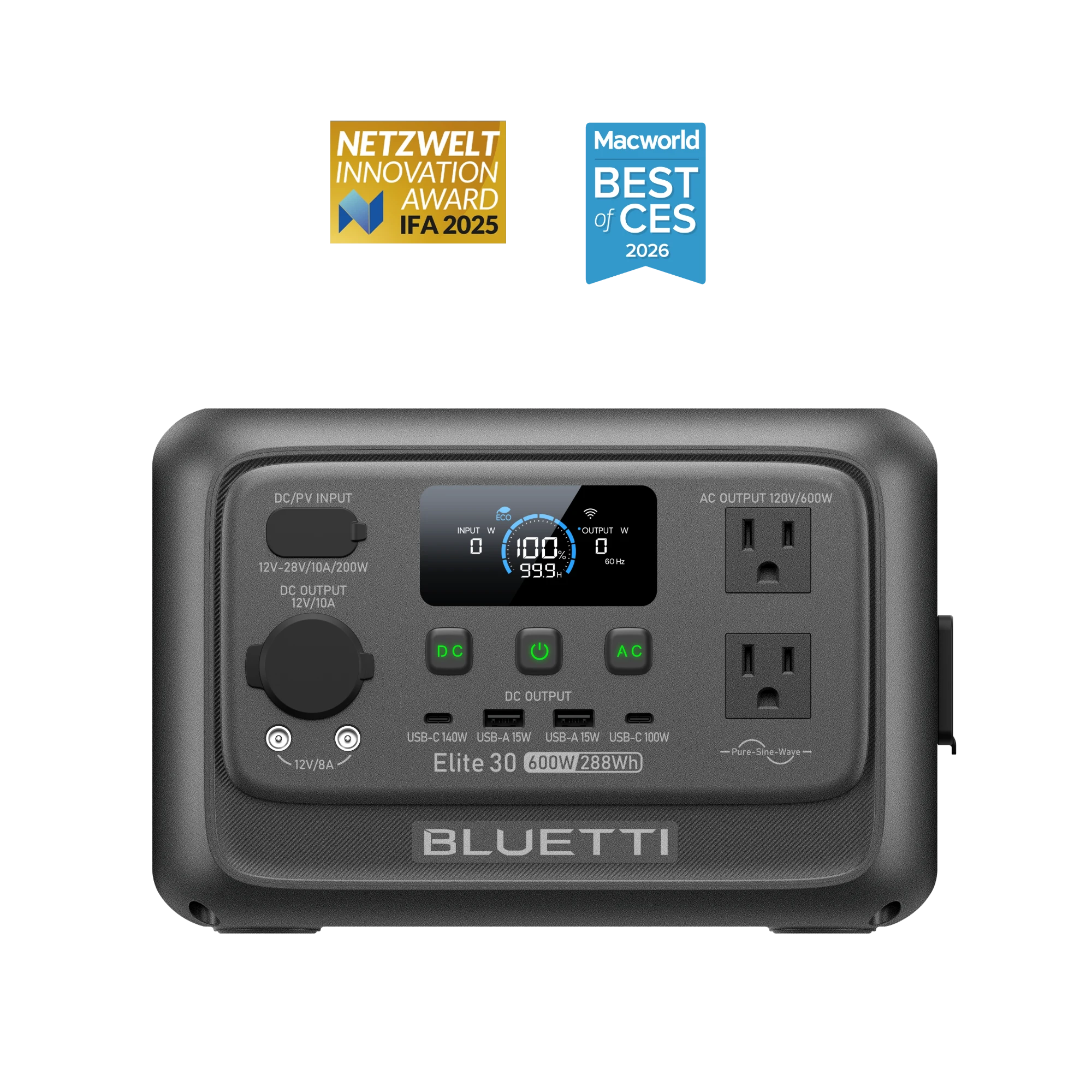
Explore this need in the finder →The BLUETTI Elite 30 V2 (model EL30V2, US standalone SKU EL30V2-US-GY-BL-SPFUS-00) is a little 288 Wh, 600 W station rather than a miniature home battery. It is worth considering when a real 120 V outlet is necessary but your list is still small: chargers, lights, network equipment or a modest appliance that stays within the shared 600 W AC rating. The 9.48 lb weight is manageable for a campsite or vehicle kit; the battery is too small to treat as a whole-outage reserve without a measured load plan.
Two USB-C speeds and a 600 W AC ceiling
Its front panel has two household AC receptacles sharing 600 W total at 120 V, one USB-C port rated to 140 W, another to 100 W, two 15 W USB-A ports and a 12 V/10 A car-style outlet. The USB-C ratings are individual port ceilings, not a promise that all outputs reach their maxima simultaneously. There are also two DC5521 barrel outputs: each is rated at 12 V/5 A, but the pair is capped at 8 A total. The car socket and DC5521 sockets share wiring and the manual gives a 10 A combined maximum across them, so don't add each connector's headline rating as if all three were independent supplies.
BLUETTI's Power Lifting mode is an easy spec to misread. It can support certain pure resistive heating loads rated from 600 to 1,500 W, but the station's actual output remains 600 W. That is not a general 1,500 W inverter and it is not a safe way to meet a 700 W motor or a 1,200 W cooking load. Check the exact appliance input and starting behavior before treating any station as compatible. The nameplate 288 Wh is also battery capacity, not a measured amount of AC energy delivered to an appliance; the sources reviewed do not provide load-specific usable AC energy.
Solar and vehicle charging are not the same as an included panel
One DC input accepts up to 200 W of solar within 12–28 V and 10 A. The manual also shows a vehicle charging route, but does not state its maximum wattage in the reviewed specifications. The 380 W maximum AC charging figure is separate: the manual also lists 380 W maximum for AC plus solar combined, and 980 W for AC input with bypass. These are different modes, not independent rates that can be stacked without limit.
The manufacturer page shows standalone and solar-panel package selections. This assessment covers the exact standalone EL30V2 SKU; its manual's packing list does not include a solar panel. Confirm a bundle's included panel, cable and exact variant before counting it as part of a kit. A panel's advertised wattage is not guaranteed output; voltage, current, sunlight, temperature and cable compatibility all matter.
Small loads, backup switching and care
The manual lists a UPS feature with switchover within 10 ms. That is a manufacturer figure, not an independent switching test or proof that a desktop computer, network appliance or medical device will ride through an outage. Test the exact equipment with a safe fallback before relying on it. AC- and DC-ECO modes are enabled by default and can shut an output off after low or no load; BLUETTI specifically warns about devices under 10 W and critical appliances such as lights. Disable ECO where a small steady load needs to remain powered, then verify the behavior rather than assuming a display indicator means uninterrupted service.
BLUETTI lists an IP20 enclosure, so this is not a rainproof campsite battery. Keep it dry, on a firm ventilated surface, and within the manual's temperature limits: charging is listed at 32–104°F and discharging at −4–104°F. The manufacturer advertises 3,000-plus cycles; that is a service-life claim, not a cycle test performed for this review. No physical sample or electrical load testing was performed here.
Who should choose it, and what changes the answer?
Choose the Elite 30 V2 if your plan needs 120 V AC at no more than 600 W, around 288 Wh of stored energy, one 140 W USB-C connection, 200 W solar acceptance and a station under 10 lb. A 600 W minimum and 9.5 lb maximum both fit; raising the AC floor to 601 W or dropping the carry limit below 9.48 lb rules it out. If future battery expansion is essential, it is a no: the US page says it does not support expansion. The optional B80 in Power Bank Mode can charge it but does not turn it into a 288 Wh-plus-B80 expanded station.
The EcoFlow RIVER 3 Plus is a nearby 286 Wh/600 W alternative with a supported extra-battery route and higher solar ceiling, but its reviewed body is heavier and it changes the available USB-C/expansion setup. The Anker SOLIX C300 has 288 Wh but a lower 300 W AC rating; it is a better comparison if all essential loads are direct USB/DC and its connector mix suits you. For a fixed 1 kWh plan, the Elite 100 V2 or another 1,024 Wh-class station trades this model's lighter body for several times the nameplate energy. Neither battery figure predicts runtime without your real load, inverter use and reserve.
Key details at a glance
| Nameplate battery capacity | 288 Wh |
|---|---|
| Rated AC output | 600 W |
| Maximum solar input | 200 W |
| Maximum USB-C output per port | 140 W |
| Listed weight | 9.48 lb |
| Compatible extra-battery expansion | No |
| 12 V DC output | 120 W |
| Maximum AC recharge input | 380 W |
| Manufacturer UPS transfer figure | 10 ms |
| AC outlet output | Yes |
| USB-C ports | 2 |
| USB-A ports | 2 |
| Solar input ports | 1 |
| 12 V car-style output | 120 W |
| Battery chemistry | LiFePO4 |
| Ingress rating | IP20 |
Use the exact model’s instructions for operating limits, supplied equipment and version differences.
Sources for this assessment
A useful match starts with the loads that matter.
Use the finder for hard electrical requirements, then check appliance starting behavior, actual run time and the exact package in the full assessment.