
Your needs, this model
Does it fit your priorities?
Must a 3 kWh, 120 V station with TT-30 be sold together with two 200 W panels?
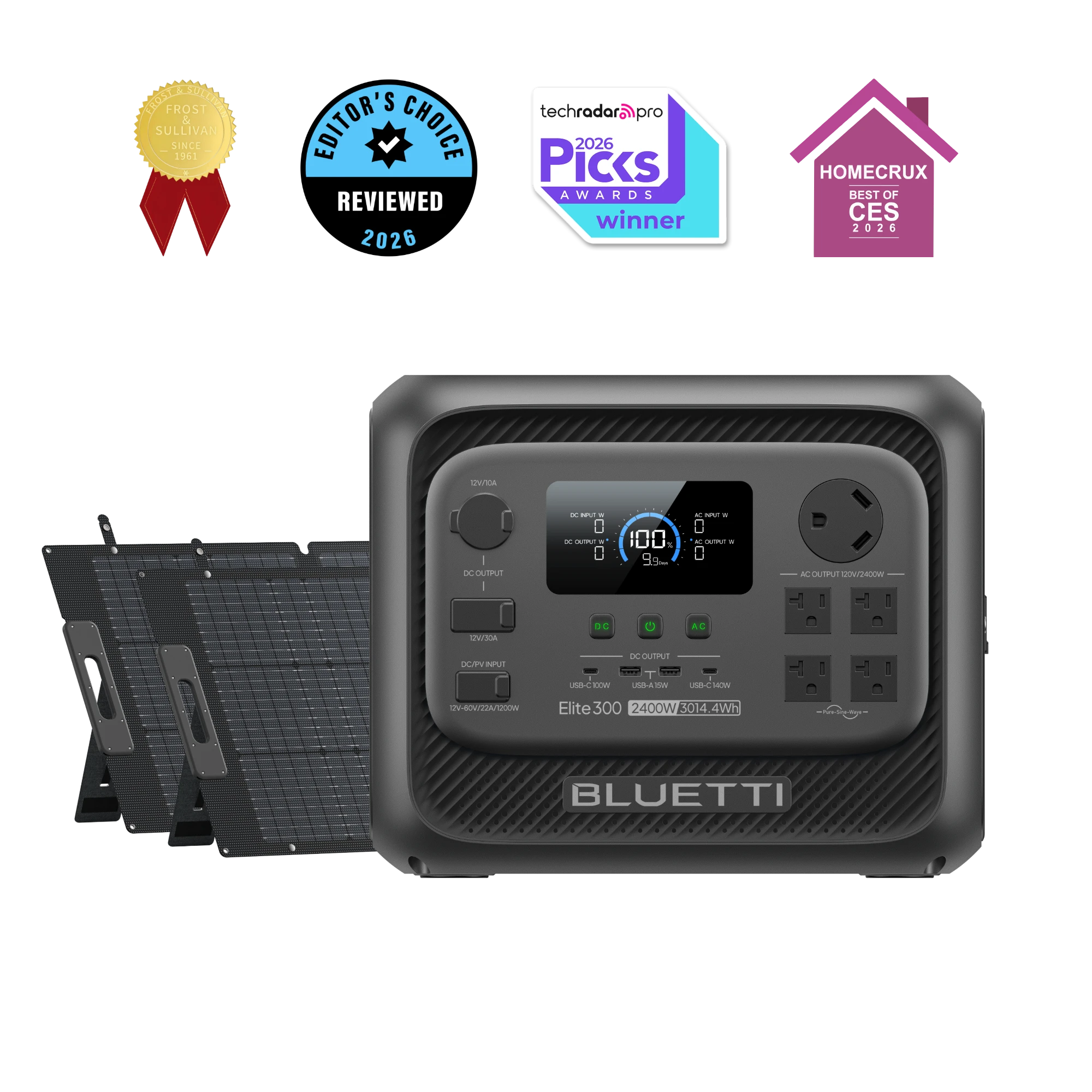
This exact U.S. option is the EL300 plus a pair of PV200 panels, 400 W combined nameplate; the station remains 3,014.4 Wh and 2,400 W. A 401 W supplied-panel minimum excludes it. The current option view does not establish all cable contents.
Explore this need in the finder →Does the pair of panels raise the EL300 above 2,400 W of continuous AC output?
No. The 2×200 W option leaves the EL300 at 2,400 W continuous AC. A 2,500 W essential requirement excludes this version even though its panels total 400 W nameplate.
Explore this need in the finder →Do you need an EL300 with two panels and at least 1,200 W of station-side solar-input capacity?
The EL300 supports up to 1,200 W, 12–60 V and 22 A at its solar input, while the two PV200s total 400 W nameplate. That station input headroom is not a claim that this package can harvest 1,200 W. EL300 has no direct expansion-battery port; requiring battery expansion rules it out.
Explore this need in the finder →BLUETTI’s Elite 300 + 2×200W solar option keeps the same EL300 station and supplies a pair of 200 W panels. The meaningful change from the standalone EL300 is its solar equipment, not a larger battery or inverter.
What this exact package changes
The U.S. compare-box option identifies itself as “Elite 300+2*200W.” The selected offer has its own Shopify option and variant IDs and package SKU EL300-3-21-SPFUS-00. BLUETTI’s U.S. direct-store listing identifies the included panel model as PV200. The two panels add 400 W of combined nameplate rating. That is the panel total, not a measured charge rate or guarantee of 400 W entering the battery.
The station remains EL300: 3,014.4 Wh LiFePO4 capacity, 2,400 W continuous 120 V AC output and a TT-30 receptacle. The TT-30 is a connection type, not a promise of 30 A of continuous output; the station’s overall AC rating stays 2,400 W. The package does not add a battery, and EL300 has no direct expansion-battery port.
Two smaller panels require a little more planning
BLUETTI’s PV200 guide lists 200 W peak power per panel, 20.5 V at maximum power, 9.7 A at maximum power, 26.1 V open circuit and 10.3 A short circuit. A two-panel series string works out to about 41 V at maximum power and 52.2 V open circuit under those published panel figures, with the string current staying at one panel’s value. The EL300 manual specifies a solar input from 12–60 V, up to 22 A and up to 1,200 W. On the published figures, that two-panel string sits under the station’s voltage and current ceilings and totals just under 400 W at maximum power.
Those are nameplate calculations, not a charge test. Open-circuit voltage rises in cold conditions, and the PV200 guide does not give the temperature coefficient needed for a universal cold-weather string check. Before wiring the pair in series, compare the cold-corrected string voltage with the EL300’s 60 V maximum. Do not connect the array if that corrected value could exceed the limit. The current EL300 FAQ discusses PV200 arrays but illustrates a four-panel 2S2P layout; the package itself is only two panels. If you want to avoid string sizing, one PV200 at a time is the simpler conservative setup, although it uses only half the package’s panel rating.
The selected package page does not expose a complete kit-specific box list in the captured view. The base EL300 box includes its AC cable, grounding screw and manual, but the exact 2×200W option does not clearly list every solar lead or branch connector. Do not assume that an MC4-to-XT60 cable, series adapter or extension is included. BLUETTI separately lists a 20 A MC4-to-XT60 solar charging cable; check the actual carton list and connector arrangement before travel. The panel pair will not be ready to charge the station without a suitable lead.
Capacity is still the EL300’s strength and limit
At nearly 58 lb, the station is a vehicle-supported or parked-site unit rather than a backpacking choice. Each PV200 guide lists 16.1 lb, so the pair adds 32.2 lb; station plus panels total about 90.2 lb before cables. The complete package weight is unpublished.
The EL300’s 3,014.4 Wh is a nameplate battery figure, not energy guaranteed at an AC socket after conversion losses. It can suit a refrigerator, lights, communications and selected household or RV loads when their combined demand stays within 2,400 W and the planned duration fits. It is not a house-transfer installation, and its TT-30 outlet does not make it a substitute for a properly installed transfer switch. BLUETTI lists fast charging modes, but no independent runtime or solar-harvest result is claimed here.
Which version fits your priorities?
This package is a sensible shortlist candidate when you need the EL300’s 120 V output, capacity and TT-30 connection, want two 200 W panels bought with the station, and can set up panels with a safe compatible cable. If your essential solar requirement is merely a panel included, the 350 W EL300 option supplies one PV350 instead; its own guide and page have a voltage discrepancy to keep in mind when extending the array. The 500 W EL300 kit includes one named SORA500 panel, but that panel’s maximum-power figures do not reconcile arithmetically in its manual. This 2×200W option has more total panel nameplate than the 350 W kit, but involves two separate modules and no verified claim of better real-world harvest. The plain EL300 is the simpler choice if you already own compatible panels; it does not include this pair.
Questionnaire choices should distinguish “solar input supported” from “panels included.” Setting a minimum supplied-panel value of 400 W, a 3,000 Wh floor, 120 V and TT-30 selects a different package than the station-only EL300 or its one-panel 350 W bundle. A 401 W supplied-panel minimum rules this version out, and a 2,500 W continuous AC requirement rules it out despite the panels. If you need a complete kit with a named cable in the same carton, the current package page is not specific enough to meet that requirement without checking the actual box contents. The station-weight filter describes the EL300 alone, not the roughly 90 lb total of its two panels and station.
This is a source-based assessment, not a test report: no ownership, runtime, output measurement or panel-harvest result is claimed. Confirm the exact package SKU and cable contents before buying.
Official references: BLUETTI’s Elite 300 + 2×200W U.S. option, the BLUETTI U.S. direct-store model listing for the included PV200 model, the PV200 support page and linked User Guide, the Solar Charging Cable support page and the Elite 300 U.S. manual.
Key details at a glance
| Nameplate battery capacity | 3014.4 Wh |
|---|---|
| Rated AC output | 2400 W |
| Maximum solar input | 1200 W |
| Included panels, combined nameplate | 400 W |
| Maximum USB-C output per port | 140 W |
| Listed weight | 57.98 lb |
| Compatible extra-battery expansion | No |
| 12 V DC output | 360 W |
| Maximum AC recharge input | 1800 W |
| Manufacturer UPS transfer figure | 10 ms |
| AC outlet output | Yes |
| USB-C ports | 2 |
| USB-A ports | 2 |
| Solar input ports | 1 |
| 12 V car-style output | 120 W |
| Battery chemistry | LiFePO4 |
| Ingress rating | IP20 |
| TT-30 RV outlet | Yes |
| Solar panels in exact offer | 2 |
Use the exact model’s instructions for operating limits, supplied equipment and version differences.
Sources for this assessment
- BLUETTI Elite 300 + 2*200W exact U.S. package option
- BLUETTI U.S. direct-store listing for Elite 300 + 2*200W solar kit
- BLUETTI PV200 U.S. support page
- BLUETTI PV200 Solar Panel User Guide
- BLUETTI Elite 300 U.S. User Manual V1.0
- BLUETTI Elite 300 U.S. page solar compatibility FAQ
- BLUETTI Solar Charging Cable support page
A useful match starts with the loads that matter.
Use the finder for hard electrical requirements, then check appliance starting behavior, actual run time and the exact package in the full assessment.