
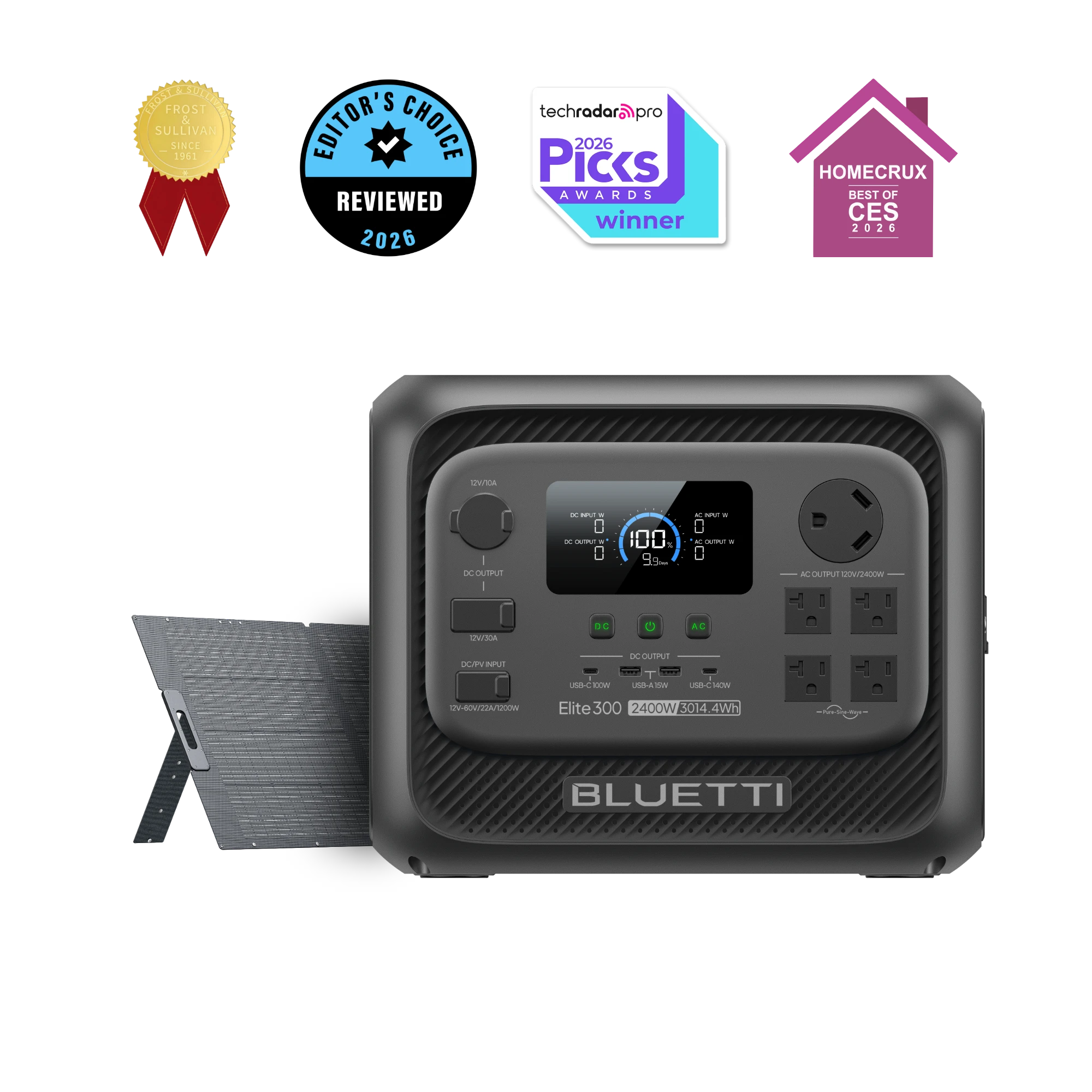
Your needs, this model
Does it fit your priorities?
Do you want an Elite 300 with a panel included in the same purchase package?
The selected U.S. SKU lists one 350 W PV350 folding panel and an MC4-to-XT60 cable with the EL300. It does not add a second panel or change the station’s battery size.
Explore this need in the finder →Is a 350 W nameplate panel enough for your solar plan?
This package includes one 350 W panel. That is its panel rating, not promised real-world output, and it is far below the EL300’s separate 1,200 W input ceiling. A requirement above 350 W of supplied panel capacity rules it out.
Explore this need in the finder →Can you move a roughly 58 lb station and a separate 32.4 lb panel rather than carry one compact unit?
The exact station weight and PV350 guide weight total about 90.4 lb before cables, although the complete package weight is not published. The EL300 and panel are separate components; the 350 W package does not make this a lightweight hike-in setup.
Explore this need in the finder →The BLUETTI Elite 300 + 350W is a U.S. package of the reviewed EL300 station, one foldable 350 W panel and a cable. Unlike the standalone station, this carton names the panel and its connection lead; it does not change the battery or inverter.
One station, one included panel
The exact U.S. option is SKU EL300-2-43-SPFUS-00. Its page lists an Elite 300 station, a 350W Solar Panel, AC cable, grounding screw, 1.5 m MC4-to-XT60 solar cable and user manual. The station remains model EL300: 3,014.4 Wh LiFePO4, 2,400 W at 120 V AC and the same outlets as the standalone unit. Its TT-30 receptacle suits a compatible RV inlet but does not make the station a 30 A source; the shared AC limit remains 2,400 W. No expansion battery, Charger 1 or Charger 2 is listed.
This is a recharge accessory, not extra storage. One portable panel can replenish the station in suitable sun, but it does not make the EL300 a continuous solar-powered home system.
How the panel fits the Elite 300
The package image and box list identify one BLUETTI 350 W folding panel, model PV350, with a matching MC4-to-XT60 lead. Its model-specific guide lists 350 W maximum power at standard test conditions, a 37 V maximum-power voltage and 44 V open-circuit voltage. The Elite 300 manual lists a 12–60 V, 22 A, up-to-1,200 W solar input. On those published ratings, one included PV350 is a plausible single-panel plan: its open-circuit voltage is below the station’s 60 V ceiling, and its rating is well under the station’s wattage ceiling. The exact option’s own listing also says the station and panel are sold together.
There is a discrepancy worth keeping visible if you are planning to add panels later. A BLUETTI marketing paragraph on the current 350W panel page says 33 V Voc, while the linked PV350 guide identifies the panel as model PV350 and lists 44 V Voc. Do not use the shorter marketing value to calculate a larger string. The one-panel package can be assessed from its named components and manuals, but this mismatch makes it unwise to improvise an expanded array from the bundle card alone. Verify any additional panel’s open-circuit voltage, current, connector and wiring arrangement against the station limits before buying or connecting it.
What 350 watts does—and does not—promise
350 W is the panel’s rated maximum under specified test conditions, not a guaranteed charging rate in a yard, campground or winter outage. Orientation, cloud, shade, temperature and the station’s state of charge change the real input. The package includes one panel rather than enough modules to approach the EL300’s 1,200 W solar-input ceiling. Do not translate the 1,200 W station limit into a claim that this bundle harvests 1,200 W, and do not assume a second panel, splitter or extension lead is in the box. If you already own compatible panels, the standalone EL300 may be a more flexible starting point; the electrical rules still matter when you connect your own array.
The PV350 guide describes a four-section folding panel with adjustable support. Its listed weight is 32.4 lb; the EL300 itself is 57.98 lb. The main pieces total about 90.4 lb before cable, so they are separate carries but not a light hike-in system. Treat the package as vehicle-supported equipment or a setup that can remain in place. The panel guide warns against shade, soaking, bending and extreme weather; its product page calls it splash-resistant but cautions against prolonged rain or water. It is not a roof-panel kit.
Who should choose this version?
This exact package is most useful when the buyer wants a large 120 V station, values the EL300’s TT-30 outlet, does not already own an appropriate panel, and wants a clearly identified single-panel solar route without selecting cables independently. The panel can supplement grid charging during a sunny day or provide a way to put some energy back into the station when an outlet is unavailable. It is less compelling for someone who only needs the battery and already owns compatible solar gear, or who expects a high solar harvest from one portable panel. The station’s nearly 58 lb body remains the main limitation for frequent movement, and the full bundle weight is not published.
Questionnaire choices should change the shortlist for concrete reasons. Requiring a solar input alone is not the same as requiring a panel in the same package; choosing “panel included” and at least 350 W points to this SKU, while a higher panel-wattage minimum rules it out. The finder’s listed-weight limits describe the station and its documented expansion batteries, not every accessory in a box: the PV350 adds 32.4 lb, and BLUETTI does not publish a complete combined weight for this bundle. If an exact maximum for all carried pieces is essential, count the panel separately rather than reading the station’s 57.98 lb figure as a kit weight. If vehicle charging while driving is the essential need, compare the separate Elite 300 Charger 1 or Charger 2 packages instead: those change the recharge route and installation burden, not the battery size. If 3,840 Wh is more important than the EL300’s TT-30 receptacle, compare the standalone Elite 400 assessment; it is a different, heavier station rather than a panel upgrade.
This is a source-based assessment, not a test report: no measured output, recharge time, ownership or complete package weight is claimed. Check the SKU and manuals before planning a connection.
Official references: the Elite 300 + 350W U.S. option and its box list, the BLUETTI 350W panel product page, its linked PV350 User Guide, and the Elite 300 U.S. manual.
Key details at a glance
| Nameplate battery capacity | 3014.4 Wh |
|---|---|
| Rated AC output | 2400 W |
| Maximum solar input | 1200 W |
| Included panels, combined nameplate | 350 W |
| Maximum USB-C output per port | 140 W |
| Listed weight | 57.98 lb |
| Compatible extra-battery expansion | No |
| 12 V DC output | 360 W |
| Maximum AC recharge input | 1800 W |
| Manufacturer UPS transfer figure | 10 ms |
| AC outlet output | Yes |
| USB-C ports | 2 |
| USB-A ports | 2 |
| Solar input ports | 1 |
| 12 V car-style output | 120 W |
| Battery chemistry | LiFePO4 |
| Ingress rating | IP20 |
| TT-30 RV outlet | Yes |
| Solar panels in exact offer | 1 |
Use the exact model’s instructions for operating limits, supplied equipment and version differences.
Sources for this assessment
A useful match starts with the loads that matter.
Use the finder for hard electrical requirements, then check appliance starting behavior, actual run time and the exact package in the full assessment.