
Your needs, this model
Does it fit your priorities?
Do you need 120 V output, a 2,400 W AC ceiling and a dedicated TT-30 RV connector?
The exact U.S. Elite 300 offers 2,400 W maximum output at 120 V and the product page/manual identify a TT-30 receptacle. The connector is not a promise of 30 A output; all AC loads share the 2,400 W station ceiling.
Explore this need in the finder →Will one 1,200 W solar input at 12–60 V and a 140 W USB-C port support your recharge and device plan?
The manual lists 1,200 W maximum solar input at 12–60 V/22 A and individual USB-C ratings of 140 W and 100 W. Keep panel open-circuit voltage within range and do not treat panel wattage as guaranteed harvest.
Explore this need in the finder →Does the 12 V/30 A outlet fit if it shares a 30 A total ceiling with the car socket?
The manual connects the 12 V/30 A output and 12 V/10 A car-style socket in parallel with 30 A total, not 40 A. The station weighs 57.98 lb; the current official FAQ says the EL300 has no native expansion port.
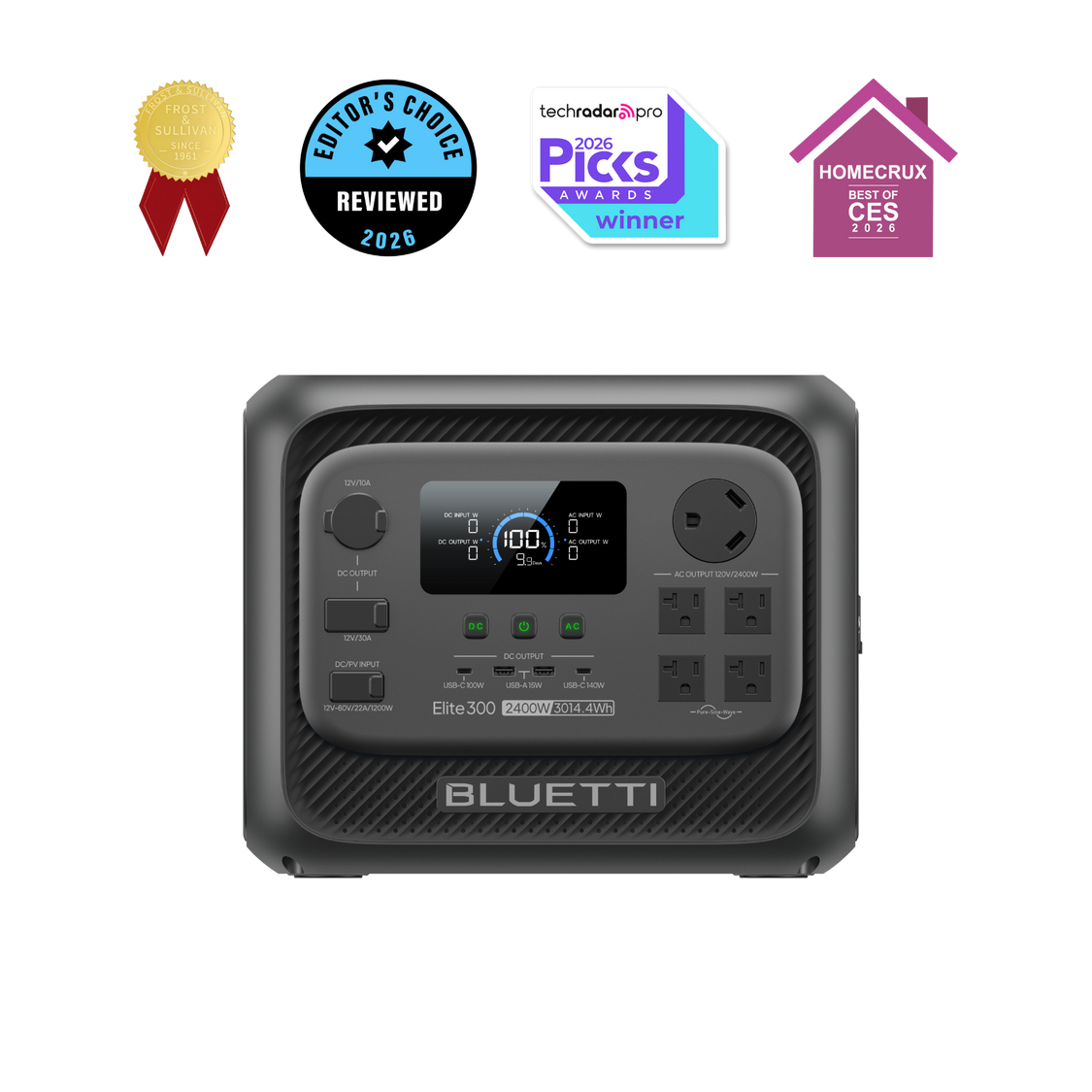
Explore this need in the finder →The BLUETTI Elite 300 (model EL300, U.S. standalone SKU EL300-US-GY-ID-SPFUS-00) is a roughly 3 kWh, 2,400 W station built around a useful difference: its U.S. product page explicitly lists an RV-style TT-30 outlet. It also accepts up to 1,200 W of solar and includes a 140 W USB-C port, but the station itself weighs about 57.98 lb. Think of it as a compact-for-its-capacity backup or RV battery that can be moved deliberately, not a small grab-and-go power bank.
Room for a larger load list, with a clear AC ceiling
BLUETTI’s U.S. manual lists 3,014.4 Wh of LiFePO4 battery capacity and 2,400 W maximum U.S. AC output at 120 V. The 2,400 W figure is the continuous nameplate ceiling for the reviewed station plan; it does not show that an appliance with a big motor will start. BLUETTI notes that some motors and compressors draw several times their rated power during startup, so check the actual appliance label and startup requirement rather than treating a household wattage estimate as proof of fit.
Power Lifting mode is particularly easy to overread. The manual says it can accommodate certain pure-resistive loads rated from 2,400 W up to 4,800 W, such as heating devices, while the actual output rating remains 2,400 W. It is not a general 4,800 W inverter and does not convert a motor, compressor, or other non-resistive load into a supported one. The manual separately lists a lower 1,800 W AC bypass rating, so wall pass-through and battery-mode AC output are not interchangeable figures.
The listed U.S. outputs include household AC receptacles, a TT-30 RV connection, a 12 V/30 A DC outlet, a 12 V/10 A car-style socket, two USB-A ports, and USB-C ports rated at 140 W and 100 W. Those DC outlets are not independent: BLUETTI says the car-style socket and 12 V/30 A outlet are connected in parallel with 30 A total. That means the two claims do not provide 40 A of simultaneous 12 V output. The two USB-C limits are also per-port maxima, not a promise that every output can simultaneously operate at its individual label.
Solar accepts more than the station’s included box provides
The manual specifies a single XT60-F DC input accepting up to 1,200 W, 12–60 V and 22 A. It warns against solar-panel open-circuit voltage above 60 V; its FAQ calls for a 12–60 V panel input and MC4 connectors. That is a broad enough voltage range to require careful array and cable checks. Do not select panels from wattage alone, and do not assume a 1,200 W panel will deliver 1,200 W in ordinary sunlight.
For AC charging the manual lists up to 1,800 W. Its AC-plus-DC input ceiling is 2,400 W, but the modes and input limits should be treated as a combined system cap rather than values that can all be added freely. The standalone product page’s box list names the station, AC charging cable, and grounding screw; it does not list a solar panel. The page also offers panel and charging-accessory packages. This review covers the exact standalone SKU only, so verify a selected package’s panel identity, cable, carton, and compatibility before counting it in a solar plan.
Portable by station standards, but still almost 58 pounds
The manual lists dimensions of 14.41 × 12.01 × 11.71 inches and a weight of about 26.3 kg (57.98 lb). That is substantially easier to reposition than the 39 kg Elite 400, but it remains a substantial lift into a vehicle or up stairs. The TT-30 outlet makes this configuration more directly relevant to RV users than a station whose outlet list contains only household receptacles, while its size and battery make it more compelling for a parked trailer or short outage than for hiking or repeated one-person carrying.
BLUETTI lists a 10 ms UPS switchover, but the manual specifically cautions against using its UPS mode for data servers or workstations that require high-performance UPS behavior. Ten milliseconds is a manufacturer specification, not an independently measured transfer test or assurance that a sensitive device will stay on. This is also not an automatic home-panel or grid-interconnection system: the manual says not to connect the station’s AC output to the grid.
The manual rates the enclosure IP20 and lists charging from 32–104°F and discharging from −4–104°F. Keep it dry and ventilated. Its care instructions also call for prompt recharge below 5% and storage at 40–60% state of charge when unused for an extended period. No runtime, sound level, or electrical output was measured for this assessment, and no physical sample was inspected.
Who should choose it, and when does the answer change?
The Elite 300 makes sense when one operating plan needs 120 V AC at or below 2,400 W, approximately 3,014 Wh of stored energy, a dedicated TT-30 connection, up to 1,200 W solar input, and no more than about 58 lb to move. A 2,400 W minimum output and a 60 lb handling limit include it; a 2,500 W output floor or a strict 50 lb carry limit removes it. If a 140 W USB-C connection matters, it has one such port alongside a separate 100 W port.
Compare the Elite 400 if you want more listed capacity and output and are willing to roll a heavier 39 kg unit; it is not the better answer for a verified TT-30 need, and its solar ceiling is lower. The Elite 200 V2 is a 2,073.6 Wh, 2,600 W alternative with two 100 W USB-C ports, but its 53.35 lb weight and smaller battery change the plan. The Elite 100 V2 is lighter at 25.3 lb and holds 1,024 Wh, but its 1,800 W AC rating and lack of a confirmed expansion route are different constraints. The exact page checked on October 23, 2026 stated the Elite 300 would ship from October 23; confirm the manufacturer’s current fulfillment timing before ordering.
For separate Charger 1 and Charger 2 package assessments, see our charger-bundle guide; this review remains for the exact station-only SKU.
Key details at a glance
| Nameplate battery capacity | 3014.4 Wh |
|---|---|
| Rated AC output | 2400 W |
| Maximum solar input | 1200 W |
| Maximum USB-C output per port | 140 W |
| Listed weight | 57.98 lb |
| Compatible extra-battery expansion | No |
| 12 V DC output | 360 W |
| Maximum AC recharge input | 1800 W |
| Manufacturer UPS transfer figure | 10 ms |
| AC outlet output | Yes |
| USB-C ports | 2 |
| USB-A ports | 2 |
| Solar input ports | 1 |
| 12 V car-style output | 120 W |
| Battery chemistry | LiFePO4 |
| Ingress rating | IP20 |
| TT-30 RV outlet | Yes |
Use the exact model’s instructions for operating limits, supplied equipment and version differences.
Sources for this assessment

A useful match starts with the loads that matter.
Use the finder for hard electrical requirements, then check appliance starting behavior, actual run time and the exact package in the full assessment.