
Your needs, this model
Does it fit your priorities?
Do you need two panels rated at 350 W each in the same U.S. Elite 400 package?
The exact option lists two 350W Solar Panel items. The matching U.S. panel listing identifies the 350W model as PV350 / SKU PV350-UJ-BK-MD-SPFUS-00. This is 700 W of box-list nameplate, not a measured station input.
Explore this need in the finder →Must both PV350 panels be connected together to meet an essential solar-input condition?
The package includes two individual leads and a Y-branch, but the EL400 manual caps solar input at 20 A; the PV350 guide lists 9.5 A Imp and 11.4 A Isc per panel. The exact safe combined current and cold-corrected voltage arrangement is not confirmed here. Do not assume both can be connected at once.
Explore this need in the finder →Would TT-30 or 240 V output still be essential if the package supplies 700 W of panels?
No panel changes the EL400 station. It remains a 120 V / 2,600 W single-station configuration without TT-30 or 240 V output; either essential requirement rules it out.
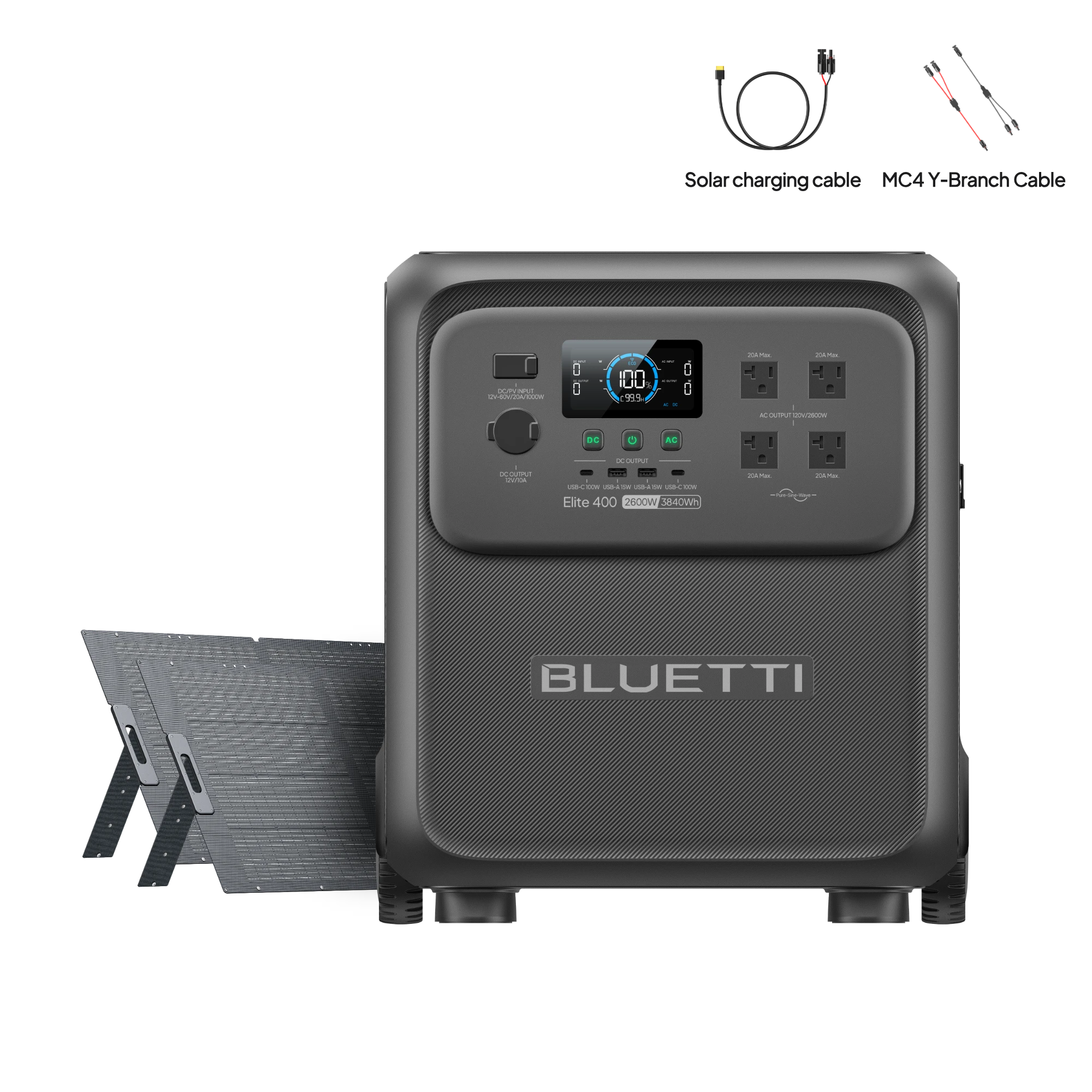
Explore this need in the finder →The BLUETTI Elite 400 + 2×350W option is a separate U.S. package configuration of the same EL400 station already covered in the standalone review. Its manufacturer-selected option is variant 47915195957467, package SKU EL400-4-07-SPFUS-00. The box list names the Elite 400 once and two 350 W solar panels. That is a larger panel-in-box offer than the one-PV350 EL400 kit, but it does not increase the station's 3,840 Wh capacity, 2,600 W rated AC output, or the outlets you can use.
What the 700 W panel label does—and does not—mean
The exact option page lists two 350 W panels, for 700 W of combined panel nameplate. BLUETTI's separate U.S. 350 W panel listing and its product data identify that panel as PV350, SKU PV350-UJ-BK-MD-SPFUS-00. The linked PV350 guide lists each panel at 37 V maximum-power voltage and 9.5 A maximum-power current, with 44 V open-circuit voltage and 11.4 A short-circuit current. Those are panel ratings under specified test conditions, not a promise of charge power through a real day. Shade, orientation, temperature, available sunlight and conversion losses all affect what reaches the station.
Do not treat the 700 W combined nameplate as an assurance of 700 W station input. The EL400 manual limits solar input to 1,000 W, 12–60 V DC and 20 A maximum. The option's box list is unusually specific: two 1.5 m MC4-to-XT60 leads and one MC4 Y-branch are included. That suggests a bundled way to join the panels, but the package page is not an electrical wiring diagram. At the PV350 guide's rated maximum-power point, two panels in parallel would total about 19 A; their short-circuit ratings sum to 22.8 A. The EL400 manual does not resolve in the pages inspected how its 20 A maximum should be applied to that bundled pair. The separate panel page also says 33 V open circuit in one current text section, while the linked PV350 guide says 44 V; neither source gives the PV350 temperature coefficient for cold-corrected voltage. Do not build a two-panel array from the artwork or these arithmetic comparisons alone. Until current BLUETTI instructions confirm permissible pair wiring, connect at most one PV350 at a time only after checking that its temperature-adjusted Voc remains within the EL400's 60 V ceiling for local conditions. If that cannot be verified, ask BLUETTI before connecting either panel.
What arrives, and what you still have to handle
The selected option's U.S. box list names the EL400, two 350 W Solar Panels, one AC charging cable, one grounding screw, two solar charging cables (MC4 to XT60), one MC4 Y-branch cable and one Elite 400 manual. No Charger 1/Charger 2 or expansion battery is on this list. The exact direct-store listing maps the 350 W panel to PV350, so this package should not be confused with the earlier 2×200 W option whose panel model details were not confirmed.
Portability is a real tradeoff. The station weighs 85.98 lb and each PV350 is listed at 32.4 lb; together the three main items total about 150.8 lb before leads, manual, bags or packaging. The EL400's wheels and telescoping handle help move the power station on a suitable surface, but they do not make two large folding panels light or turn the whole order into a one-person carry-on kit. This configuration suits a semi-permanent backup location, workshop, vehicle base camp or home garage where the panels can be stored and deployed separately. It is not the natural choice for frequent foot transport.
The station stays an EL400
For appliance selection, keep the EL400's limits in view: 3,840 Wh nameplate capacity and 2,600 W continuous AC output at 120 V. The manufacturer also lists a 3,900 W Power Lifting mode, but the manual restricts it to pure-resistive loads; it is not an extra continuous rating for motors, compressors or uncertain startup surges. The station has four household AC outlets, USB ports and a 12 V car-style outlet. It has no TT-30 receptacle and no 240 V output, so the panel bundle cannot satisfy an RV 30 A inlet or split-phase appliance requirement. Its 15 ms UPS figure is a manufacturer specification, not a guarantee for medical equipment or high-performance computer loads.
This package is worth considering if the EL400's larger storage and 2,600 W output are right for you and you want two manufacturer-listed PV350 panels in the same order. The one-PV350 package is simpler when a single panel is enough and avoids the unresolved two-panel input question. The EL400 + 500 W option offers a single higher-nameplate panel; it remains a different panel identity and a different carrying load. The Elite 300 + 2×200 W package has a lower 2,400 W station and 3,014.4 Wh capacity but an exact named PV200 pair; compare the complete station and compatibility facts rather than choosing by panel watts alone.
How the questionnaire should change the shortlist
Choosing “solar panel included” with a 700 W in-box minimum can surface this exact variant; a 701 W minimum cannot. The solar-input question describes the station's documented 1,000 W ceiling, not measured collection or the package's usable combined panel power. Capacity, AC-output, 120 V, TT-30 and weight requirements still apply to the EL400 configuration: a TT-30 or 240 V requirement should remove it. The weight field refers to the station only, so account separately for the two 32.4 lb panels and the unknown shipping/package weight. As checked on October 23, 2026, the manufacturer page said the EL400 would ship in late November while other package items were in stock; preorder timing can change. No physical sample, measured solar harvest, independent runtime or delivered-AC-energy result is claimed.
BLUETTI's selected Elite 400+2*350W U.S. package option and the linked 350 W panel listing are the reviewed manufacturer sources.
Key details at a glance
| Nameplate battery capacity | 3840 Wh |
|---|---|
| Rated AC output | 2600 W |
| Maximum solar input | 1000 W |
| Included panels, combined nameplate | 700 W |
| Maximum USB-C output per port | 100 W |
| Listed weight | 85.98 lb |
| 12 V DC output | 120 W |
| Maximum AC recharge input | 1800 W |
| Manufacturer UPS transfer figure | 15 ms |
| AC outlet output | Yes |
| USB-C ports | 2 |
| USB-A ports | 2 |
| Solar input ports | 1 |
| 12 V car-style output | 120 W |
| Battery chemistry | LiFePO4 |
| Ingress rating | IP20 |
| TT-30 RV outlet | No |
| Solar panels in exact offer | 2 |
Use the exact model’s instructions for operating limits, supplied equipment and version differences.
Sources for this assessment

A useful match starts with the loads that matter.
Use the finder for hard electrical requirements, then check appliance starting behavior, actual run time and the exact package in the full assessment.