
Your needs, this model
Does it fit your priorities?
Must the same order include a panel rated at least 350 W?
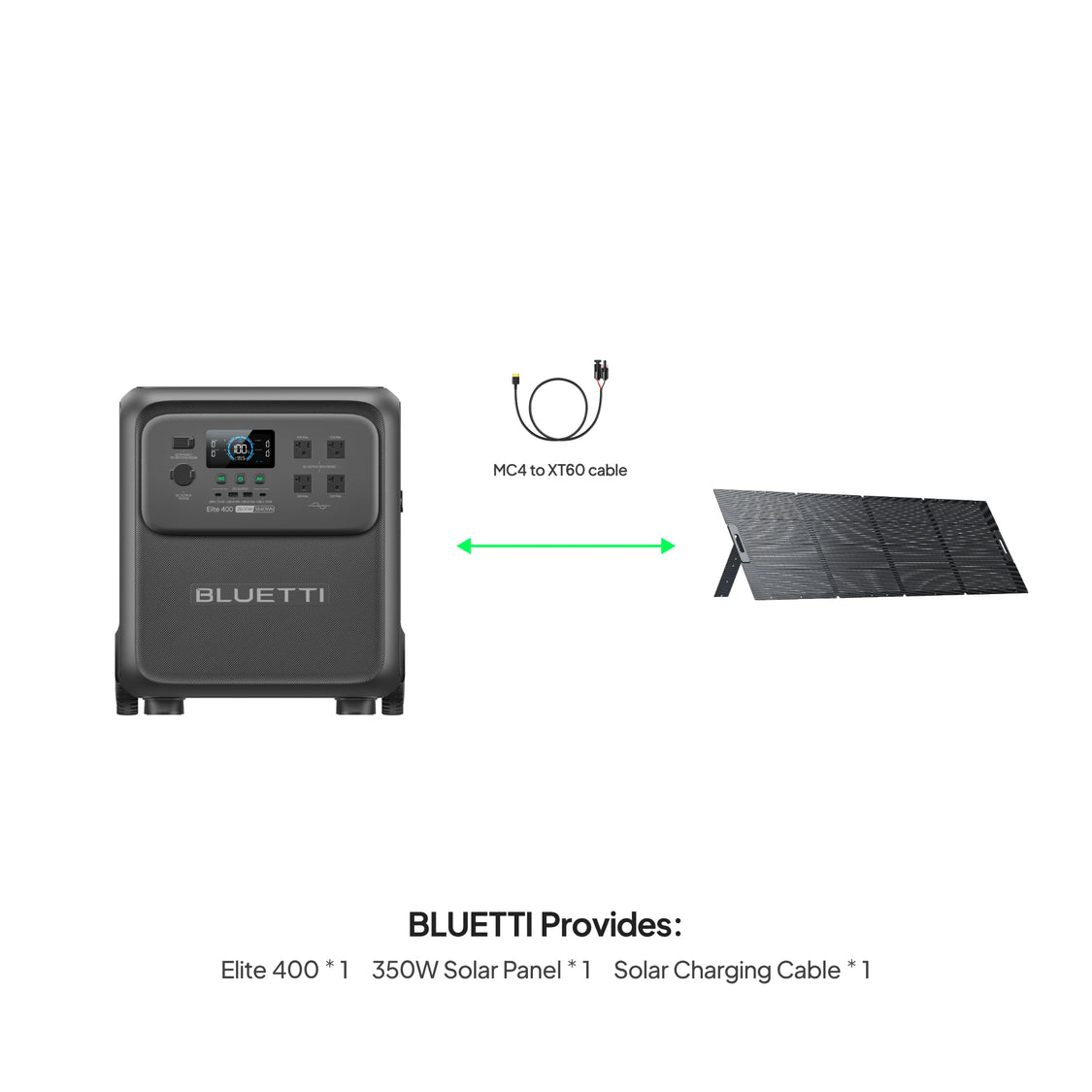
The exact Elite 400+350W option lists one 350 W panel and an MC4-to-XT60 solar lead. It is not the standalone station and does not include two panels.
Explore this need in the finder →Do you need the EL400’s larger 3.84 kWh / 2.6 kW station with a panel included?
The station remains 3,840 Wh and 2,600 W at 120 V; its 350 W panel changes replenishment options, not stored energy or AC output.
Explore this need in the finder →Can your setup handle an 86 lb rolling station and a separate 32.4 lb folding panel?
The Elite 400 alone is 85.98 lb and rolls on level floors; the PV350 is a separate 32.4 lb component. The finder weight threshold applies to the station, not the full package.
Explore this need in the finder →The BLUETTI Elite 400 + 350W Solar Panel option is an exact U.S. package built around the same EL400 station reviewed on its own. The selected manufacturer option (variant 47915195760859) lists one Elite 400 and one 350 W panel, plus an MC4-to-XT60 solar cable. The station remains a 3,840 Wh, 2,600 W 120 V unit; the panel adds a way to replenish it, not more stored energy, a higher AC rating or a different outlet set.
One PV350 panel, not a 1,000 W solar array
The station manual permits up to 1,000 W of solar input over a 12–60 V DC, 20 A maximum input. The package supplies only one 350 W panel. BLUETTI's separate U.S. 350 W panel listing identifies the model as PV350, SKU PV350-UJ-BK-MD-SPFUS-00, and lists the EL400 as compatible. Its current linked PV350 guide gives 37 V at maximum power, 9.5 A, 44 V open circuit and 11.4 A short-circuit current. Those one-panel figures sit within the EL400's documented voltage and current limits. The rated 350 W is a laboratory nameplate condition, however; daylight, orientation, shade, temperature and conversion losses affect what reaches the battery. It is not a promise that the station will receive 350 W continuously.
Do not confuse the 1,000 W station input ceiling with the panel supplied. Nor should the page's advertised 0–80% in 70 minutes at 2,800 W of dual AC-and-solar charging be read as a panel-only charge estimate. One 350 W panel cannot supply that combined input rate. The same PV350 page contains a voltage sentence saying 33 V open circuit, while its linked model-specific guide states 44 V. Either published figure is below this station's 60 V maximum for one panel, but the conflict matters if considering a second panel; this review does not infer a safe multi-panel wiring plan from the single-panel package.
What is actually in this carton
The selected EL400 option's U.S. box list names the station, one 350 W solar panel, one 1.8 m AC charging cable, one grounding screw, one 1.5 m MC4-to-XT60 solar cable and one user manual. The named panel is connected to the station's solar input using the listed lead. The package page does not publish a complete shipped weight. The station weighs 85.98 lb by its manual and the PV350 weighs 32.4 lb by its guide, or about 118.4 lb for those two main pieces before cables and packing. They are separate items, not a single thing to carry at once, but this is still a bulky home, workshop or vehicle kit rather than a light trail setup.
The EL400's limits stay the same
For appliance planning, use the EL400's rated 2,600 W AC output at 120 V and its 3,840 Wh nameplate capacity. The page also advertises 3,900 W Power Lifting, but the manual limits that mode to pure-resistive loads and says the actual output remains 2,600 W. It is not a 3,900 W continuous rating for a refrigerator, motor or pump with uncertain startup demand. The reviewed port list has household AC outlets, USB ports and a 12 V car-style outlet, but no TT-30 receptacle or 240 V output. Adding a solar panel does not turn this into a split-phase home system or a direct RV 30 A outlet. The manual's 15 ms UPS figure is a manufacturer claim, not a medical-device guarantee or a reason to substitute it for a high-performance computer UPS.
Who should choose this option?
It is a reasonable fit when a buyer wants a rolling 3.84 kWh station and would otherwise have to source a compatible panel and cable separately. It makes less sense if the station already has a panel, because the standalone EL400 does not include this kit's 350 W panel. It also misses a requirement for more than 350 W of supplied panel capacity, a TT-30 socket, 240 V output or a station appreciably lighter than 86 lb. If the same panel rating and an RV TT-30 outlet matter more than the extra storage, the separately reviewed Elite 300 + 350W package has a smaller 3,014.4 Wh / 2,400 W station and does list TT-30; it is not a substitute if the EL400's larger capacity or output is essential.
In a needs questionnaire, selecting “panel included” and a 350 W minimum can include this exact package, while a 351 W minimum cannot. Capacity and rated-output thresholds still apply to the EL400 itself. A TT-30 or 240 V requirement rules it out. The weight question refers to the station, not the entire panel kit, so check the separate panel weight before deciding whether the complete setup is manageable. As checked on October 23, 2026, the product page said the EL400 would ship in late November while other kit items were in stock; preorder and shipping information can change. No physical sample, real-world recharge test or delivered-AC-energy measurement is claimed here.
Key details at a glance
| Nameplate battery capacity | 3840 Wh |
|---|---|
| Rated AC output | 2600 W |
| Maximum solar input | 1000 W |
| Included panels, combined nameplate | 350 W |
| Maximum USB-C output per port | 100 W |
| Listed weight | 85.98 lb |
| 12 V DC output | 120 W |
| Maximum AC recharge input | 1800 W |
| Manufacturer UPS transfer figure | 15 ms |
| AC outlet output | Yes |
| USB-C ports | 2 |
| USB-A ports | 2 |
| Solar input ports | 1 |
| 12 V car-style output | 120 W |
| Battery chemistry | LiFePO4 |
| Ingress rating | IP20 |
| TT-30 RV outlet | No |
| Solar panels in exact offer | 1 |
Use the exact model’s instructions for operating limits, supplied equipment and version differences.
Sources for this assessment

A useful match starts with the loads that matter.
Use the finder for hard electrical requirements, then check appliance starting behavior, actual run time and the exact package in the full assessment.