
Your needs, this model
Does it fit your priorities?
Does your plan need at least 3,840 Wh and 2,600 W at 120 V, with a rolling case under a 90 lb handling allowance?
The Elite 400 standalone model is rated 3,840 Wh and 2,600 W at 120 V and weighs about 85.98 lb before optional package components. Its trolley helps on a smooth floor; the weight remains a real obstacle for stairs and loading.
Explore this need in the finder →Is a 1,000 W solar input enough, or do you require more than its 12–60 V / 20 A ceiling?
The manual lists solar up to 1,000 W at 12–60 V/20 A and a separate 1,800 W AC-input ceiling. It does not include a panel in the standalone box.
Explore this need in the finder →Are two 100 W USB-C ports enough, or is at least one 140 W port essential?
The two USB-C ports are each listed at 100 W. If one 140 W port is a hard condition, this model does not meet it; the Elite 300 manual lists one 140 W port.
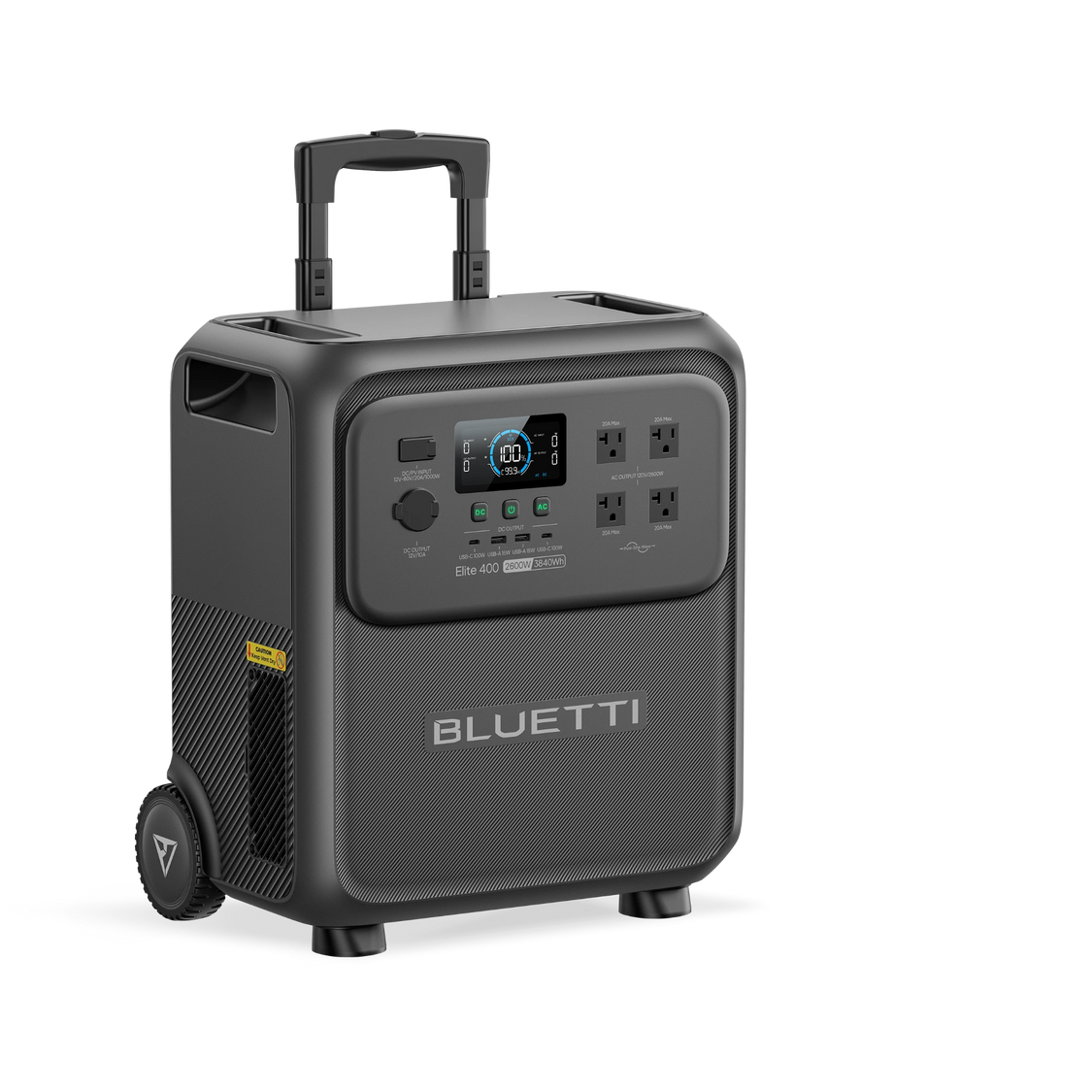
Explore this need in the finder →The BLUETTI Elite 400 is a 3,840 Wh, 2,600 W portable power station with a luggage-style handle and wheels. Its exact U.S. product page identifies model EL400 and standalone SKU EL400-US-GY-SPFUS-00; the user manual lists a 120 V U.S. output, LiFePO4 battery and 39 kg (85.98 lb) weight. This is a rolling backup unit for a location where added stored energy matters more than carrying it by hand. Its wheels help on level floors; loading and stairs still require lifting an 86 lb unit.
More stored energy than the Elite 300, not a separate inverter class
The manual lists 3,840 Wh and 2,600 W maximum U.S. AC output. Compared with the Elite 300, that is 825.6 Wh more nameplate capacity and 200 W more rated AC output, but also about 12.7 kg (28 lb) more station weight. Capacity is stored energy, not promised AC energy. Actual runtime depends on load, inverter use, reserve and temperature; none was measured here.
The product page advertises 3,900 W of “lifting” output. The manual limits that mode to pure-resistive loads rated between 2,600 W and 3,900 W, while confirming that the station’s actual output remains 2,600 W. It should not be treated as a 3,900 W continuous supply for a motor, refrigerator compressor, pump, or other load whose startup behavior is uncertain. Match a device’s running and starting requirements to the rated 2,600 W AC plan.
The exact product page and manual list four AC outlets, two USB-A ports rated 15 W each (30 W total), two 100 W USB-C ports, and one 12 V/10 A car-style socket. The published total is nine output connections. The reviewed port list does not include a dedicated TT-30 receptacle, so do not select the Elite 400 on the assumption that a household outlet will connect directly to an RV TT-30 cord. If that connector is essential, the Elite 300’s U.S. page explicitly identifies a TT-30 outlet and is the more relevant model in this pair.
Solar, wall and vehicle charging each have different limits
The Elite 400 accepts solar through its DC input at up to 1,000 W, 12–60 V and 20 A. Its manual says to keep panel open-circuit voltage within the 60 V maximum. The standalone box list includes the power station, AC charging cable, grounding screw and manual; it does not list a solar panel. BLUETTI’s manual marks the solar charging cable as an optional accessory, and the product page separately offers panel kits. A 350 W or 500 W package is not part of this station-only assessment, and a panel’s nameplate output is not guaranteed harvest.
The manual lists a maximum 1,800 W AC charging input and 1,000 W DC input, with a U.S. AC-plus-DC input limit of 2,800 W. It describes standard, turbo and silent AC charge modes; turbo is faster but is not the only way to recharge. Its car section describes charging from a vehicle’s 12 V or 24 V cigarette-lighter socket using the car charging cable. Separate accessory bundles advertise faster car charging, but those accessory names do not establish that the charger or its wiring is included with the standalone SKU. Plan around the exact box contents and the maximum input of the chosen route, not the accessory bundle headline.
The manual lists a 15 ms UPS switchover and explains how the unit can take over AC loads when grid input fails. It also says this UPS feature is not for data servers or workstations requiring high-performance UPS service. The 15 ms figure is not independent testing or a guarantee for medical or sensitive equipment. Try a noncritical load first and arrange suitable backup when uninterrupted power is essential. The manual also says not to connect the station’s AC output to the grid.
Rolling mobility, indoor use and care
BLUETTI lists the Elite 400 at 427 × 286 × 490 mm (16.8 × 11.3 × 19.3 inches) before accounting for the extended pull handle. Its built-in wheels and handle make room-to-room movement less awkward than carrying an 86 lb box, but the user still has to manage lifting, loading and stairs. It is a better fit beside a home refrigerator, workshop, or parked vehicle than for a walk-in campsite where the station must be carried far from the car.
IP20 is not rain protection. The manual lists charging at 32–104°F and discharging at −4–104°F; keep the unit dry and ventilated. For storage beyond three months, it recommends 40–60% charge, not leaving the battery depleted. The product page, checked October 23, 2026, listed the Elite 400 for late-November shipment. That ship window can change; check the current U.S. listing before planning around delivery. No physical unit, output, charge time, fan noise or UPS transition was independently tested here.
Who should choose it, and what changes the shortlist?
Choose the Elite 400 when the plan needs 120 V output up to 2,600 W, at least 3,840 Wh of listed storage, a rolling format and no more than 1,000 W of solar input. A 2,600 W minimum output with an 86 lb handling allowance fits; a 3,000 W minimum, a 60 lb lift limit, a 1,200 W solar-input requirement, or a TT-30 plug requirement points away from it. Each of those choices changes which alternatives qualify rather than merely changing a preference label.
The Elite 300 has a lower 2,400 W output and 825.6 Wh less capacity, but weighs 57.98 lb, lists a 1,200 W solar ceiling and explicitly supports TT-30. The Elite 200 V2 provides the same 2,600 W AC rating with 2,073.6 Wh in a 53.35 lb case, trading away stored energy without making the station light. For a household plan that needs still more output, 240 V or battery expansion, compare a separately documented system rather than assuming those capabilities from a 120 V Elite station. The manufacturer’s U.S. listing distinguishes the standalone Elite 400 from its panel and charger bundles; confirm the exact included accessory set if ordering a package.
For separate Charger 1 and Charger 2 package assessments, see our charger-bundle guide; this review remains for the exact station-only SKU.
Key details at a glance
| Nameplate battery capacity | 3840 Wh |
|---|---|
| Rated AC output | 2600 W |
| Maximum solar input | 1000 W |
| Maximum USB-C output per port | 100 W |
| Listed weight | 85.98 lb |
| 12 V DC output | 120 W |
| Maximum AC recharge input | 1800 W |
| Manufacturer UPS transfer figure | 15 ms |
| AC outlet output | Yes |
| USB-C ports | 2 |
| USB-A ports | 2 |
| Solar input ports | 1 |
| 12 V car-style output | 120 W |
| Battery chemistry | LiFePO4 |
| Ingress rating | IP20 |
| TT-30 RV outlet | No |
Use the exact model’s instructions for operating limits, supplied equipment and version differences.
Sources for this assessment

A useful match starts with the loads that matter.
Use the finder for hard electrical requirements, then check appliance starting behavior, actual run time and the exact package in the full assessment.