
Your needs, this model
Does it fit your priorities?
Do you specifically require sodium-ion chemistry and a 120 V station with at least 900 Wh and 1,500 W?
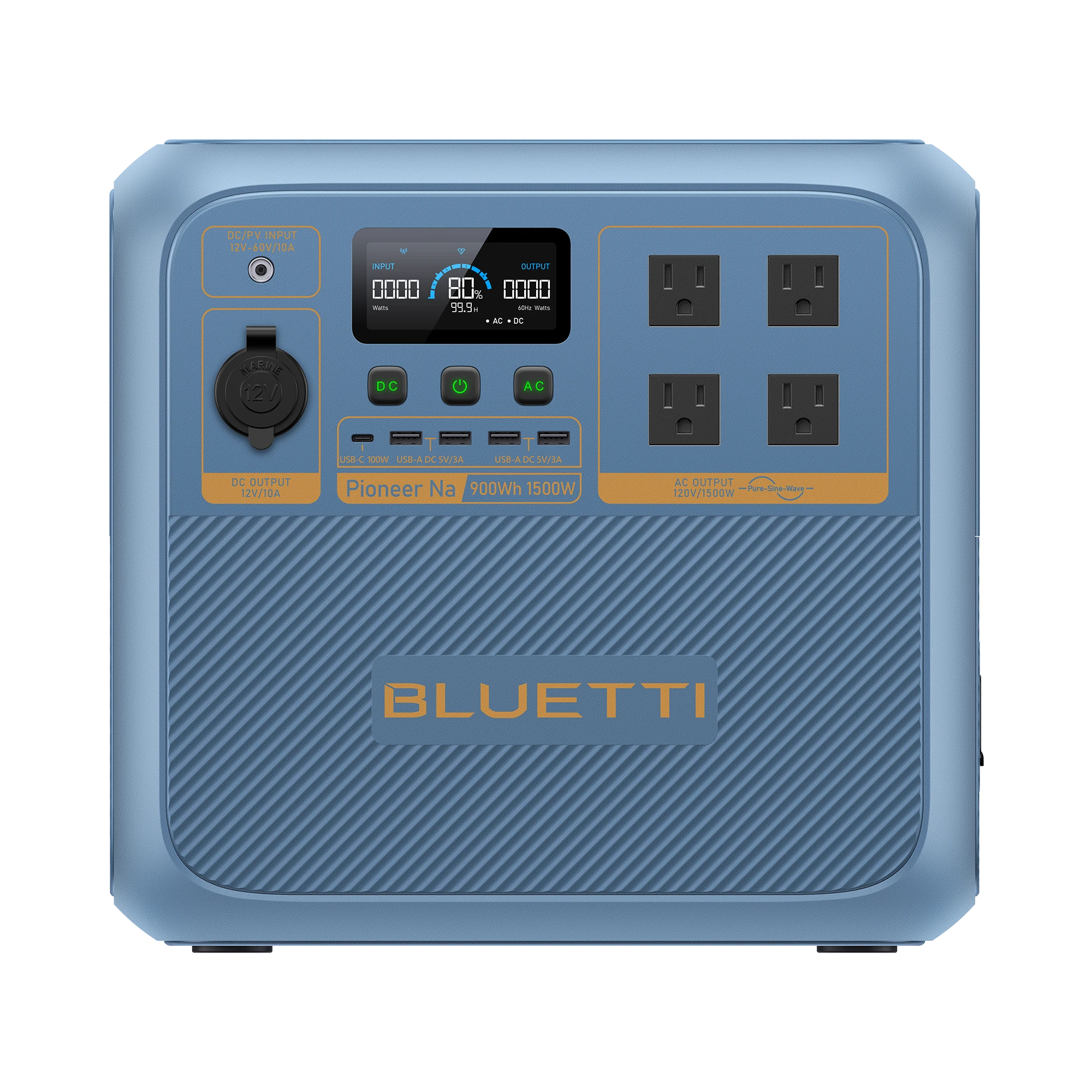
The exact US Pioneer Na station uses sodium-ion cells, stores 900 Wh and supplies 1,500 W total at 120 V. Its chemistry does not make the 900 Wh a promise of delivered AC energy.
Explore this need in the finder →Must the station provide discharge power down to −25°C (−13°F)?
BLUETTI's manual lists a discharge range down to −25°C. The product page claims 80% capacity there, but the manual does not repeat that percentage and this guide did not test it.
Explore this need in the finder →Must it accept charging at −15°C (5°F), with the manual's cold state-of-charge limits?
The manual lists charging down to −15°C. When the ambient and cell surface are below 0°C, charge state may be capped at 60% below −10°C or 70% from −10°C to 0°C; a full cold-soaked charge is not promised.
Explore this need in the finder →The BLUETTI Pioneer Na is a 900 Wh, 1,500 W, 120 V station built around a sodium-ion battery and a documented low-temperature operating range. Its unusual selling point is cold-weather use, not a large storage reserve: the 16 kg (35.3 lb) case holds less nameplate energy than the reviewed two-kilowatt-hour stations. It is worth considering when winter temperatures are a real constraint and the devices you need stay within its actual 1,500 W output. BLUETTI's cold-weather statements are manufacturer specifications and claims, not independent testing of this unit.
Cold operation has a separate charging limit
The US manual lists a charging range of −15°C to 40°C (5°F to 104°F) and a discharge range of −25°C to 40°C (−13°F to 104°F). BLUETTI's current product page additionally claims that the station retains 80% discharge capacity at −25°C; that percentage is a product-page claim, not a cold-chamber result from this guide. The manual supports the operating-temperature boundary but does not repeat that capacity percentage.
Charging while cold needs more care than the simple −15°C minimum suggests. When both the ambient temperature and cell surface are below 0°C, the manual limits charge state to 60% if the ambient temperature is below −10°C, and to 70% when it is between −10°C and 0°C. Above 0°C it says a full charge is possible; if the cells warm during charging, the unit adjusts the permitted capacity to the actual temperature. A buyer planning a winter outage should therefore separate “can be charged at this temperature” from “can be brought to 100% quickly while cold.” The low-temperature range is useful, but not a promise of full cold-soaked charging.
One 1,500 W AC ceiling, not a 2,250 W inverter
The four household receptacles are 120 V and share 1,500 W total. The manual lists temporary overload handling above that rating, but the special Power Lifting mode is expressly for pure-resistive loads rated from 1,500 W to 2,250 W; actual output remains 1,500 W. It is not a general 2,250 W continuous rating and should not be used to satisfy a motor, compressor, or other appliance requirement above the stated output. Check starting demand as well as the appliance's running label, and do not count four outlets as four independent power budgets.
The 900 Wh nameplate figure is stored battery energy, not a promised amount delivered from the AC outlets. Conversion losses, load shape, temperature, standby draw, and settings change runtime. The manufacturer's own idle-power figures also need context: the product page says 1.5 W no-load draw, while the manual's runtime FAQ uses about 15 W self-consumption for its stated calculation above 10°C. Neither is a measurement here, and the difference makes a precise small-load runtime claim inappropriate.
For direct devices, the station has one USB-C port rated to 100 W, four USB-A ports listed at up to 15 W each (the manual shows two paired 15 W combined-output groups), a 15 W wireless charging pad, and one 12 V/10 A car-style output. It does not provide a bank of separate 12 V sockets. Small devices can also be affected by the default ECO shutoff; BLUETTI's manual says to disable ECO for loads under 60 W or critical appliances that must remain on.
Solar, vehicle and wall charging are different routes
The DC input accepts solar up to 500 W within 12–60 V and 10 A; the manual warns against panel open-circuit voltage above 60 V and describes series or parallel connections only within those limits. The station-only package contains no panel, so panel wattage is a separate purchase and nameplate rating is not expected harvest. A 1,000 W solar-input requirement rules the Pioneer Na out even though it can run cold.
There is an unresolved package-detail conflict worth checking before ordering. The exact US Pioneer Na page's box list names one Solar Charging Cable, but the same-model manual groups that cable with accessories not included. I have not treated the lead as confirmed in the box, although solar input itself is documented. BLUETTI lists the supplied car cable for 12 V or 24 V vehicle charging; the manual does not give a maximum car-input wattage in its specifications, so do not assume that route is fast. AC charging is listed up to 1,400 W, and combined AC plus solar input up to 1,900 W. The published fast-charge times depend on temperature and available input; they are not test results.
Handling, continuity and fit
At 35.3 lb, this is not a featherweight winter-camping accessory, though its weight is well below the 53.35 lb Elite 200 V2. The Pioneer Na measures about 13.4 × 9.7 × 12.5 inches and has no documented extra-battery expansion path; BLUETTI says it does not support external battery packs. Its manual lists a UPS switchover of no more than 20 ms, but explicitly says it is not for data servers or workstations that need a high-performance UPS. Do not use that transfer figure as a medical-device or guaranteed-continuity claim.
Choose it when the 900 Wh / 1,500 W plan is enough, cold discharge matters, and the documented cold charging state limits fit your routine. If you mainly want lighter handling and more output outside severe cold, the reviewed Elite 100 V2 is 1,024 Wh, 1,800 W and 25.3 lb; its facts do not establish the Pioneer Na's temperature range, so do not transfer that capability between models. If you need much more energy and AC output, the Elite 200 V2 provides 2,073.6 Wh and 2,600 W but weighs 53.35 lb. Compare exact outlet, solar, weight and temperature requirements before choosing either. No sample, runtime, noise, or cold-weather test was performed for this assessment.
Key details at a glance
| Nameplate battery capacity | 900 Wh |
|---|---|
| Rated AC output | 1500 W |
| Maximum solar input | 500 W |
| Included panels, combined nameplate | 0 W |
| Maximum USB-C output per port | 100 W |
| Listed weight | 35.3 lb |
| Compatible extra-battery expansion | No |
| 12 V DC output | 120 W |
| Maximum AC recharge input | 1400 W |
| Manufacturer UPS transfer figure | 20 ms |
| Base warranty term | 3 years |
| AC outlet output | Yes |
| USB-C ports | 1 |
| USB-A ports | 4 |
| Solar input ports | 1 |
| 12 V car-style output | 120 W |
| Battery chemistry | Sodium-ion |
| Manufacturer minimum charge temperature | -15 °C |
| Manufacturer minimum discharge temperature | -25 °C |
Use the exact model’s instructions for operating limits, supplied equipment and version differences.
Sources for this assessment
- BLUETTI US portable power station overview/navigation
- BLUETTI US Pioneer Na selected standalone product variant
- BLUETTI US Shopify product/variant JSON
- BLUETTI Pioneer Na User Manual V2.0, US English/French
- BLUETTI US Pioneer Na support and download page
- BLUETTI Pioneer Na official product-page primary image

A useful match starts with the loads that matter.
Use the finder for hard electrical requirements, then check appliance starting behavior, actual run time and the exact package in the full assessment.